
Suzuki S-Presso S-Edition (2020) Review: Cheap and much more cheerful than you’d imagine.
In an automotive marketplace that’s constrained by hostile economic conditions, the budget-car sector is one of the few that shows consistent growth in market share. Putting it simply, new-car buyers are increasingly shopping in the bargain basement. In a remarkably prescient move, Suzuki brought the S-Presso economy car to South Africa at exactly the right moment to rake in impressive sales right off the bat. Could this be the most significant new car of 2020?


It takes about 20 metres behind the wheel of a Suzuki S-Presso to realise that, even though it’s as small as a city car and has somewhat toy-like styling, the newest, smallest Suzuki does a marvellous impression of a “real” car. This realisation begins dawning the moment you grab the exterior door handle, which feels disproportionately substantial for such a diminutive car. It continues when you slip through the generously-sized (considering its small size) door aperture and settle behind the steering wheel.
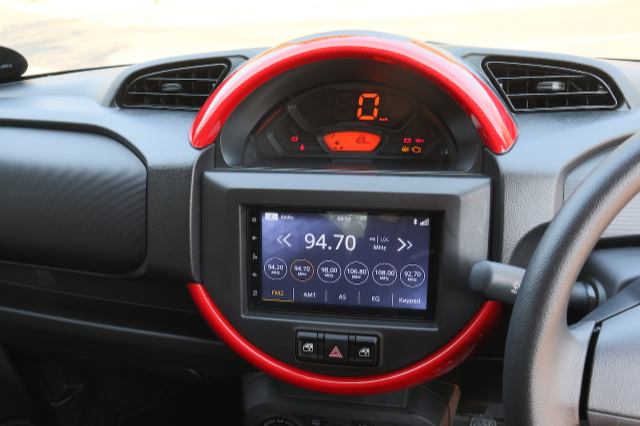
The cabin design looks funky and modern in a minimalistic kind of way, with a clearly Mini-inspired circular cluster mounted in the middle of the dashboard. Instrumentation is sparse (only a digital speedo, a graphic indication of the fuel level, and a basic odometer and trip computer), and integrated into the cluster, along with the touchscreen display and window controls.

Start up the engine, and some budget-beater vibes slip through, though – the 3-cylinder engine up front sets up a gentle vibration through the body structure, but it’s much less intrusive than other budget cars with similar engine configurations. And, crucially, the engine doesn't feel like it wants to shake itself free of its metal shell, because it's well-located and reasonably refined for this configuration. Instantly, the little S-Presso feels substantial and complete, and happy to be serving you. And, just like that, you can’t help but become friends with the new entry-level Suzuki.
Related: We compared the value on offer from the Suzuki S-Presso with that of the Renault Kwid.
Styling
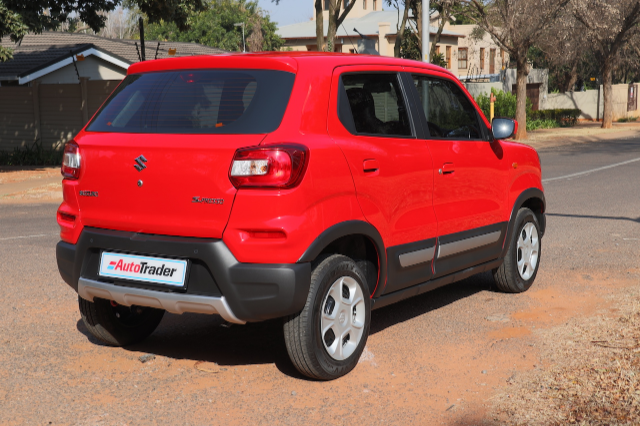
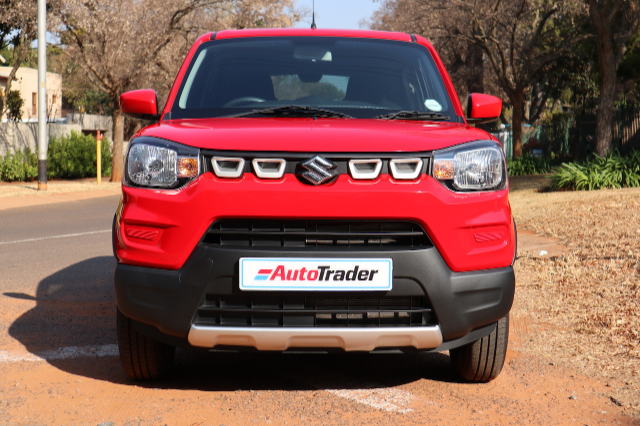
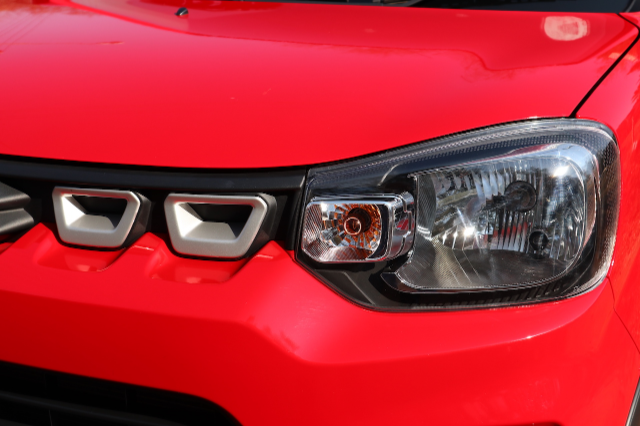
Much has already been said about the S-Presso’s appearance, and not many of those words were complimentary. It has a tall, gangly stance, a flat and rather feature-less profile view, and a curiously bulbous-appearing glasshouse (from some angles), and no number of euphemisms can make it sound any different. Pretty it ain’t, but the wide headlights and toothy grin up front (decorated with silver grille inserts on our test car) at least gives it a happy countenance.
Also standard on our red S-Edition test car are black body cladding all round to visually slim down that top-heavy stance (somewhat), and plastic door- and bumper inserts (painted in contrasting silver). But in the end, it’s still a small, upright economy car, and none of these styling flourishes can fully hide the reality that the S-Presso is actually taller than it is wide.
Related: Three extras you should fit on a new Suzuki S-Presso.

Engine and drivetrain
Matters do look rather better under that stubby bonnet, however, because it conceals the same drivetrain that does duty in the (slightly) larger Celerio. It’s an agreeable package all round, thanks to the combination of a wide power band, free-revving nature, well-chosen gear ratios, slick-shifting gearbox, and a relative lack of nasty 3-cylinder tremors.
The thrumming little 1.0-litre is mated to a 5-speed gearbox, with either a normal manual shifter and clutch pedal, or with an automated (clutch-less and self-shifting) version of the same transmission. And, because it’s a well-proven and uncomplicated design, the power unit should give years of dependable and economical service.
Related: We pondered the question whether the Suzuki S-Presso was the best new low-priced car.
Performance
Of course, high peak outputs aren’t on the menu at all: 50 kW and 90 Nm is precious little in anyone’s language, but the S-Presso has a kerb weight of only 770 kg, so the diminutive engine does a fine job of keeping up with traffic – provided the driver is prepared to stir the gearbox to keep it on the boil.
The 0 – 100 km/h amble should take around 13.5 seconds, and it will run out of puff around the 150 km/h mark (Suzuki doesn’t quote performance figures for the S-Presso). It’s definitely not quick, but the cheeky intake roar under heavy load conditions makes it sound more potent than it is. Of greater importance is the surprisingly tall gearing – first gear runs up to 45 km/h, second is good for 88 km/h, and third will take it almost to the national speed limit.
This sounds rather long-legged for an engine with so little torque, but the nice thing is that the engine is flexible and delivers useful urge across a very wide rev range. As a result, about-town driving requires fewer gearchanges than the S-Presso’s opponents would need, with stronger perceived in-gear acceleration thanks to the comparatively fat torque spread, and lower engine speeds while cruising on the freeway.
Related: For another take on the Suzuki S-Presso, have a look at Ané Theron’s review of a Cape Town-based S-Edition variant.

The Drive
Driving an S-Presso is a low-effort experience, with light and easy clutch- and gearbox actuation, electrically-assisted steering, and the ever-present sensations of driving a very lightweight car. It feels compact and wieldy behind the wheel, but the elevated seating position alleviates much of the sense of vulnerability one often feels in small economy cars.
Thanks to skinny standard tyres, it’s even possible to elicit a brief squeal from the front end in a sudden pull-away, but after that, progress is steady but gentle. Of particular interest is the ride quality: light cars with short wheelbases can easily get rather choppy on rougher surfaces, but the S-Presso manages to hide that effect with a fair measure of success.

Part of this almost grown-up feel is as a result of the S-Presso’s platform, which is derived from the capable “Heartect” architecture that’s also employed by the larger Swift, Baleno and Ignis – in other words, the S-Presso is a small car that’s built around bigger, better bones. This translates into a greater feeling of solidity on the road, with little of the perceived flimsiness that's in evidence in most its competitors.
But, once again, there is a caveat: the S-Presso doesn’t really enjoy high speeds when there’s a cross-wind involved. Due to its slab-sided design, narrow track width and light weight, it tends to wander about its lane through such winds, requiring constant steering corrections to maintain a steady course. At city speeds or in a gentler cruise, this doesn’t really matter, but going faster than the speed limit will definitely require quite a lot of extra concentration from the driver.
Related: Is the Suzuki S-Presso good for new drivers?
Space and Comfort
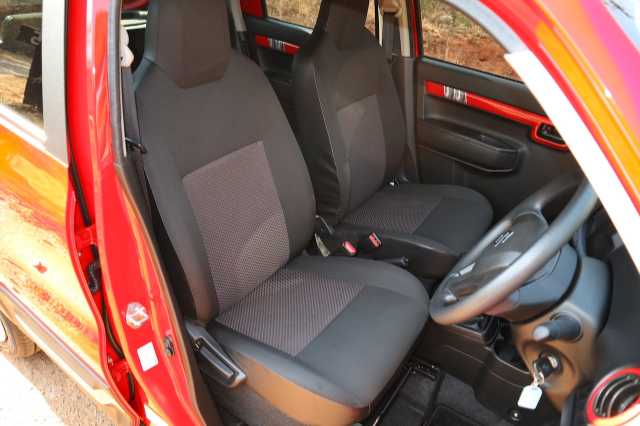
As mentioned earlier, the S-Presso’s cabin is very narrow: sitting in the driver’s seat, an average-sized person will be able to touch the front passenger’s side window without leaving their seat. This results in an oddly cosy environment, with occupants laterally placed very close to each other. Some sharing of personal space will by necessity be involved, with rubbing elbows being the order of the day.
But in other respects, the S-Presso is marvel of packaging efficiency. Take the rear bench seat as an example: while you won’t be able to fit three adults in the back with any degree of comfort, you’ll definitely manage to seat two 6-foot adults behind each other with room to spare. Thank the upright seating position and elevated roofline for this feat, with the attendant leg- and headroom advantages that this layout brings.

In a previous review, Ané Theron expressed concern about outward visibility from the S-Presso’s driver seat. And yes, the window area is quite small in relation to the car’s height, but at 1.94-meters, I had no problem looking out under the windscreen header rail or out the side windows. Different anatomies might get different experiences, though – most of my own height resides in my legs instead of my torso.
Luggage space is equally impressive: while the boot only holds a claimed 239 litres with all seats in place, the load bay itself is wide, deep, and evenly shaped (for a car of this size). And, unlike many other economy cars, even the sides of the luggage compartment are lined. It’s a small touch, but it makes the S-Presso appear that little bit more-upmarket than its competitors.
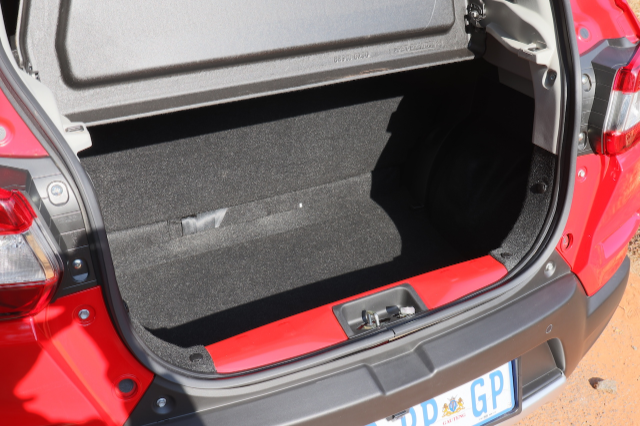
The only downside to the boot involves the hard luggage cover, which tends to obstruct the loading aperture even when it’s flipped up, out of the way. This is the one practical element where we’d like to see an improvement, and is something that could quite easily be rectified by simply connecting a short piece of string between the tailgate and the luggage cover.
Related: Is the Suzuki S-Presso good for families?
Standard equipment
This is a budget car, so don’t expect luxury barge-levels of equipment. The basics are all present and accounted for, though, with electric windows in front, remote central locking, and air conditioning standard across the range. From mid-level GL+ trim upwards, there’s also a colour touchscreen infotainment system with a rear-view camera, USB/Bluetooth connectivity, and full smartphone mirroring. One unfortunate omission is the absence of a rear-screen wiper, but this often also applies to other "bargain" cars, so I can't really criticise the S-Presso on that count.
Rear-view mirrors are adjusted remotely via stalks on the doors, and the boot and fuel flap have remote release levers. Seat upholstery is in durable vinyl and coarse-weave cloth, so it should be fairly hard-wearing, and head restraints feature on the four usable seats. Given the pricetag, this spec sheet actually reads as generous, and combines with the decent build quality to create a rather more-upmarket ambience than the S-Presso’s market positioning would suggest.
Related: Suzuki’s S-Presso was poised for dominance from the moment it arrived. Read our (virtual) launch report here for more information about the range.

Safety
As far as we could ascertain, no testing authority has yet hurled an S-Presso at a static obstacle, so the jury is still out regarding its ultimate crash safety ratings. However, the Heartect platform (which features clever use of high-strength steel for a very rigid body shell with well-managed impact energy dissipation) should give the little Suzuki a noticeable advantage over its infamously un-crashworthy opponents.
Standard safety kit is as comprehensive as anyone could expect at this price point, with two airbags, ABS with electronic brake-force distribution (EBD), and rear parking sensors fitted as standard across the range. But, in the end, this is still a very small and light car, so it’s probably best to avoid collisions as far as possible.
Fuel Consumption
This powertrain is known for its frugality, and this characteristic carries over to the S-Presso as well. Suzuki claims an average fuel consumption of only 4.9 ℓ/100 km, and it should be able to get very close to this number with moderately conservative driving. But, even when driven without any effort to save fuel, it’s unlikely to drink much more than that.
Our test period involved a number of heavy-footed freeway trips, where the little engine had to be wrung out to maintain (probably unrealistically) high cruising speeds in the face of a blocky and likely not very-aerodynamic body. This treatment sent the average consumption for the test period soaring (!) up to 5.5 ℓ/100 km, which can realistically be seen as the worst an S-Presso would return in the hands of an unsympathetic driver.

Price
Given the level of quality and relatively comprehensive spec sheet, one could expect that the S-Presso would weigh in on the expensive side for its segment. However, Suzuki managed to pare down the cost to land the S-Presso here as the least-expensive new car currently on our market. And not by a slim margin, either – the S-Presso is substantially cheaper than its opponents across almost the entire range, and better-equipped than any other equivalent new cars in the same price bracket.
In top-spec S-Edition manual trim (as tested) with a list price of R 152 900, it undercuts the cheapest Renault Kwid (which has to make do without a number of the Suzuki’s upmarket touches) by about R 4 000, with the S-Edition AMT (automatic) costing exactly the same as the more sparsely-equipped entry-level Kwid automatic.
Included in the price is a warranty for 3 years or 100 000 km, and a service plan for 2 years or 30 000 km (giving two pre-paid services) – the latter of which isn’t available with the Renault. In mitigation, it has to be noted that the Kwid's warranty runs for a longer distance and time period, with coverage for 5 years or 150 000 km.
And, until the end of September 2020, all S-Pressos will also come with a year’s free insurance and a warranty extension up to 5 years or 200 000 km thrown into a very affordable finance deal that starts at R 1 799 per month. Score another value point for the Suzuki, right there.
Related: Suzuki S-Presso vs Mahindra KUV100 vs Hyundai Atos – which one is the best value for money?

The Verdict
City cars are, quite understandably, not everybody’s cup of tea: they’re usually low on power, don’t really feel at home on the freeway, and are cheaply made from nasty materials. The S-Presso bucks this trend, and does a passable impersonation of a “real” car that’s wrapped into a small body, with plenty of standard convenience features for the money, reasonable cruising ability(for something this small), excellent fuel efficiency, surprising comfort, low initial running costs, and Tardis-like cabin space all part of the package.
Yes, you can buy a second-hand Almost Anything Else instead and likely get a larger, more-accomplished and faster car for similar money, but those cars won’t have a fresh warranty and service plan, so the value proposition could become shaky. Seen in this light, and given the fact that we’re all taking financial strain at the moment, buying a new S-Presso is both sensible and logical – it’s the right car at the right place and the right time. No wonder Suzuki South Africa is selling as many as they can get!
* Pricing was accurate at the time of writing, but may change without prior notice.
* Included in the standard list price is a warranty for 3 years or 100 000 km, and a service plan for 2 years or 30 000 km.
Related: How much are monthly repayments on a new Suzuki S-Presso?
Expert rating:
4.5/5 in the city, 2.5/5 on the open road, 10/10 for new-car value.
