
Is the Suzuki S-Presso good for new drivers? Here’s our verdict.
New drivers are often younger and rather strapped for cash, so they’ll need something affordable for their first car. And, on top of that, it helps a lot if that car has reasonable safety equipment, is easy to drive, and at least somewhat resistant to the occasional parking lot mishap. With these requirements in mind, we looked at South Africa’s least-expensive new car to see how well it would suit the needs of new drivers.



There are a number of elements which influence the suitability of a car for a new driver’s needs. First of all, it needs to be easy to operate: the inexperienced driver should not have to struggle to control the car’s motions and various driving functions. This seems like a no-brainer, but some modern cars are surprisingly difficult to operate properly.
Good sightlines and a clear idea of the car’s physical dimensions are also of paramount importance, with an elevated driver’s seating position instantly scoring points in both these respects. It also has to be safe, with reasonably body protection against parking miscalculations and very good brakes. So, from the perspective of a new driver, how well does the new Suzuki S-Presso serve their needs? Is it a good choice for an inexperienced driver? Let’s take a more-detailed look at this little car, to see how it measures up.
Size and space
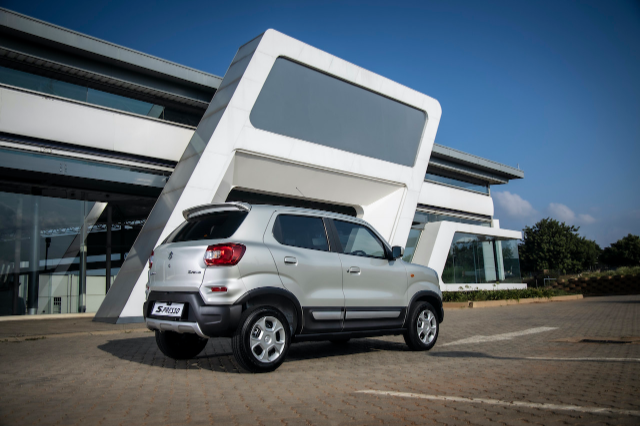
With an overall length of just 3.56-metres and a width of only 1.52-metres, the Suzuki S-Presso is one of the smallest new cars in our marketplace. That means that it will easily fit into even the smallest parking spot, with room to spare all round. No matter if the parking job isn’t perfectly straight, even, because this car is small enough to leave plenty of space left over all around it.
This very compact size will obviously have an impact on cabin- and luggage space, so don’t expect to carry three burly passengers on the rear seat – the cabin is far too narrow for that. However, the S-Presso’s upright seating position makes for surprisingly generous legroom all round, and that elevated roofline leaves plenty of headroom as well. Luggage space isn’t overly generous, though, with only 239-litres available in the boot. This definitely isn’t the car with which to take a large family or a bunch of friends on a long road trip, then.

However, thanks to the S-Presso’s elevated seating position and upright windscreens, outward visibility is mostly first-rate, and makes it easy to gauge the car’s extremities from the driver’s seat. The only possible bugbears could arise from the surprisingly shallow front windscreen, which may force tall drivers to peer underneath the windscreen’s header rail for a clearer view of the road ahead; while the B-pillar is surprisingly chunky and is located right next to a long-legged driver’s head.
Related: Our review found the Suzuki S-Presso to offer a lot of value for money.
Safety
Don’t expect all the high-tech safety kit you’d find in an upper-class car, but the basics are covered as well as you’d expect in a budget car. Two airbags and ABS brakes are standard across the S-Presso range, with rear parking sensors included as well. It’s too early to cast a verdict about its crash protection, because it hasn’t yet been tested against NCAP standards, but Suzuki’s “Heartect” platform (upon which the S-Presso is based) generally performs well in crash tests. One strange omission is the absence of ISOFIX child seat anchors, so the S-Presso is probably not ideal for a new driver who needs to drive kids around.
Related: Is the Suzuki S-Presso good for families?
Ergonomics and tech
As we noted earlier, the S-Presso has a decently generous glass area, which hands it an immediate advantage. For the rest, the ergonomics are a bit unusual, with its instruments mounted at the top of the large, circular centre console section. The gauges are all electronic, with a large digital speedo display and a much smaller bar graph for the fuel level being the main attractions.

In contrast, the switchgear is super-simple and intuitive to operate. All S-Pressos bar the entry-level GL variant boast a colour touchscreen infotainment system with smartphone mirroring, USB, and Bluetooth connectivity; and front electric windows, power steering and air conditioning are all standard across the range. The end result is an inexpensive car that somehow still manages to offers most modern conveniences. Buying on a budget doesn’t have to equate to bare-bones motoring...
Related: Three extras you should fit on a new Suzuki S-Presso.
Fuel Economy
There’s only one engine on offer in the Suzuki S-Presso: a 1.0-litre, non-turbo 3-cylinder petrol that sends 50 kW and 90 Nm to a 5-speed transmission (either a normal manual gearbox or an automated manual). Performance is quite pedestrian, but a low kerb weight of only 750 kg means that the power-to-weight ratio is better than you’d expect at this price point.

The upshot of the modest performance on offer is superb economy. This engine (also used in the Celerio) has proven to deliver exceptional fuel efficiency, and the S-Presso should be no different in this regard. Official average consumption is claimed to be 4.9 ℓ/100 km, and real-world driving should be very close to this figure. If you have a tight transport budget, the S-Presso should soothe your aching bank account with its low-low purchase price and affordable running costs.
Related: Suzuki S-Presso vs Hyundai Atos vs Mahindra KUV100 – which one offers the best value for money?
Verdict
With its small size, frugal engine, standard safety features, and budget-conscious pricing, the Suzuki S-Presso meets the needs of most new drivers. The only ones who might not be completely satisfied would be those who want to carry small children, due to the lack of dedicated child seat anchors and rather small boot. For everyone else, the S-Presso will be ideally suited for city-bound driving.

What else is available at this price point?
Nothing else on the new-car market can match the entry-level S-Presso’s list price, so it’s really in a class of its own. The Renault Kwid is the closest in size, price and concept to the S-Presso, so the same buyers who’d look at the entry-level Suzuki would probably also consider the French alternative. Going slightly more upmarket can net a marginally larger Suzuki Celerio or a Datsun Go, or a used-car buyer could find a nearly-new, late-model Suzuki Swift for similar outlay.
Recommended Next:
Shop for new and used Suzuki S-Presso cars for sale here.