




Cash-strapped South Africans are always asking me what the best, cheapest car is to buy new. Up until now, I used to say, “rather just buy a lightly-used Toyota Aygo, Renault Sandero, or VW Up”, but ever since I drove the Suzuki S-Presso, I'm giving different advice...
Styling
The S-Presso's look is polarising — some think it's cute enough to hug, while others think it's frumpy-looking. The boxy-shaped Suzuki S-Presso with its blunt little face and rectangular rear-end actually reminds me of a Lada Niva. The Lada was produced by former Soviet manufacturer AvtoVAZ and ultimately inspired the design of the Suzuki Escudo (1988), which we know today as the Suzuki Vitara.
I have to admit that really like the S-Presso's retro styling with its squared-off headlamps and fashionable four-slot grille. Viewed from the side, it looks like a toy car, but let me assure you, its 2.38m wheelbase ensures that there's plenty of room inside. Ground clearance is 180 mm, which actually makes the S-Presso a real, albeit micro-SUV.
Related: How much are monthly car repayments on a new Suzuki S-Presso?

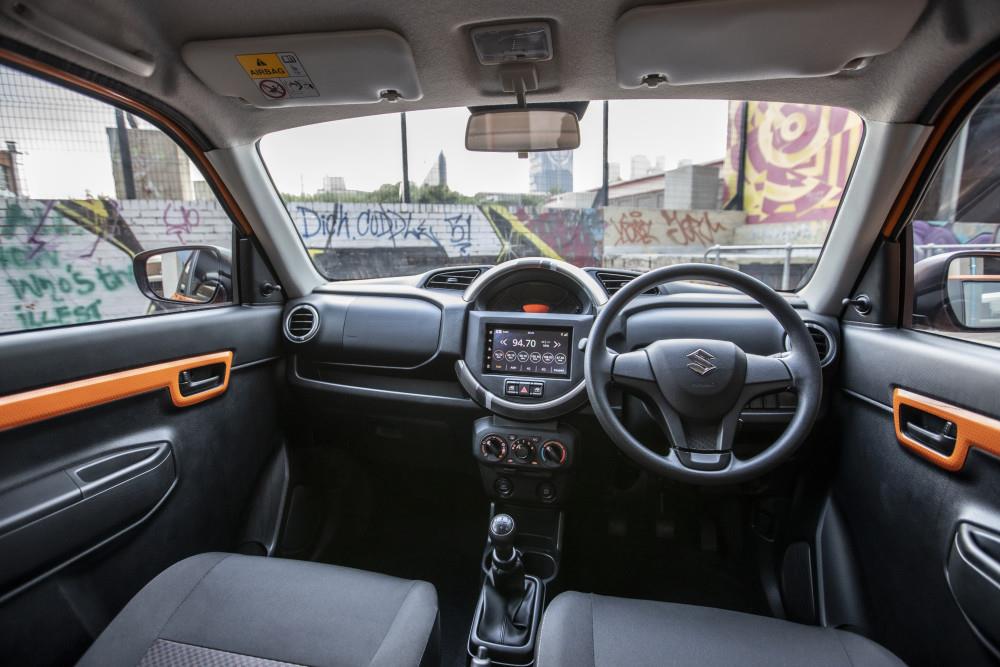
On the inside, the S-Presso makes do without the traditional instrument cluster directly in front of the driver. Instead, there's a MINI-inspired circular dial with a colour touchscreen in the centre (from GL+ derivatives upwards) and a digital speedometer at the top. Splashes of colour that match the S-Presso's exterior paint job liven up the predominantly black interior in the flagship S-Edition model we tested. S-Edition S-Pressos pay homage to the above-mentioned Suzuki Escudo S-Edition which was launched in Japan in 2004, and features funkier design details, such as silver highlights in the four-slot grille, silver skid plates (front and rear), and side cladding over the wheel arches and lower sections of the doors.
Related: New Suzuki S-Presso: Setting the cat amongst the sale pigeons

Comfort and convenience
The black seat material seems of a decent quality; indeed better than you'd find in most of its closest competitors. The seats are supportive enough, but the only downside is that the driver's seat is not height-adjustable. This gives taller drivers the feeling of sitting too high, as if they're peering underneath the S-Presso's roof rather than seeing straight ahead. As a lady of 1.73 cm, I am considered tall, so I can't imagine how my six-foot-plus male friends will feel driving the S-Presso. I'd say you would have to be no taller than 1.80 cm if you're going to make the S-Presso work for you on a daily basis.
For the amount of money you're paying, the second most affordable GL+ model (R139 900) is a sweet deal. It has niceties such as the touchscreen system with Bluetooth/Apple CarPlay/Android Auto, 1x AUX and USB port, and a rearview camera. All models have electric windows in front.
When we had our little road trip, we streamed music from Spotify and then listened to a few songs via a USB memory stick, but we never managed to tune the audio system to sound less hollow or 'tinny'. Be that as it may, you can still enjoy listening to your favourite tunes as long as it's not too loud. Leaning over to adjust the volume while driving is a bit of a pain, especially if you're used to satellite buttons on the steering wheel.
I mostly used Siri to make calls, but the sound quality isn't fantastic for the person you're talking to via the sound system. My best friend said I sounded like I was in outer space and my fiancé said he could hear me, but not very well.

Space
All models have a nifty phone-sized storage binnacle and two cupholders underneath the air-conditioning controls. There's another single cupholder available in the centre for the rear passengers, but nothing in rear door cards. The front door pockets have space for a single water bottle each and other small items, but that's about it. At least the cubby hole is of a reasonable size, and we used it to hide an iPad and a mi-fi device, as well as a small packet with a T-Shirt inside.
Compact cars usually have more than enough space for the driver and front passenger, but the poor folks on the rear bench usually have to be satisfied with a meagre amount of legroom. In the S-Presso, this is not the case:Two tall adults won't want for knee- or elbow room. This actually makes the S-Presso the ideal city runabout for the average two-kid family, as I really don't reckon there's space for a third passenger in the middle. Plus, there's a reasonably large and high boot (239 litres) that will happily swallow eight bags' worth of groceries, and then some, on top.

Drive and performance
Built to withstand the dilapidated roads of India, Suzuki made sure our SA-version of the S-Presso received the same ground clearance and suspension travel, to hold its own over our local potholes. To put this to the test, we travelled over the washed-out dirt road that connects the centre of town to the Greater Hermanus area. To the S-Presso, this probably felt like its natural habitat, because it casually went about its business without shaking its occupants' tooth fillings loose. For a car without stability control, the S-Presso felt decidedly sure-footed, too.

In town, the S-Presso took great pleasure in flitting through traffic and making its cheeky three-cylinder voice heard while doing so. When a car weighs in at well under 800 kg, 50kW is more than enough for making swift progress - at sea level, at least. I never felt as if the S-Presso was underpowered.
The S-Presso's ultimate driving test was its voyage over Sir Lowry's pass on a windy day. I half-expected us to be blown about by crosswinds, and for the little engine to lose its zest going uphill, but this never happened. There wasn't too much stirring required of the five-speed gearbox, either, and gear changes were quite smooth. When you're cruising in the S-Presso at 120 km/h, there's quite a bit of road- and wind noise, and the steering is a little on the vague side, but given the engine's enthusiasm and the S-Presso's impressive directional stability, I was happy to overlook this.
Sometimes it required a bit of effort to slip the gear lever into reverse when I needed to exit my driveway, but this hardly proved bothersome enough to put me off.

Fuel consumption
The tiny 27-litre fuel tank seemed to stay forever full, and city driving returned an average of 5.5 litres per 100 km. This is pretty decent, considering that you have quite a spacious car at your disposal which has no issue at all keeping up with the average Joe on our roads.

Safety
Every S-Presso is equipped with ABS, EBD and two frontal airbags, as well as rear parking sensors. From GL+ models and up, the touchscreen displays the view from the rear-view camera.
While we're still waiting for a safety rating, we reckon it won't be much different from the Suzuki Swift, Ignis and Dzire, with whom it shares a platform and good amounts of high-tensile steel, as well as strategically-placed crumple zones. If you want stability control, you'll have to spend a bit more or opt for those cars I recommend at the beginning of this article.

Pricing
The entry-level S-Presso is priced right, and even the GL+ model, at R139 900, undercuts both the least expensive Datsun Go and cheapest Renault Kwid. It also beats the Hyundai Atos and Mahindra KUV to the price punch, but offers the buyer much more. To compare specs, you should read our comparative article between the S-Presso and two of its rivals, here.
The GL+ model perfectly illustrates what a value proposition the S-Presso is, and it's likely to be the best-seller in the range. It's not quite as trendy-looking as the S-Edition model we tested, which still comes in at an affordable R147 900. Bear in mind that you can also add a whole host of accessories to doll up even the most basic S-Presso to the max.
Related: Renault Kwid vs. Suzuki S-Presso: Which one is the best value for money?

Verdict
The S-Presso proves that budget motoring doesn't have to feel like you're missing out on something. If you're looking for a vehicle that's inexpensive but fun and surprisingly practical, this baby-SUV will be just right for you, as long as you're under 180 cm tall...
* All models in the range are sold with a standard 5-year / 200 000 km mechanical warranty, a 2-year / 30 000 km service plan and one year’s comprehensive insurance.
Recommended next
Suzuki S-Presso launches in SA
Top 3 things you need to know about Suzuki's new micro-SUV, the S-Presso