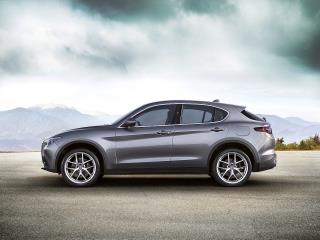
Alfa Romeo Stelvio vs Lexus NX vs Volvo XC60: Which mid-sized SUV has the lowest running costs?
While it’s true that German-branded products dominate the local premium SUV market, there are some noteworthy challengers that cater for buyers with a taste for the unusual. Italy offers the seductive Alfa Romeo Stelvio, the Lexus NX brings Japanese origami to the table, and Sweden presents the svelte and sensible Volvo XC90. But which one should you consider if running costs is your primary consideration?



Can you pre-determine your car’s running costs?
When considering a car’s running costs, it’s important to look at it over its entire life-cycle. This allows third or fourth owners of older cars to get a clearer picture of possible future expenses, and it can help first owners to determine at what age their cars may become too expensive to run.
There are certain key points which could give an idea of a car’s general upkeep requirements. This includes the length of the service intervals, the cost of replacement tyres and service- and maintenance parts, and the prices of service parts. However, these cars are really still too new on the market to make predictions about their long-term running costs, so we’ll investigate them from the perspective of a new-car buyer instead.
Let’s meet the contenders

Alfa Romeo Stelvio 2.0T Super Q4 (R899 900)
The local Stelvio range currently comprises only two variants, with the entry-level 2.0T Super Q4 derivative coming under the spotlight today. It is the only car in this group to employ a longitudinal engine location (the others have transverse engines), leading to a balanced 50/50 weight distribution and classic RWD proportions.
Claimed engine outputs are quite staunch, with 206 kW and 400 Nm on offer, sent to the rear-biased AWD system via an 8-speed torque converter automatic gearbox. As the lightest car here with the most power, the Stelvio 2.0T offers the strongest performance in this trio: 0 – 100 km/h is dispatched in a claimed 5.7 seconds, and it should run on to a top speed of 230 km/h.
Related: Shop for new and used Alfa Romeo Stelvio cars for sale here.

Lexus NX 300 F-Sport (R 937 900)
Next up is the most-expensive car in this group, which also happens to come from the range that starts out the least-expensive of today’s three model ranges. The current (first-generation) Lexus NX is due for local replacement soon, as its successor is already available overseas.
Motive power is provided by a 2.0-litre turbocharged 4-cylinder petrol engine, as with the other two, which sends power to an electronically-controlled on-demand AWD system via a 6-speed automatic. Claimed performance is the weakest here, with 175 kW and 350 Nm pushing the heaviest car here to 100 km/h in 7.1 seconds, an on to a top speed of 200 km/h.
Related: Shop for new and used Lexus NX cars for sale here.

Volvo XC60 T5 AWD R-Design
The Volvo XC60 range opens at R 807 000, which buys a de-powered diesel engine in the D4 variant. Our selected XC60 T5 (turbocharged petrol 2.0-litre) is much closer in concept to the other two, however, and the tasty R-Design styling kit can be matched with the cheaper petrol engine around the Alfa’s price point.
It is middling in both kerb weight and engine outputs, so the Volvo XC60’s performance is likewise mid-pack here. Sending 187 kW and 350 Nm to the (likewise electronically-controlled and on-demand) AWD system via an 8-speed automatic gearbox, it sprints to 100 km/h in a claimed 6.8 seconds, with the top speed set at 220 km/h.
Related: Shop for new and used Volvo XC60 cars for sale here.

Which one has the lowest running costs?
Purchase price and depreciation
The Alfa Romeo starts with a slight advantage here, because it carries the lightest pricetag in this trio. The Stelvio also appears to be fairly depreciation-resistant, with some nearly-new 2021-examples listed here on AutoTrader even commanding a higher price than their list price when new, and a low-mileage two-year-old one still asking at 96.6% of its new price.
In addition to being the most-expensive car here, the Lexus NX also shows signs of stronger depreciation. Two-year-old examples listed on AutoTrader retained only 72.7% of their new value, although nearly-new (2021) ones are still worth 98% as much as new examples.
Meanwhile, the Volvo appears to have near-Alfa-like resistance to depreciation (!), with 2019-examples listed at 98.6% of their new prices. Let’s call it a draw between the Alfa Romeo and the Volvo, with the Lexus slotting into third place.

Instalment calculator
Alfa Romeo Stelvio 2.0T Super Q4
List price: R 899 900
Instalment: R 15 004/month
Lexus NX 300 F-Sport
List price: R 937 900
Instalment: R 15 638/month
Volvo XC60 T5 AWD R-Design
List Price: R 909 900
Instalment: R 15 171/month
*Calculated according to the AutoTrader Car Finance Calculator, with a 72-month finance agreement, 10% interest rate, 10% deposit, and no residual value.
All prices listed in this article were accurate at the time of writing, but may change without prior notice.

Fuel efficiency
The Alfa Romeo Stelvio’s performance advantage doesn’t come with any fuel efficiency penalty, either, because it posts the lowest claimed fuel consumption in this group as well. This is likely due to the Stelvio being the lightest car here, giving it a claimed consumption of only 7.0 ℓ/100 km – quite remarkable for a car of this size, really.
Second place goes to the Volvo, which is claimed to use 7.3 ℓ/100 km, and the Lexus again brings up the rear with a claimed average of 7.9 ℓ/100 km. Be aware that none of these cars are likely to ever return these impressive figures in mixed-cycle driving, with even the Alfa Romeo returning 9.2 ℓ/100 km on test, albeit when driven with some enthusiasm. We’re considering official consumption figures here, however, so the Stelvio walks away with another first place.
Related: Which engines have the best efficiency?

Warranties, maintenance plans, and service intervals
It’s inevitable, really: pitch a Lexus into a running cost comparison, and it will walk away with first place in the aftersales package evaluation. That doesn’t mean that the other two are lacking in real terms, though: The Volvo and the Alfa Romeo offer excellent warranties and maintenance plans, everything running for 5 years or 100 000 km in both cases. Consequently, they share second place in this criterion.
But even that isn’t enough to match the Lexus’s self-confident warranty and maintenance plan, both of which stretch the time limit to 7 years and add 5 000 km of additional coverage. For buyers who plan to keep their cars for the long run, the Lexus NX 300 aftersales package convincingly grabs the first place in this group.
Related: What is usually covered under a manufacturer’s warranty?

Parts prices
Of these three cars, only the Volvo has featured in any AA Kinsey Report on parts prices, mainly on account of the other two’s marginal sales figures. However, the Volvo XC90 T5 was the least-expensive car in its category to run. Meanwhile, the Alfa Romeo Giulia sedan, which shares its oily bits with the Stelvio, was the least-expensive car in its category to run in the same report.
The Lexus fights back with the widest dealer support network and aftermarket support of these three, thanks to its Toyota parentage. Its parts prices, should that generous warranty and service plan expire, are unfortunately also likely to be quite pricey, again as a result of its Toyota parentage. Call it a joint first place for the Volvo and the Alfa Romeo, then, and shatter some popular misconceptions about Volvo and Alfa parts prices at the same time.

Insurance
None of these cars are considered to high-risk vehicles, on account of their abundant standard safety features, but the Alfa Romeo’s sporting performance does move it into a higher-risk category with most insurers. Its insurance premiums should start off lower, thanks to the Stelvio’s lower purchase price, but its high replacement cost (a result of its apparent market value retention) likely means that those premiums are bound to remain at that level for a while.
The Lexus’s steeper depreciation counts in its favour here. Yes, it’s more expensive in the beginning, which will move initial premiums higher than the Alfa’s, but those premiums will drop sooner to reflect its rapidly-reducing replacement value. However, it’s the Volvo’s (comparatively) cheap repair part costs, along with its moderate replacement cost, that should ensure lower insurance rates for the XC60.
Remember that insurance premiums will vary, mostly based on the projected mileage to be covered and where the cars are kept and driven, both in the daytime and overnight. Younger drivers or those with prior accident histories will experience additional penalties, due to their higher collision risk.
Related: Top tips to save on your car insurance.

Tyre replacement
Standard tyre prices play a significant part in any running cost evaluation, but it’s not always a given that smaller tyres will be less expensive – if they’re less commonly used, they might be harder to find and more expensive to replace than larger tyres which are in wider use.
Between these three contenders, the Lexus F-Sport’s 235/55R18 tyres are physically the smallest, but they’re rather expensive to replace. A reputable-brand replacement tyre can easily cost R3 600 apiece, and there isn’t a huge variety of tyre choices in this size.

The next size up clothes the Alfa Romeo’s wheels, with 235/60R18 being the Stelvio’s standard size. 19- and 20-inch alternatives are available as added-cost options, but the standard tyres are almost as expensive than the Lexus’s footwear already... Name-brand performance tyres can be had around the R 3 000 mark, while we wouldn’t recommend fitting cheaper “house-brand” tyres to a high-performance machine like the Stelvio.
Lastly, the Volvo XC60 rolls on 235/55R19 rubber in R-Design specification (lower-level trim derivatives can drop the size down to 18-inchers of identical width and a slightly higher profile). In this configuration, the Volvo’s tyres are by far the most-expensive to replace among this already-pricey trio.

Entry-level replacements cost as much as the Lexus’s least-expensive options, but prices run to R 4 000 for similar quality tyres to the ones we’d want for the Alfa. This means that the Stelvio has the least-expensive replacement tyres, which are still rather expensive.
Related: How long is a tyre supposed to last?

Verdict
Less-expensive insurance counts in the Volvo’s favour, but its tyre replacement costs are a bit of a shocker. Other positives include surprisingly well-priced service- and maintenance parts, mild initial depreciation, mid-pack fuel efficiency, and a reasonable pricetag. This consistently strong performance hands the Volvo XC60 a strong second place in this comparison, only being slightly undone by those expensive tyres.

The Alfa performs well in the same areas as the Volvo, but beats it on claimed fuel consumption, uses cheaper tyres, and has an even less-expensive parts basket, to give the Stelvio a slight edge over the XC60 and netting it the first place overall. Meanwhile, the Lexus lags the other two slightly in most respects, and suffers from steeper depreciation, but betters them with a far more-comprehensive aftersales package.

Smart shoppers will take advantage of the Lexus’s superior warranty, and hunt down a two-year-old example at a bargain price, and then enjoy warranty cover for as long as the other two’s sparkling-fresh new warranties would run (albeit with a reduced yearly mileage allowance). The best bit is that Lexus NX values are likely to drop even more steeply when the new model arrives, making for even better bargain-hunting.