
Review: Alfa Romeo Stelvio 2.0T Super Q4: An Italian supermodel in Gucci hiking boots
Review: Alfa Romeo Stelvio 2.0T Super Q4: An Italian supermodel in Gucci hiking boots


By Martin Pretorius
Of all the niches in the modern motoring landscape, performance SUVs occupy arguably one of the least sensible market segments. They offer most of the straight-line speed of a performance saloon, yet they’re nowhere near as useful on twisty roads. They also have the increased ground clearance you’d find in bundu bashers, yet they’ll struggle to mount a shopping mall kerb on account of their oversized wheels and low-profile tyres. And then there’s the Alfa Stelvio: it may look like a crossover SUV, but at heart, it’s really a hot hatchback on stilts.
Handsome styling.
While there’s no denying that the Stelvio is a seriously good-looking car, it still pays lip service to traditional SUV styling. It’s clearly related to the low-slung Giulia sedan, but it’s clearly been stretched in an upward direction: the grille and fenders are taller, the headlights sit higher up, and its flanks are noticeably deeper as well.
But with all that, it still manages to look sleeker than most of its opponents. The body is as curvy and sensually shaped as you’d expect from an Italian thoroughbred, even with the extra height. In fact, its profile is closer to an hatchback interpretation of the Giulia’s styling themes than it is to any other faux-4x4 except perhaps the Porsche Macan. There’s no massive rear overhang to make room for a third seating row either, and the shoulder line is delicately curved to hide most of its visual bulk.
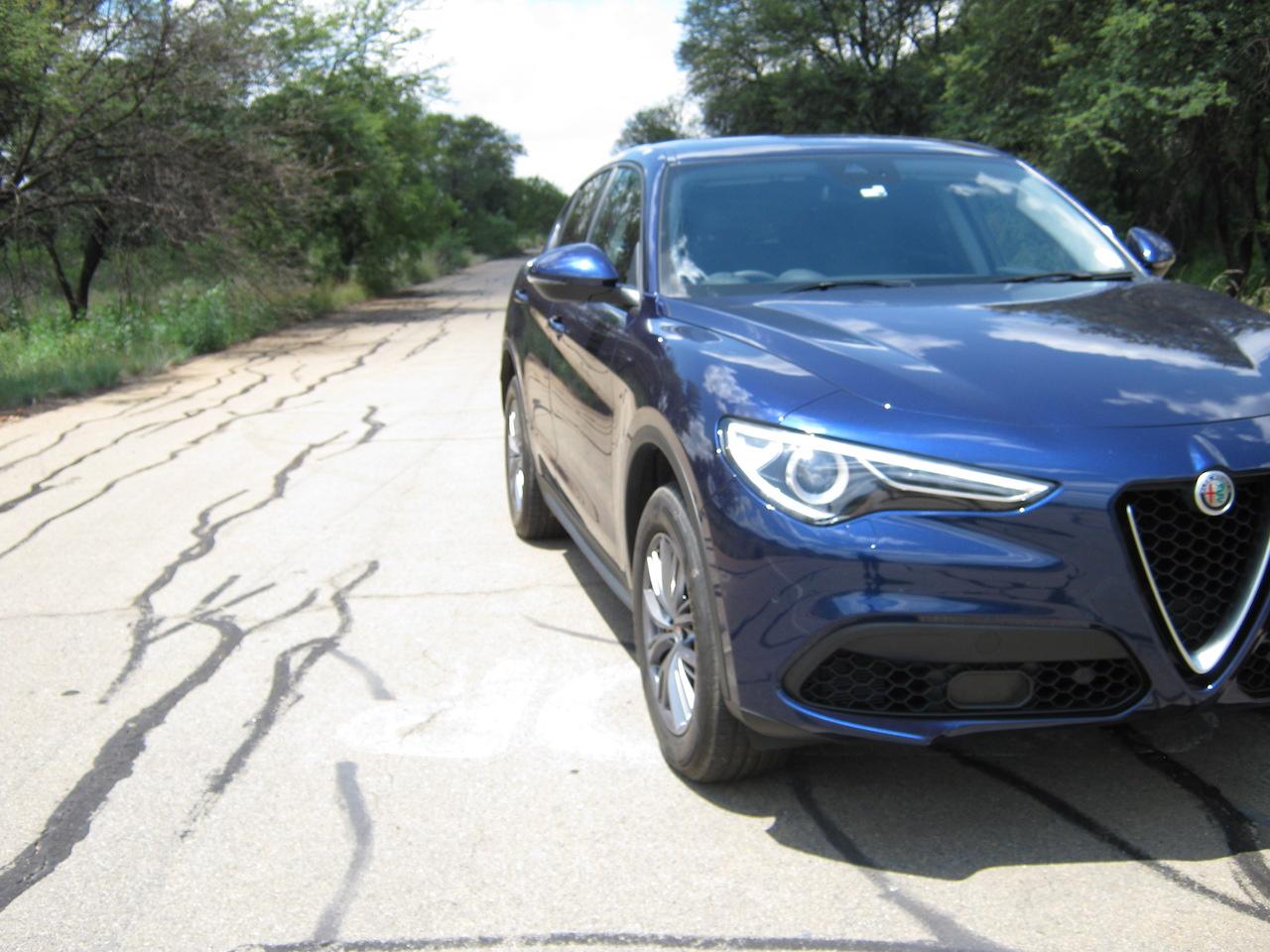
That said, it’s not a look which translates well into photographs, which struggle to show the subtle curves in the surface treatment. Especially in a dark colour like our blue test car, the creases and folds of its bonnet and sides disappear somewhat: imposing and sensual in the metal, it looks flat and featureless on photos. If your Instagram account simply cannot survive without plenty of Alfa pictures, it’s best to consider a lighter colour. White or metallic red works much better.
It’s beautiful underneath as well.
Much like a dark colour hides the Stelvio’s pretty styling, that beautiful body hides some amazing oily bits. Built on the same “Giorgio” platform as the Giulia, the Stelvio prioritises the same attributes as its sedan sister: driving enjoyment is paramount, with an almost-equal emphasis on comfort and practicality.
The Giorgio platform is quite a remarkable achievement, as the whole thing was developed from scratch in about two years. It’s not a half-baked effort either, as the Ferrari engineers recruited for this development made sure that it’s every bit as competent as its specifications make it appear. There’s the perfect 50/50 weight distribution you’d expect in a sporting machine, along with advanced independent suspension all round and possibly the best steering system ever seen on a car of this type. All of these factors make the Stelvio a driving machine par excellence.
It's all about soul.
Without resorting to the clichés which usually ooze from any Alfa Romeo review, it has to be said that the Stelvio feels unlike any other SUV behind the wheel. The first thing a keen driver would notice is the unbelievably sharp steering – this isn't a car you drive by moving your arms, you drive it by twitching your wrists.
After years of being soothed by cars with smooth but slow steering, the Alfa's system initially comes as a bit of a shock. Because it's so quick of response, the Stelvio feels rather nervous at first acquaintance, darting this way and that in response to the slightest steering inputs. But, once you've re-calibrated your brain to allow for these immediate responses, you'll realise that the Stelvio is actually super-stable, even with those sharp responses.
The chassis tuning is similarly unusual, because it's set up to feel like a sports sedan. Following that immediate turn-in, the chassis balance is perfectly neutral, resisting both under- and oversteer all the way up to its very high limits. In fact, you'll need to look at something like a Jaguar F-Pace or Porsche Macan to find as agile an SUV, and even in such exalted company, the Stelvio can hold its head high. And, even with that impressively sporty demeanour, the ride quality is also superbly comfortable – especially on the standard 18-inch tyres fitted to our test car. Just like the Giulia, it manages to blend stunning chassis dynamics, predictable responses, ultimate agility and a cosseting ride into a package which is right at the head of its class.
The engine is a cracker.
This dynamic prowess would all have come to naught, if the Stelvio didn't have a powertrain to match. Fortunately, the engine and transmission also hold up their ends of the bargain. There's a turbo-charged 2.0-litre petrol engine under the bonnet, sending its power into the full-time all-wheel drive system via a very slick ZF 8-speed automatic gearbox. No manual transmission is on offer, but with an automatic this good, that's not really a drawback at all.
With 206 kW and 400 Nm available from just a tap of your right foot, performance is quite brisk for a large vehicle with such a small engine. Following a slight bit of take-off lag, the Stelvio picks up its skirts to sprint past the 100 km/h marker in only 5.7 seconds, on the way to its top speed of 230 km/h. In-gear acceleration is equally impressive, with the gearbox keeping the engine operating in the fattest wedge of the power band.
Fuel economy is about par for this class, with an official average figure of 7.0 ℓ/100 km, something we never even came close to matching. Our test average of 9.2 ℓ/100 km is however more of an indication of how much we enjoyed the Stelvio's performance than it is a poor reflection of its efficiency, as freeway figures easily dropped below 6 ℓ/100 km on the trip computer. Strangely for an Alfa, the engine isn't much of a screamer – the power peaks at 5250 r/min, and the rev limiter will call a halt to the fun around the 6000 r/min mark – but it does sound pretty sporty while operating inside that rev band.
Practicality takes pride of place.
Any SUV worthy of its title must have a spacious cabin and ample room in the load bay, and on this front, the Stelvio also delivers with aplomb. Clever packaging (such as a very thin but perfectly formed rear seat squab) liberates enough room to accommodate 5 full-sized South Africans, with plenty of leg- and headroom. The Stelvio's tapered glasshouse does have a slight impact on shoulder room for the rear passengers, but that's only really noticeable because of the generous dimensions in all other respects.
The luggage compartment is also impressively sized, with a minimum capacity of 525 litres, growing to 1600 litres with the 40/20/40 split rear seats folded down. The Stelvio's generous footprint plays its part here, because while the load bay isn't very wide, it does stretch quite a way forward, and is quite deep due to the car's height. The only slight downside is that the loading height is rather high, which could easily lead to scratches on the rear bumper due to inconsiderate wielding of suitcases, but at least the tailgate reveals a large loading aperture.
Fittings and finish
It seems like the Giorgios’ build quality improves as time goes by. While the (early build) Giulias and Stelvios we've sampled at their local launch events had some trim pieces of questionable quality, with things such as misaligned glove box lids and roof pillar covers detracting from the impression of quality, our test car exhibited none of these afflictions. There were also no rattles evident at all, and most of the touch surfaces felt solidly made.
The plastics are generally of an acceptable quality now, and it all seemed to be well screwed together. Electronic quirks which have plagued some other test cars were also entirely absent, and this test car performed flawlessly during its time with us. Meanwhile, the driver assistance systems also worked the way they were supposed to, with the (standard) lane departure warning and (optional) blind spot monitoring only drawing attention when required.
There isn't a huge lot of kit, though.
Being in the most basic specification, our test car wasn't exactly over-endowed with toys. Apart from automatic headlights and wipers, and dual-zone climate control with rear seat outlets, this car only featured a centrally-mounted (and beautifully integrated) colour display for things such as rear camera, infotainment and navigation functions. This is standard, but adaptive cruise control, panoramic sunroof and keyless entry were all options absent from our test car.
In reality, it's just about as barren as any base-spec German competitor, which means that you'll need to tick some option boxes to access things like LED headlights and electric seat adjustment. Given this relatively low spec level, the entry-level Stelvio's price tag may be a bit hard to swallow: R810 000 is a lot of money for a 2.0-litre SUV, even if it is as accomplished as this one.
It's facing tough opposition.
Then again, none of its opponents are really affordable either, and most of them carry even less in terms of standard equipment. The Stelvio's saving grace comes in the form of its performance and driving dynamics, which elevate it into a higher class. Add its excellent practicality, space, and comfort, and the Stelvio starts to claw back some more points in the value stakes.
The only downside is that few buyers in this segment really care about sparkling driving dynamics, and would rather have some nice technology to play with instead of hurtling through the corners in a most un-SUV-like fashion. Let's hope that enough buyers will warm up to the Stelvio's charms, though: this is one of the very few test cars we returned with real regret and nothing but fond memories. If this is the future of Alfa Romeo, they definitely deserve a fair chance to succeed.