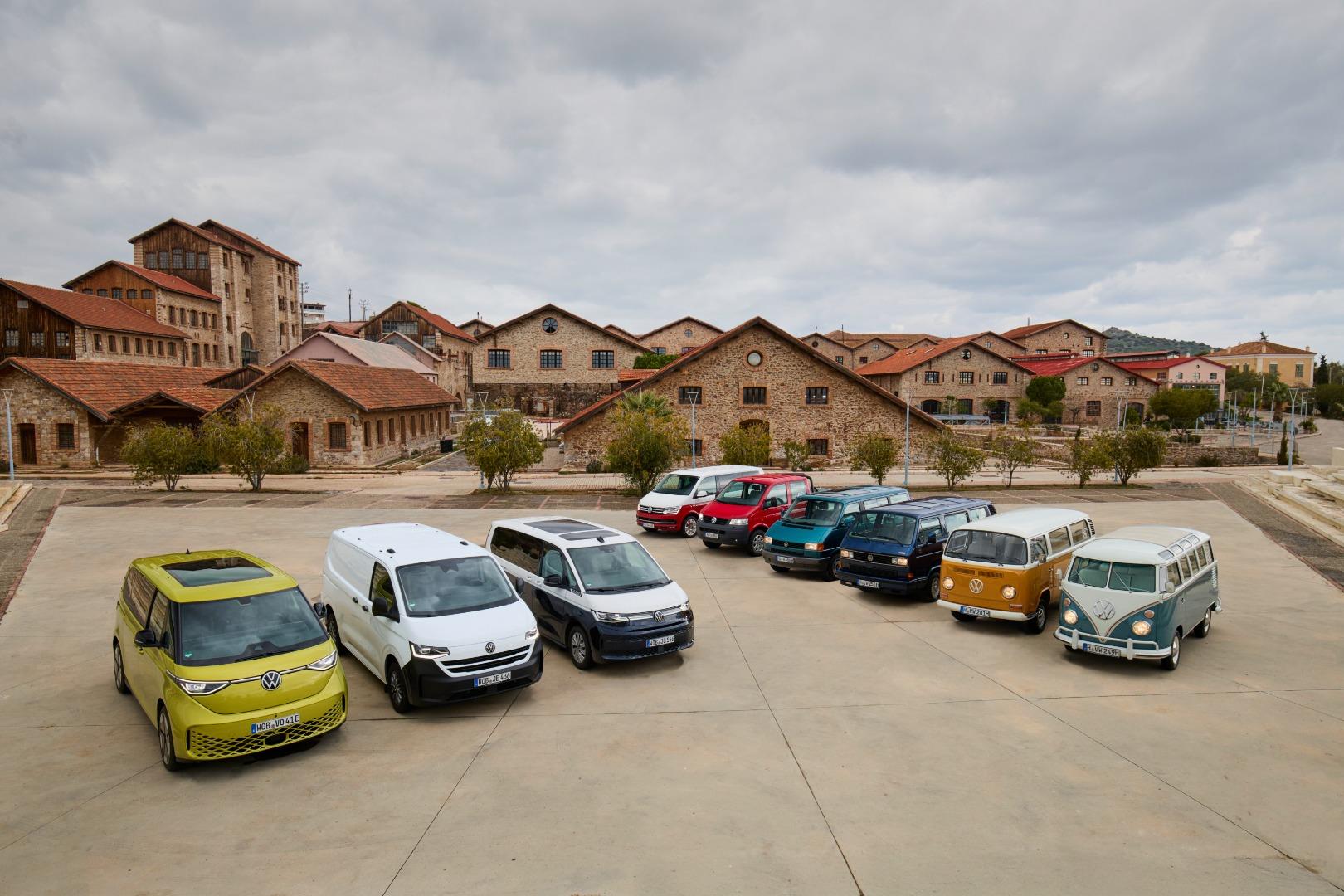


Officially known as the Volkswagen Transporter and affectionately called the “Bulli,” this multi-tasking marvel is the longest-built and most successful commercial vehicle in Europe. Since its debut on 8 March 1950, more than 12.5 million have rolled off the production lines, cementing its status as a symbol of freedom, adventure, and practicality.

1950: The T1 – Birth of a legend
It all started in post-war Germany when Volkswagen rolled out the first Transporter, or T1, from its Wolfsburg plant. With its split windscreen and endearing face, the T1 was an instant hit. Capable of carrying everything from bricks to band equipment, it was the perfect workhorse for Europe’s burgeoning post-war economy. British fans quickly nicknamed it the “Splittie” due to its distinctive two-piece windscreen.

The T1 wasn’t just practical; it was also super cool. By the 1960s, it had morphed into the vehicle of choice for surfers, campers, and free spirits everywhere. The Samba bus, with its two-tone paint job and 23 windows, became a rolling icon of counterculture.
1967: The T2 – Peace, love, and sliding doors
Just as The Beatles were releasing “Sgt. Pepper’s Lonely Hearts Club Band”, Volkswagen gave the world the T2. This version introduced the now-standard sliding side door and bigger windows, enhancing the Bus’s versatility. From Woodstock to the streets of San Francisco, the T2 was a fixture of the flower power movement.

In 1979, German T2 production was discontinued. However, production continued in Brazil until 2013 – a testament to the vehicle’s charm.
1979: The T3 – The square with flair
1979 was arguably disco's most commercially successful year. Hits like “I Will Survive" by Gloria Gaynor, "Bad Girls" by Donna Summer, and "Heart of Glass" by Blondie were dominating the charts. At the same time, the VW Bus got a new look – and it dominated showroom floors.
The T3 was boxier but packed with new tech, including a catalytic converter, turbodiesel engines, and all-wheel drive. It was the ultimate Swiss Army knife on wheels.
The T3 also marked the debut of the California camper van, turning road trips into a lifestyle. With a pop-up roof and kitchenette, it was a mobile home for the adventurous.
1990: The T4 – The space wonder
By 1990, the world was grooving to Madonna, and VW was flipping the script with the T4. Featuring a front-mounted engine and front-wheel drive, the T4 was roomier and more car-like to drive. It was a revolution for tradespeople, campers, and anyone needing serious space.

While the world had moved on, the T3 was still produced in South Africa until 2002. Even today, spotting a well-loved locally built T3 in the wild isn’t uncommon.
2003: The T5 – The gentleman’s van
Sleek, powerful, and more refined than ever, the T5 was the first VW Bus to be considered a collector’s item before it was even out of production. With a wide range of engines (including a V6 petrol) and a plush interior, it was the Bentley of vans.
Limited editions like the California NoLimit and Multivan Business (which had individual seats in Phaeton style) quickly became cult classics. If you see one for sale today, snap it up – T5s hold their value like vintage wines.
2015: The T6 and T6.1 – The digital age
Enter the T6 in 2015, bringing touchscreen infotainment, 4MOTION all-wheel drive, and more driver aids than you could shake a gear stick at. The T6.1 in 2019 cranked things up further with fully digital dashboards and voice control. For a van that started life hauling crates and cabbages, the T6 was practically a spaceship.
2022: ID. Buzz – Retro goes electric
As Volkswagen pivots to electric, the ID. Buzz is leading the charge – literally. This all-electric homage to the original T1 – launched on 9 March 2022 – merges retro styling with zero-emissions tech. Available in both family-friendly and cargo versions, the ID. Buzz is proof that you can teach an old bus new tricks.
2024: Volkswagen Transporter and Caravelle break cover
Launched in 2024, the latest Volkswagen Transporter and Caravelle models offer improved space, efficiency, and versatility.
The Transporter is available as a panel van, Kombi, or dropside, with options for different wheelbases and roof heights. On the other hand, the Caravelle is designed for professional passenger transport, ranging from large-capacity taxis to VIP shuttles.

Both models feature upgraded assist and infotainment systems, as well as turbodiesel, plug-in hybrid, and electric drive options.
Together with the Multivan, California, and ID. Buzz, they form the most extensive VW Bus range to date.
Birthday parties galore
To mark 75 years of the VW Bus, Volkswagen is rolling out the red carpet with TV commercials, print ads, and an Instagram campaign. Events around the globe will celebrate the Bus’s legacy, from classic car rallies to exhibitions.

So, whether you’re a die-hard fan or a newcomer to the cult of the Bulli, there’s never been a better time to tip your cap to this multi-tasking marvel. After all, 75 years on, the VW Bus isn’t just a van; it’s a part of automotive history.