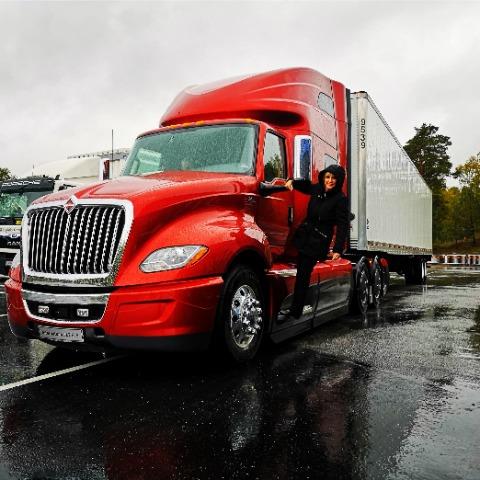
Self-driving trucks: what’s it like to take a trip in one?
Trucks that don’t necessarily require drivers are just around the corner – and Italian journalist Gianenrico Griffini (who is also Chairman of the International Truck of the Year jury) has been to the United States to drive in one! What’s it like? Is it perhaps a bit intimidating? I caught up with Griffini – and had many questions for him.


Charleen Clarke: In which truck did you drive – and where?
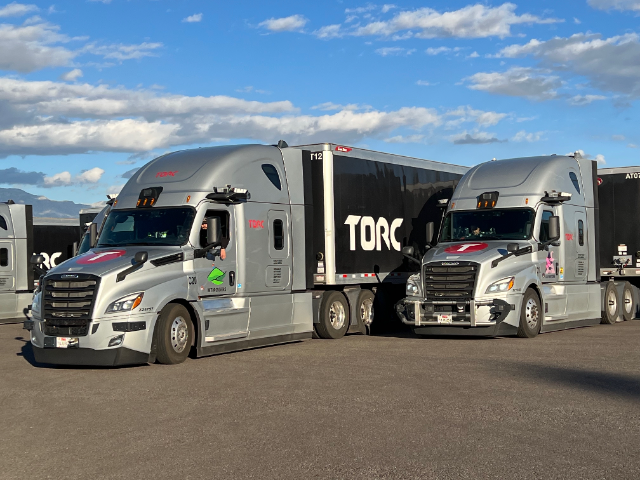
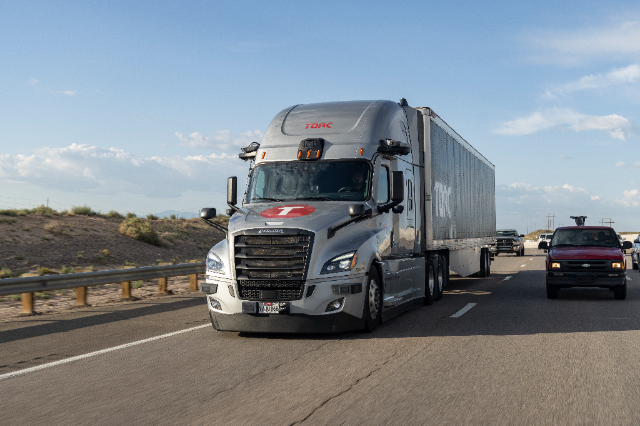
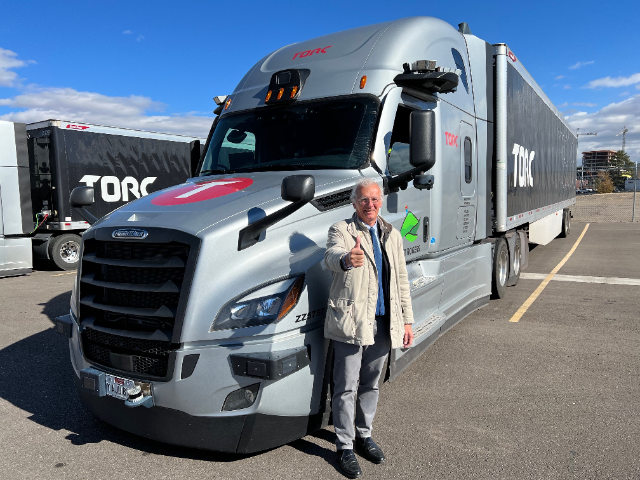
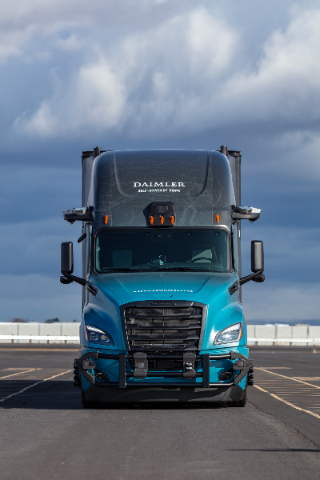
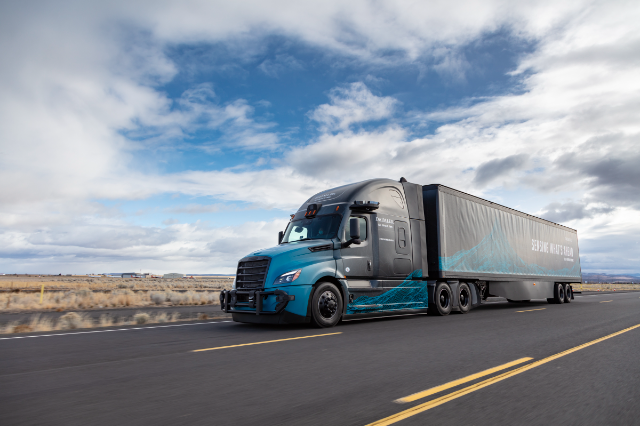
Gianenrico Griffini: I was invited to the United States by Daimler Truck, which plans to introduce series-production driverless trucks in the United States by 2030. I travelled aboard a Freightliner Cascadia self-driving truck on the highways around Albuquerque (New Mexico), USA.
Why Albuquerque?
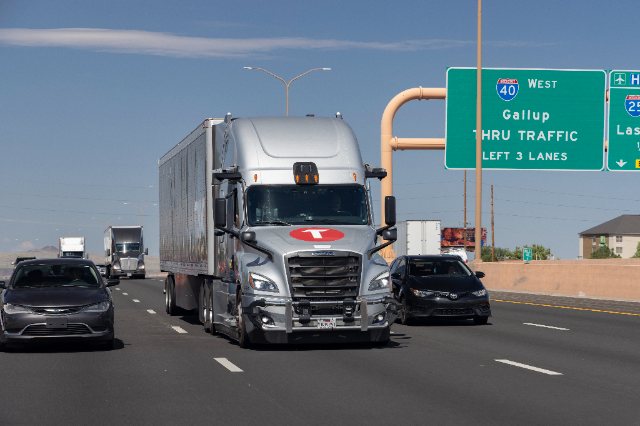
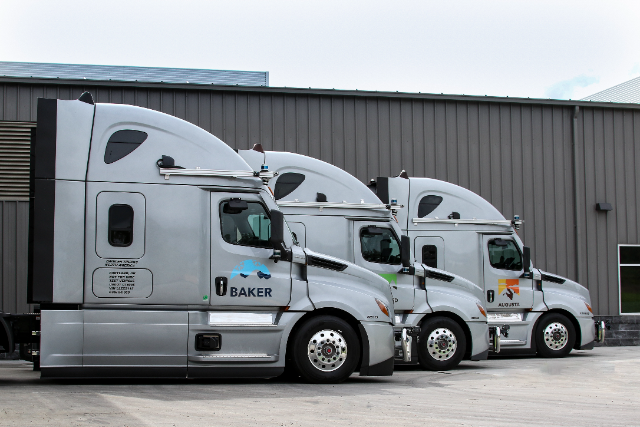
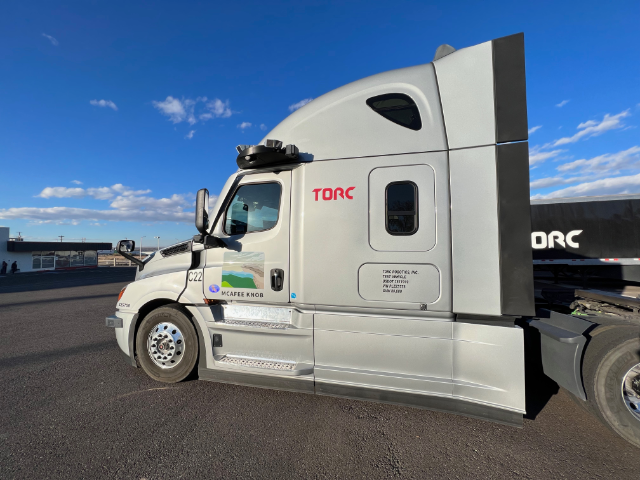
Albuquerque is the HQ of Torc Robotics, a company acquired by Daimler Truck in 2019. Torc develops the software, integrates, and fuses the inputs from different sensors, such as cameras, lasers, radars, and lidars, to allow safe automatic driving on high-traffic density highways. I also travelled to Albuquerque because this is where some prototype self-driving trucks, based on the Freightliner Cascadia platform, are undergoing field tests in actual operating conditions.
What is a lidar?
A lidar is a device that measures the distance from an object by a laser beam and returns high-resolution three-dimensional information on the surrounding environment.
What is it like to be in a self-driving truck on public roads? Is it perhaps scary? Were you worried about your safety?
No, I wasn’t scared at all, because I was fully aware of the safety procedures in place. And those procedures were explained in detail before going on the highway.
You say it’s a self-driving truck, yet there was a driver behind the wheel. That doesn’t really make sense.
For the time being, a driver is required because the truck is still an experimental vehicle with SAE Level 4 autonomous driving systems. In the future, a transport mission from hub to hub on the highway will be carried out without a human driver. Trucks can accomplish the entire transport mission (hub-to-hub and last-mile delivery in any weather conditions) without a driver if they have Level 5 automated driving systems. A Level 5 truck does not require any human intervention whatsoever. Level 5 trucks don’t even need steering wheels or acceleration/braking pedals.
So, with a Level 4 experimental truck, you do still need the driver. I assume he or she is also there for safety reasons?
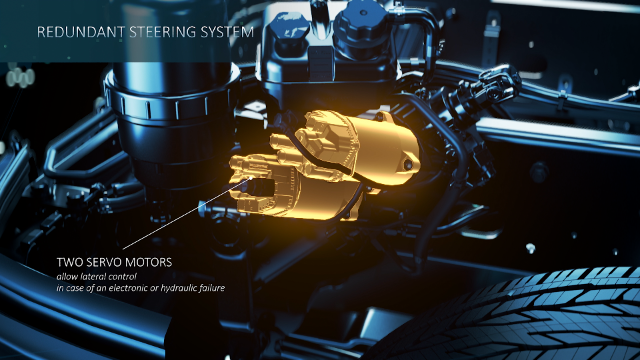
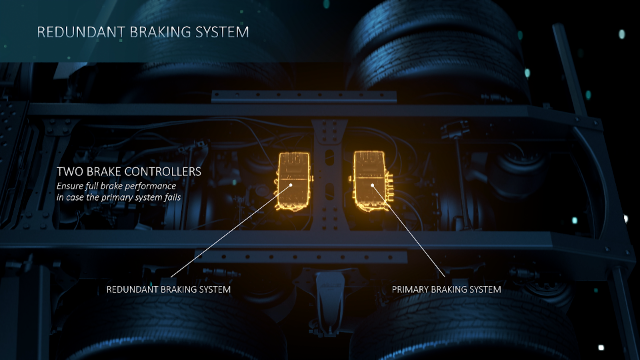
Correct. During road tests of the Freightliner Cascadia self-driving truck, a human safety driver – assisted by a Torc Robotics engineer – is always ready to take complete control of the articulated truck if a risky situation arises. The safety driver also has a crucial role in providing the software specialists with feedback to program the onboard computer according to a prudent, safe, and fuel-conscious driving style, without hard braking and harsh acceleration.
Was the truck towing a trailer and loaded? How fast did you go?
Yes, it is a standard tractor-semi-trailer combination of 80,000 pounds (about 36 tonnes). We travelled at the maximum cruising speed allowed in the States of 65 miles per hour (just under 105 kilometres per hour).
Why is Daimler testing these trucks in the United States and not in other major truck markets – Europe, for instance?
There are lots of reasons for this. Firstly, the United States has the most branched and extensive motorway network globally, and the speed difference between trucks and cars is not as high as in the EU. Moreover, US highways represent a more structured environment than an urban situation. There are lanes headed in the same direction, and it's easier to predict where cars are supposed to be going. In this environment, the Freightliner Cascadia can handle most traffic situations: lane mergers, merging into traffic from a ramp, changing lanes, and slowing down or speeding up. The US legislative framework is also favourable; the US Department of Transportation is proactive in facilitating the introduction of technical innovations. Level 4 autonomous trucks will arrive in Europe too – but it will take time.
Many people don’t like the idea of self-driving trucks because they say jobs will be lost. We already have massive unemployment in South Africa! What are your thoughts on this subject?
Well, in markets such as the United States and Europe, there is a massive driver shortage – so this is not an issue. Obviously, in South Africa, where you don’t really have the same problem, I can understand that there would be some concern. But there’s no need to panic. Truck drivers don’t only drive trucks. They also do lots of other things – from checking vehicles and securing cargo, to maintaining logs and providing customer service. Human beings will still need to perform all these tasks – because they won’t be automated any time soon.
But then what’s the point in having a self-driving truck – if you still need a driver?
With a Level 4 autonomous truck, you still need a driver for the last-mile delivery (although not for a hub-to-hub mission on a highway). The key issue today in the USA and Europe is finding heavy-duty truck drivers for long-distance missions. Staying away from the family for weeks is not attractive.
Finally, how large is the market for self-driving trucks – and when will we see them in South Africa?
Although Daimler Truck North America did not disclose any figures about autonomous driving vehicle sales forecasts, it expects that self-driving vehicles will manage 6% of freight volume in the United States by the end of this decade. So, we’re talking about a niche market because the trucks will be used in specific applications. For instance, in developing autonomous driving solutions for the States, Daimler Truck has focused on a specific business case: connecting one logistics centre to another (hub-to-hub mission) along a motorway. When the truck arrives at the destination hub, a professional truck driver takes it to the final unloading point.
Will it be feasible and, most importantly, cost-effective to have a self-driving truck travel on the N3 from Johannesburg to the outskirts of Durban, where a driver is waiting to “take over”? Honestly, I cannot see this happening in South Africa any time soon; certainly not in my lifetime!