

What is this tech all about?
What’s this engine technology all about? Well, when we think hydrogen, we typically think fuel cells – and a hydrogen internal combustion engine (H2-ICE) doesn’t need those.
According to Jim Nebergall, General Manager of the Hydrogen Engine Business at Cummins, both H2-ICE and hydrogen fuel cells can power vehicles using hydrogen, a zero-carbon fuel. “Hydrogen engines burn hydrogen in an internal combustion engine, in just the same way petrol is used in an engine. H2-ICE are nearly identical to traditional spark-ignition engines. Fuel cell hydrogen vehicles (FCEVs), on the other hand, generate electricity from hydrogen in a device known as a fuel cell, and use that electricity in an electric motor much like an electric vehicle.”
Not new…
While we’ve heard and spoken more about FCEVs in the past, the H2-ICE is also not new. “In fact, one of the very first internal combustion engines ran on a mixture of hydrogen and oxygen – and featured an electric spark ignition mechanism. Its inventor, a former Swiss artillery officer named François Isaac de Rivaz, used it to build a vehicle that could carry heavy loads over short distances,” reveals Nebergall.

More recently, DAF has been working on the H2-ICE. It even received the 2022 Truck Innovation Award, presented by the International Truck of the Year jury, for its efforts.
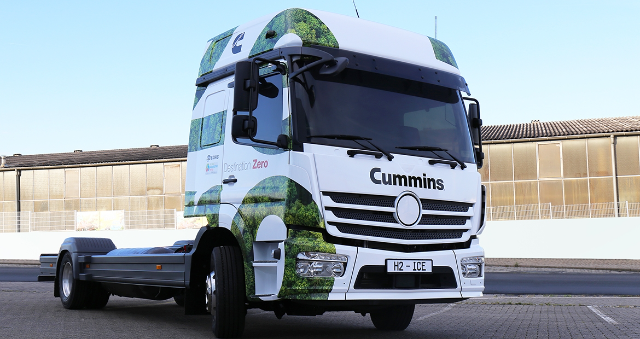
Last year, at the IAA Transportation exhibition in Hannover, Germany, Cummins revealed a medium-duty concept truck powered by the B6.7H H2-ICE.
JCB Power Systems has also developed the first H2-ICE for construction, agriculture, waste handling, and demolition. A prototype backhoe loader, fitted with this new hydrogen motor, can do everything its diesel-powered equivalent can do.

H2-ICE developments aren’t limited to trucks and heavy equipment. In a world first earlier this year, Toyota lifted the lid on a GR Corolla fuelled by liquid hydrogen. The vehicle was given a thorough test run at the Fuji Speedway in Oyama, Shizuoka. “We’re fighting to create a future for the internal combustion engine by tackling a technology deemed unfeasible for cars, in the uncharted territory of -253°C,” noted driver Masahiro Sasaki.
…But it is really clever
So the concept of H2-ICE isn’t brand new. But it is very clever. As Jamie Fox, Principal Analyst at Interact, explains, the H2-ICE comes with some perks. “Advantages of H2-ICE include the ability to use existing production facilities, a reasonable upfront vehicle cost and high power and energy density,” he explains.

“Compared to the fuel cell hydrogen solution, the combustion engine option also has transient capabilities (eliminating the need for a large energy storage system),” adds a spokesman for DAF. “Other advantages include the lower cooling capabilities needed and lower sensitivity to hydrogen purity.”

Internal combustion engines tend to be most efficient under high load – which is to say, when they work harder. “FCEVs, in contrast, are most efficient at lower loads,” says Nebergall. “So, for heavy trucks that tend to spend most of their time hauling the biggest load they can pull, internal combustion engines are usually the ideal and efficient choice. On the other hand, vehicles that frequently operate without any load – tow trucks or concrete mixer trucks, for example, may be more efficient with a fuel cell. FCEVs can also capture energy through regenerative braking in very transient duty cycles, improving their overall efficiency.”

Like most things in life, the H2-ICE doesn’t come without disadvantages. “These include high running cost (at least at current hydrogen prices), the need for refuelling infrastructure and the fact that the engines do produce some NOx emissions (although not much),” says Fox.
Where to next?
Bearing all this in mind, what does the future hold for the H2-ICE? Fox says it could have a role to play in trucking. “It will be difficult in many applications to compete with battery electric vehicles (BEVs), which are less expensive in total cost of ownership. Given the cost of hydrogen and the low efficiency of engines, the total lifetime cost of BEV could be half or a third of an H2 ICE vehicle in some cases! But you have to look at the specific use case. For vehicles doing over 200 miles day after day, the running cost of H2 ICE may be too high. But for a vehicle that does a smaller distance each day but very occasionally goes a much longer distance, H2 ICE vehicles can make the math work. And that occasional longer distance might be a problem for a BEV vehicle. So, H2 ICE may be able to find a niche,” he predicts.

But he warns that this depends on so many factors. “In a pessimistic case, it’s plausible to imagine a world with a high hydrogen price, battery prices crashing as capacity builds up, and no support for hydrogen from regulators. In such a world, the number of H2 vehicles on-road could be closer to zero. The case for H2 ICE in trucks is certainly not a slam dunk. It`s challenging. To me, BEV makes more sense in most cases,” says Fox.

The team from DAF, however, seems to be more optimistic about H2 ICE. “Thanks to hydrogen technology, the internal combustion engine still offers huge potential for the further future, especially in the heavy-duty long haul transport segment,” its website states.
Will we see BEV, FCEV, H2 ICE or some other technology prevail in the future? Only time – and the economics of the day – will tell.