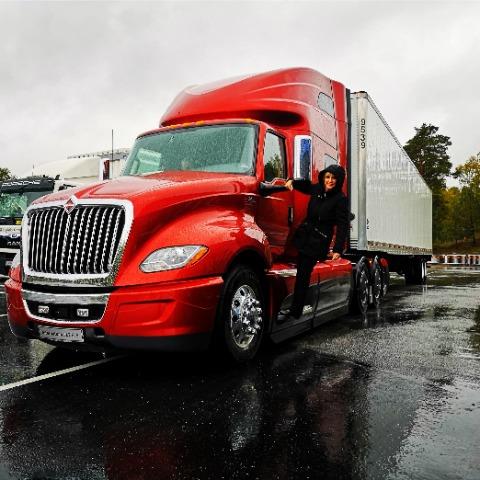
Coming soon: the world’s first self-driving hydrogen truck
Autonomy and fuel cell propulsion are two of the most talked-about trends within the commercial vehicle industry. Now, a company based in the United Kingdom is working on a vehicle that marries those technologies – and it is developing the world’s first self-driving hydrogen truck.



Hydrogen is nothing new
While there’s a lot of hype around fuel cell propulsion now, it’s nothing new. A British chap by the name of Sir William Grove built the first fuel cell in which the formation of water from hydrogen and oxygen gas generated an electric current back in 1842. Alas, it didn’t really generate enough electricity to be truly useful; that only came to fruition in 1932 – when English engineer Francis Thomas Bacon perfected the technology. His fuel cells were used by the Apollo space vehicles in the United States (the alkaline fuel cells provided in-flight power, heating, and clean drinking water).

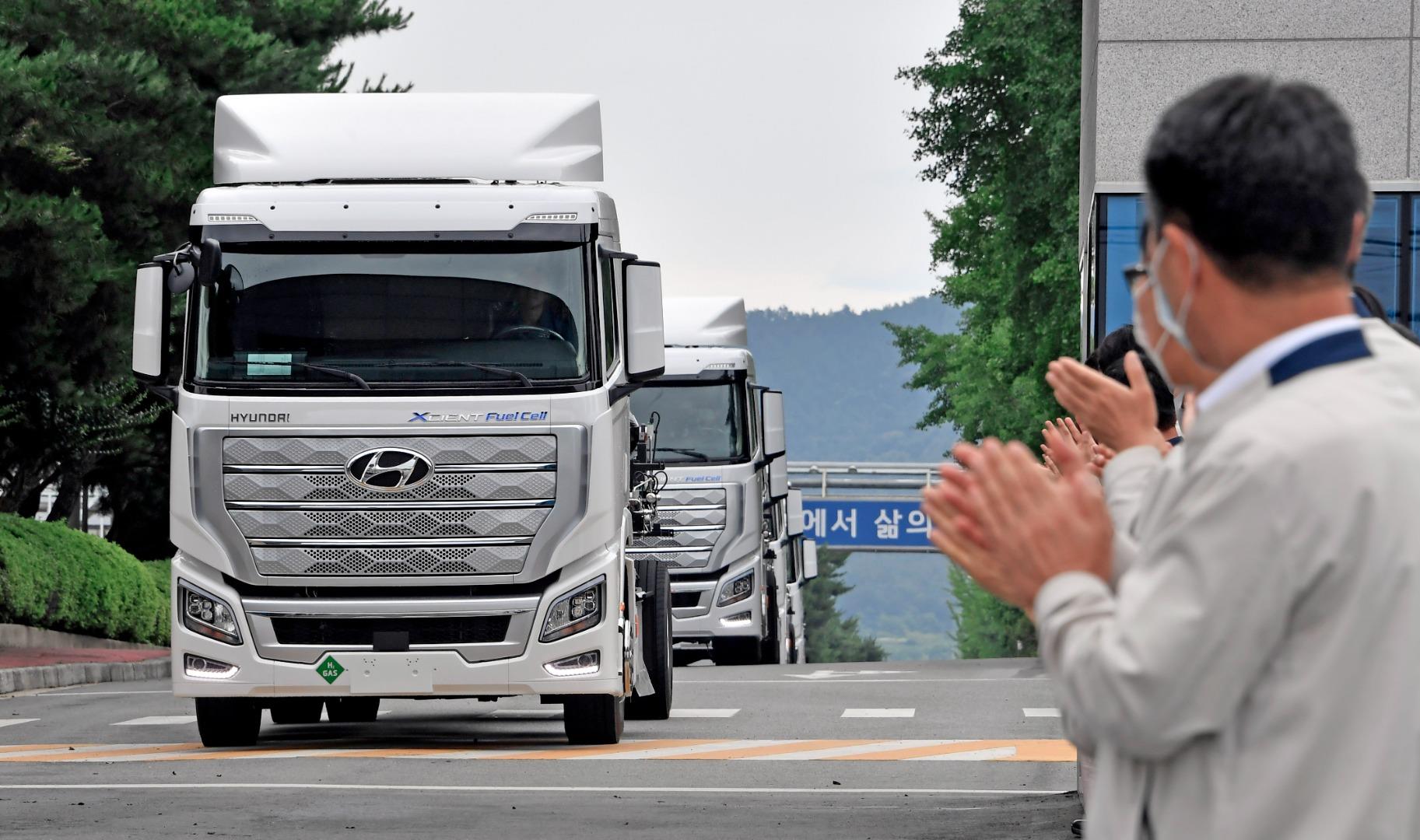
Today, fuel cells are being used for anything and everything from emergency backup power in critical facilities like hospitals to powering trucks. Thanks to their many advantages – they are a clean source of power, silent, highly reliable and flexible (individual fuel cells can be “stacked” to form larger systems capable of producing more power, thereby allowing scalability) – fuel cells are expected to be used more and more in future. They are already being seen in action on European roads on a daily basis; Hyundai recently rolled out a fleet of hydrogen trucks in Switzerland.
Enter autonomy
Autonomy, on the other hand, doesn’t have quite as long and illustrious a history. While it’s been around for a while – General Motors showed the first self-driving car at the 1939 World Fair (it was an electric vehicle guided by radio-controlled electromagnetic fields and operated from magnetized metal spikes embedded in the roadway) – this technology is still not being widely used.
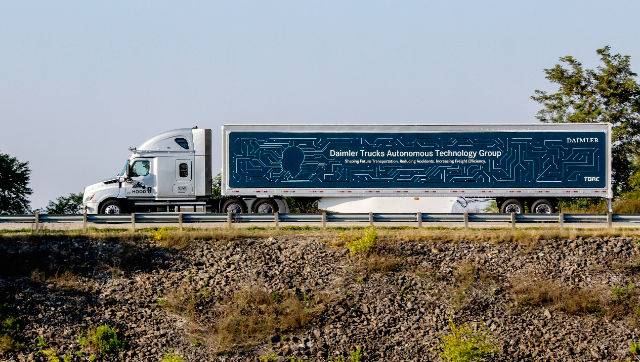
This is not to say that it’s not being employed at all. To the contrary; it’s being tested all over the planet. That’s because it really makes so much sense. Autonomous, self-driving vehicles have the potential to revolutionise haulage and logistics sectors, particularly the long-haul, heavy-duty goods vehicle market. Through the integration of ground-breaking sensor technology within the vehicle consisting of an array of radars, LIDARs, cameras, and Artificial Intelligence, autonomous trucks can provide unprecedented operational safety without human intervention.
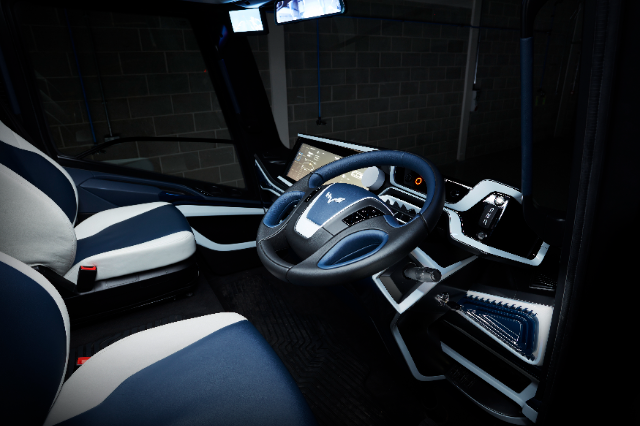
Back in 2015, Daimler demonstrated its autonomous Freightliner Inspiration Truck in Nevada. In 2019, Daimler acquired Torc Robotics, a company headquartered in Blacksburg, Virginia, which is a world leader in autonomous technology. Torc Robotics aims to commercialize autonomous trucks on the road within this decade. And, in the US, autonomous trucking could be a reality on a large scale by 2030.
An unusual marriage
But now, Hydrogen Vehicle Systems (HVS) is taking the two technologies and “marrying” them. The consortium it leads, Hub2Hub, has been awarded £6.6 million (roughly R139 million) to develop and deliver a revolutionary, world-first, autonomous zero-emission truck.

The funding is coming from the UK government, which is awarding almost £42 million (roughly R885 million) to seven projects through the Centre for Connected and Autonomous Vehicles (CCAV) Commercialising Connected and Automated Mobility (CAM) competition.

The Hub2Hub consortium, made up of world leaders in their fields – HVS, Fusion Processing and ASDA – will create a self-driving heavy goods tractor unit, which will begin vehicle trials in 2024. Two prototype vehicles that will allow Level 4 autonomous driving will be produced.
The first hydrogen-electric truck prototype will be fitted with a driver’s cab and tested on the road in autonomous operation, using Fusion Processing’s Automated Drive System, CAVStar, with a human safety driver at the wheel.
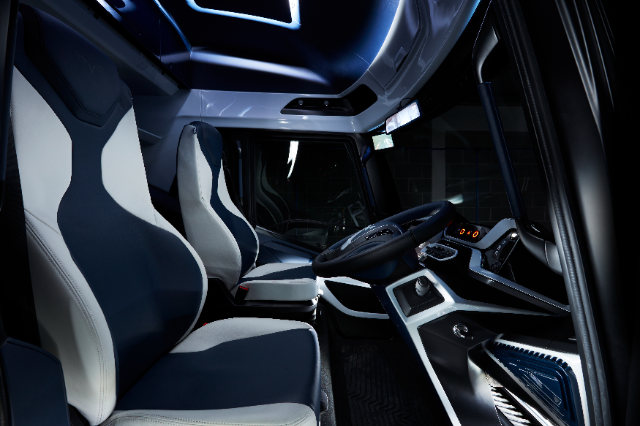
The second prototype will have the driver’s cab removed and replaced by an aerodynamic fairing. During the project this vehicle will be evaluated on test tracks, with the CAVStar system in this application allowing a remote human driver, located in a control hub, to operate the vehicle.
Together these two prototypes point to an optimised future logistics system where vehicles could be operated in autonomous mode on a hub-to-hub route, with a remote driver then taking control to drive the vehicle from the hub to its end destination.
Significant benefits
Grant Shapps, the UK’s Secretary of State for Business, Energy and Industrial Strategy, believes that these world-first vehicles could boost the economy. “In just a few years, the business of self-driving vehicles could add tens of billions to our economy and create tens of thousands of jobs across the UK. This is a massive opportunity to drive forward our priority to grow the economy, which we are determined to seize,” he notes.

The trucks also go a long way towards solving issues of driver shortages and improvement in driver quality of life, thanks to remote teleoperated vehicles. Drivers can stay local as well as take advantage of less intensive driving shifts, for a greater work-life balance.

Plus, fleet operators can benefit by optimising vehicle utilisation during less busy hours, thereby making logistics more efficient and more environmentally friendly by avoiding congestion. In addition, onboard advanced automated drive systems can reduce energy and tyre emissions by optimising acceleration and braking at a far greater level than human ability.
Most importantly, road safety will benefit – because, while human beings get tired, machines don’t. And therein lies a convincing reason for the introduction of this technology in South Africa.