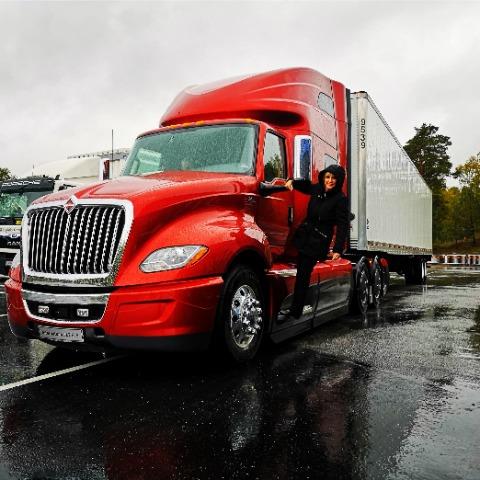
Due to the pandemic, we were unable to travel to Switzerland to test drive them. However, leading commercial vehicle writer in Switzerland, Martin Schatzmann (pictured below; he’s Executive Editor of TIRtransNews and he also represents Switzerland on the International Truck of the Year jury), managed to get behind the wheel of one of these innovative trucks! And he very kindly shared his driving impressions with us.

Introducing the H2 XCient
The Hyundai H2 XCient fuel-cell truck is produced by Hyundai in South Korea. It’s a truly significant project because – while numerous other companies have concept hydrogen trucks – the H2 XCient is actually running on the roads of Switzerland each and every day.
This level of innovation – which saw the Jury of the Truck of the Year honouring the joint venture Hyundai Hydrogen Mobility with the 2020 Truck Innovation Award – could mean the difference between make or break for Hyundai in the commercial vehicle world. For, while its cars are selling faster than hot cross buns at Easter, Hyundai Motor’s commercial vehicle business has not performed well over the past couple of years. Hyundai plans to turn this around and one of the ways it intends growing sales is via the introduction of eco-friendly models such as the H2 XCient. It hopes to sell 77 000 commercial vehicles this year (versus last year’s 57 271), with 48 500 of those vehicles being sold overseas – and some of those will be hydrogen-powered trucks.
Its first move in this direction is happening in Switzerland, where 46 of these trucks are now operating (a total of 1600 Xcient fuel-cell trucks will be deployed in Switzerland by the end of 2025). There are currently six hydrogen stations on their routes of operation. By 2023, it’s planned that there will be hydrogen stations throughout the country. This is a good thing because the trucks need quite a bit of hydrogen. “The trucks have a range of 400 km, and they need 32 kg of hydrogen for this. In contrast, a passenger car – the Hyundai Nexo, for instance – needs 6 kg for 600 km,” reveals Schatzmann.
The H2 XCient is but one piece in Hyundai’s hydrogen puzzle. It’s also working on a long-distance truck capable of travelling 1 000 km on a single charge. It will be aimed at global markets including North America and Europe.
The truck in a nutshell

The H2 XCient is powered by a 190-kW hydrogen fuel cell system with dual 95-kW fuel cell stacks. It is equipped with seven large hydrogen tanks, which offer a combined storage capacity of around 32.09 kg of hydrogen. It’s super fast to refuel; this takes between eight and 20 minutes.
Exterior

Schatzmann says you can’t see the difference between a regular truck and the hydrogen truck; only the livery reveals that the H2 XCient is something special. “In fact, from the outside, someone who doesn’t know trucks will think that this is a vehicle with an internal combustion engine. What may be obvious to the professionals is the fact that the vehicle is allowed to be 60 cm longer to accommodate the hydrogen tanks and to compensate for the loss of transport volume,” he notes.
Interior

The interior is identical to that of a diesel-powered Hyundai. The big difference of course is that when you push the start button, you don’t realise that the truck is actually running – because it’s completely silent. “You can only see by looking at the dashboard – and studying a small green truck icon (which flashes when the system is activated) – that the truck is getting ready to operate. Once the truck is on the road, the small green truck icon is still there but it doesn’t flash anymore,” Schatzmann explains.
The cockpit layout is as expected. Forward and reverse gears are selected on a lever attached to the steering wheel (like an indicator lever). The parking brake lever is very obvious; you can’t miss it.
Schatzmann says that the driver’s seat is very comfortable. “It takes the normal time to adjust; once that’s done, you can crack on. Without any noise, the truck starts accelerating. It certainly doesn’t feel as though you’re moving 36 tonnes; it’s quite effortless. Quite incredibly fast, you reach the city speed limit,” he reveals.
Drivetrain

The key component of this truck is the fuel cell. It consists of two cells from the Hyundai Nexo passenger car, and it produces up to 190 kW of electricity. Other driveline components include a 661V/73.2 kWh battery from Akasol and a 350kW/3400 Nm motor/inverter from Siemens. Of course, it sounds completely different to a diesel-engined truck. “From the outside, the system buzzes like a bee. As a side product, water drops onto the street and – from the exhaust – you just see fine steam,” reveals Schatzmann.
All the normal noises and vibrations that you’d expect from a typical truck engine are completely missing. Even on the highway, it’s very silent and peaceful in the cab. It’s easy to get used to this driving comfort.
While it’s highly innovative, the H2 XCient does employ some familiar technology. “It feels very futuristic but there is also some technology employed that we’ve grown to expect in modern diesel trucks – such as electrohydraulic steering. The steering is indirect, which means that – in traffic circles – a lot of steering is required. However, the driving comfort on highways doesn’t suffer because of this,” he says.
Transmission

The truck has an automatic Allison transmission, with six forward gears and one reverse. Similar diesel trucks have an automatic gearbox with nine or 12 gears; the consequences are that you have a lot of gear changes and the acceleration is halted – albeit slightly – during each gear change. “That obviously doesn’t happen with this truck; it pulls constantly without any disruptions. In fact, you don’t feel the gear changes at all,” notes Schatzmann.
Safety

Standard safety features include Front Collision-avoidance Assist, Smart Cruise Control, Electronic Braking System, Vehicle Dynamic Control, ABS and a Lane Departure Warning. An airbag is optional. The brakes are very sensitive. “Prod the brake pedal too hard and you’ll go through the windscreen,” warns Schatzmann.
Verdict
Hyundai is renting out the trucks to haulage companies in Switzerland on a pay-per-use basis (the company charges based on the travelled kilometres). Schatzmann explains that a hydrogen truck really makes financial sense in Switzerland, which charges extremely high toll fees for diesel-powered trucks. “The hydrogen trucks are exempt from these toll fees, meaning that this is a sound business model,” he explains.
But maybe, when it comes to delivering a verdict on this truck, we shouldn’t be looking at operating costs only – but rather the bigger picture. The trucks have now completed 370 000 km of testing in Switzerland and every single truck saves 65 tonnes of CO2 per year. Multiply that by 46 (the number of these trucks operating in Switzerland) and that’s a saving of 2990 tonnes of CO2 per year.
Now that’s really worth celebrating.