E-mobility to the fore

Numerous companies are introducing e-mobility into the South African marketplace in some shape or form. At the end of last year, Scania provided Shoprite with a heavy-duty electric truck to pilot. Daimler has previously piloted the eCanter in this country (it plans future tests, along with tests of the eActros).
Volvo – the only global truck manufacturer with a full range of electric trucks in series production today – has also committed to supplying electric trucks in South Africa. Recently, it introduced rigid trucks to its electric vehicle portfolio.

“Already producing the most complete electric line-up in the global truck industry, we are now expanding our offering with the introduction of rigid versions of the extra-heavy electric trucks: the Volvo FH, Volvo FM and Volvo FMX,” says Waldemar Christensen, MD of Volvo Trucks South Africa.

“With these new, electric trucks we are making it easier than ever for even more South African customers to go electric. Fleets can have these trucks custom-built for their specific operation, to cut emissions while getting the same functionality as from the diesel truck they are using today,” explains Christensen. “Our customers are already ordering electric vehicles that will suit their specific business needs, with the first local deliveries expected during the first quarter of 2023.”
But what about safety?

There’s no denying that these electric vehicles make a lot of sense. Besides producing zero exhaust emissions, electric trucks provide a better working environment for drivers as they are quiet – which also contributes to a more liveable city for residents. But how safe are these vehicles? What happens if an electric truck crashes into another truck? Or skids and rolls over at high speed? What about potential fires?

According to Anna Wrige Berling, Safety Director at Volvo Trucks, the company’s electric trucks are developed to be just as safe as all other trucks.
Battery electric trucks have their own specific safety challenges, mainly concerning the electromobility system which includes a 600V battery. The risk of shortcuts and chemical leakage from the system needs to be minimized. Berling reveals that Volvo uses rigorous calculations, virtual simulations as well as full-scale crash tests to verify the safety of the electric trucks in the event of a crash.

“The calculations and virtual simulations are the foundation when we develop and verify a safe design for our electric trucks. In this way, we can test a variety of scenarios and parameters digitally. To verify the results from the simulations, we also conduct full-scale crash tests of the trucks,” says Berling.
“The purpose of the full-scale crash tests is to minimize the risk of fire and chemical leakage by verifying that the batteries and electric components stay in place in a crash, and that the high voltage system switches off,” she explains.
Three different tests verify safety

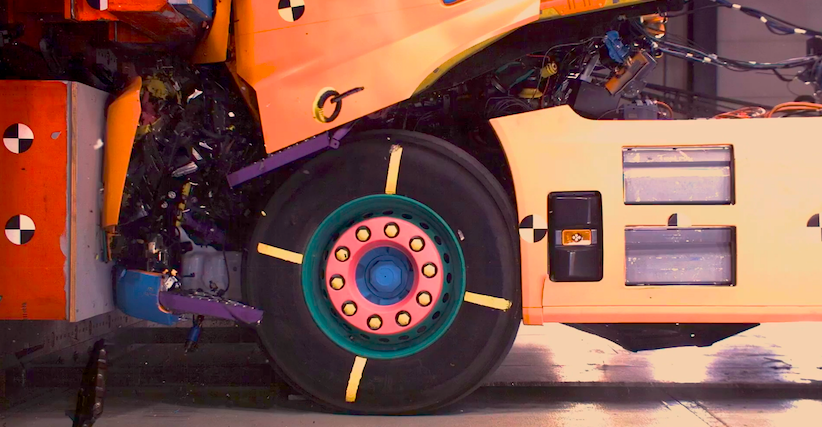
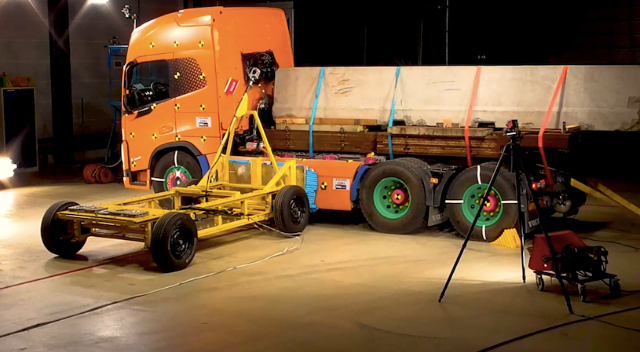
Berling and her team have carried out three different full-scale crash tests on the Volvo FM Electric, namely a side collision test, roll-over test and barrier test – and the truck passed all three with flying colours.

In the side collision test, a trolley – simulating a passenger car – crashes into the side of the truck, where the batteries are installed. The test verifies that the battery packs, with their modules and cells, are well protected and stay in place even when exposed to heavy force.
In the roll-over test, the truck is forced to roll over – a common truck accident. The purpose is to verify that the high voltage system switches off, to minimize the safety risks for the driver and the rescue team.

Finally, during the barrier test, the truck crashes into a barrier, simulating the rear of another truck. The electric truck is tested to make sure that the electric installations and components under the cab stay in place, and that there are no shortcuts leading to a fire or other hazardous situations.
“As forerunners, we have a great responsibility to ensure that the shift to fossil-free electric transport is done without compromising on safety – for drivers, rescue teams and all other road users,” concludes Berling.
So, there you have it. Electric vehicles are coming – and they’re safe. It seems as though the move to e-mobility is good news on all fronts.