SA’s love affair with hydrogen
Earlier this year, the Hydrogen Society Roadmap for South Africa (HSRM) was published by the South African government. We won’t go into the exact details of the 100-page document here. But it does give valuable insight into why South Africa could capitalise on the expected growing market for hydrogen.

According to the HSRM, South Africa currently produces approximately 2% of global hydrogen output (all grey hydrogen), with Sasol being the leading producer. With the world increasingly turning towards countries that have optimal renewable energy resources to provide green hydrogen, South Africa is among the few in a position to decarbonise its economy and export green hydrogen or its derivatives (such as green ammonia and methanol). One of the country’s trump cards is its weather; South Africa has ideal weather conditions for solar and wind generation, which are the renewable energy options typically deployed in green-hydrogen production.

Accordingly, the HSRM proposes achieve a number of outcomes. These include the development of a physical infrastructure to optimally produce, distribute and utilise hydrogen and the creation of an export market for green hydrogen and ammonia. Furthermore, the South African Department of Science and Innovation (which published the HSRM) wants to stimulate local demand for renewable hydrogen. It goes without saying therefore that we should have hydrogen to power our trucks in future – in fact, we’ll have quite a lot of it.
So, we have the hydrogen, what about the truck?
The good news is that there are a number of truck manufacturers developing hydrogen-powered trucks – or fuel-cell trucks, as they’re also known. The latest is a company called Hydrogen Vehicle Systems (HVS), which was founded in 2017 and is headquartered in Glasgow, Scotland. The company aims to “disrupt the commercial vehicle industry by being an early mover with the most advanced, all-new zero-emission heavy goods vehicle”.
Last month, it showcased this 5.5-tonne technology demonstrator, which certainly looks impressive. According to HVS CEO Jawad Khursheed, the technology demonstrator showcases the company’s ground-breaking hydrogen-electric commercial vehicle design and advanced powertrain technology, a precursor to its heavy goods vehicle (HGV) model.
“Fuelled by close-coupled green hydrogen (hydrogen produced directly by renewable energy sources such as hydro, wind or solar) our zero-emission trucks are a key part of decarbonising the logistics sector. Hydrogen is the perfect fuel for the haulage industry, offering long ranges and quick refuelling thanks to stations easily integrated into key transport networks.
“What’s more, we will supply our customers with the most advanced HGV in the sector –delivering a step change in the driving experience, the lowest total cost of ownership and market-leading fleet management support,” he notes.
All-new chassis being developed
HVS tractor units will be built on an all-new chassis, designed in-house around the hydrogen powertrain, which consists of pressurised hydrogen cylinders, fuel cells, an energy storage system and an eAxle.
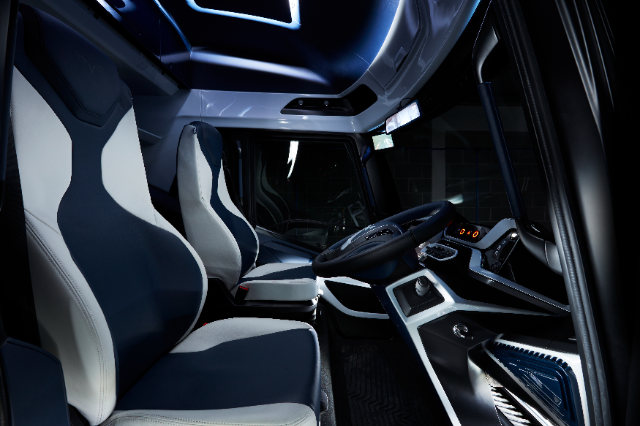
The truck itself is also being designed in-house by Pete Clarke, Head of Design, who has a wealth of experience designing commercial vehicles. “The unique ground-up design brings innovation in packaging, performance, efficiency, weight, range, consumption, maintenance, and lifecycle benefits. The technology demonstrator’s unique design allows significantly improved aerodynamics compared to current ICE trucks. Consequent benefits include enhanced fuel efficiency on long-haul runs and improved spatial ergonomics within the cab, including better access and more room at the controls, not to mention sector-leading aesthetics,” a press statement by the company contends.
Advanced technology
Like other similar trucks, HVS’ vehicle powertrain employs a fuel cell system and energy storage system to deploy electricity to an electric motor to transmit power to the wheels. It uses the KERS (kinetic energy recovery system) to recapture energy under braking and while the truck is slowing down.
The integrated powertrain is controlled with HVS' advanced control system “SEMAS” which will deliver class-leading fuel efficiency and durability. This is said to contribute to achieving a low cost of ownership comparable to that of current diesel-powered offerings in the market, the company promises.
The fuel cell permits longer range, higher load-carrying capacity, and faster refuelling than would be possible using Lithium-Ion battery technology alone. The typical refuelling time is comparable to diesel. As is always the case with trucks like this, the only emission from the vehicle is water vapour, meaning there are no harmful greenhouse gas emissions of any kind.
Future plans
HVS plans to launch a 40-tonne zero-emission HGV, with a range in excess of 500 km. Plans are in place for a left-hand drive variant of the hydrogen-fuelled 4x2 HGV tractor unit, with a rigid chassis model also in the pipeline.
And when will these trucks come to South Africa? “Once HVS establishes the manufacturing of vehicles in its initial target markets of the UK and Europe, the company will explore wider export opportunities as hydrogen infrastructure becomes more established,” a company spokesman responded to our question in this regard. Well, one thing is certain: if the South African government has its way, we will tick the hydrogen infrastructure box sooner rather than later.