
Commitment from government
The truck has come about thanks to a collaboration between Daimler and the American government. Back in 2009, the US Department of Energy launched a programme called the SuperTruck Initiative. Its goal? To improve heavy-duty truck freight efficiency by 50% between 2009 and 2015. “These trucks haul 80% of goods in the United States and use about 28 billion gallons of fuel per year, accounting for around 22% of total transportation energy usage – presenting a significant opportunity for carbon emissions reduction and energy savings,” a government spokesperson noted at the time.
Four teams – Daimler Trucks, Volvo Trucks, Navistar and a joint effort involving Cummins and Peterbilt – took part in the first $284 million programme, which aimed to help accelerate the development of advanced efficiency technologies that were not currently available in the market.
Enter the SuperTruck II project
SuperTruck I was, by all accounts, a success. And so, in August 2016, the Department of Energy announced SuperTruck II, which aimed to double the freight efficiency of Class 8 trucks, commonly known as 18-wheelers.
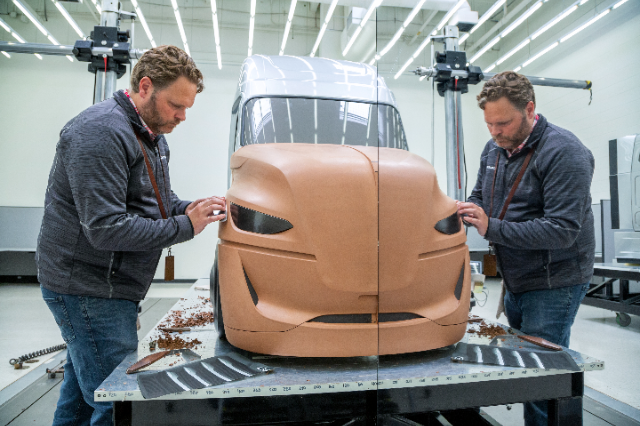
For SuperTruck II, the Energy Department selected the following four teams – Cummins, Daimler Trucks North America, Navistar and Volvo Technology of America – for projects of $20 million in federal funding (each recipient matches that amount, dollar-for-dollar).
Freightliner SuperTruck II breaks cover
Earlier this month, in Las Vegas, the Freightliner SuperTruck II was shown to the world for the very first time (we will report on the other projects in separate articles). The engineers were tasked with something somewhat difficult: they had to improve on SuperTruck I – which was already an efficient and uber-impressive truck.
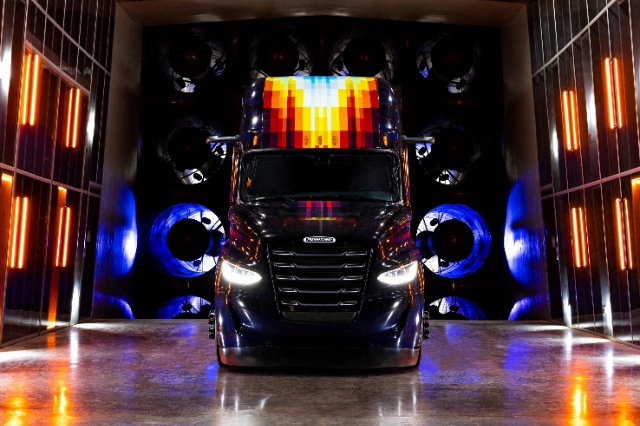
But they did. While this latest Freightliner is a concept vehicle, it includes some incredible technology that could come to production vehicles in the future. And, judging by this vehicle, transport operators can expect to enjoy some considerable savings in the future.
Let’s start with the tyres
Tyres – at several thousand rands a pop – cost transporters an arm and a leg. Plus, they can impact efficiencies like you cannot believe. Hence, considerable effort was made to improve the truck’s tyres. And the Daimler team – working with engineers from Michelin – hit the nail on the head in this regard, coming up with tyres boasting remarkably low rolling resistance.

The engineers were able to reduce the tractor rolling resistance by 12% over SuperTruck I. Furthermore, new treads and compounds translated into more than 20% improvements in drive tyre wear and tear and overall significantly improved rolling resistance. So, the tyre box was ticked.
What about aerodynamics?
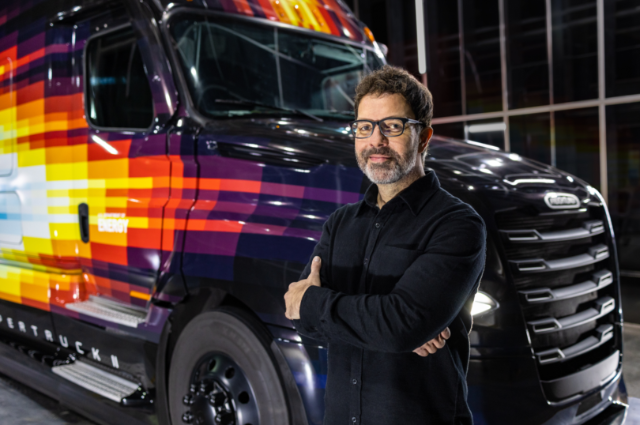
While a super-efficient truck needs tyres with low rolling resistance, this will amount to nothing if the actual truck isn’t aerodynamic. The engineers didn’t mess around in this regard; they came up with the most aerodynamic truck Freightliner has ever built.
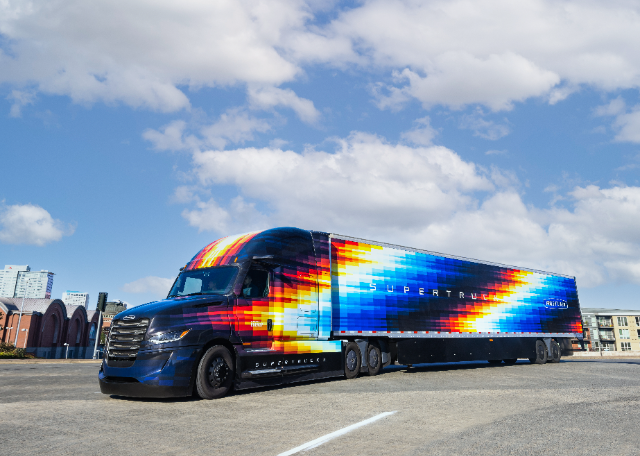
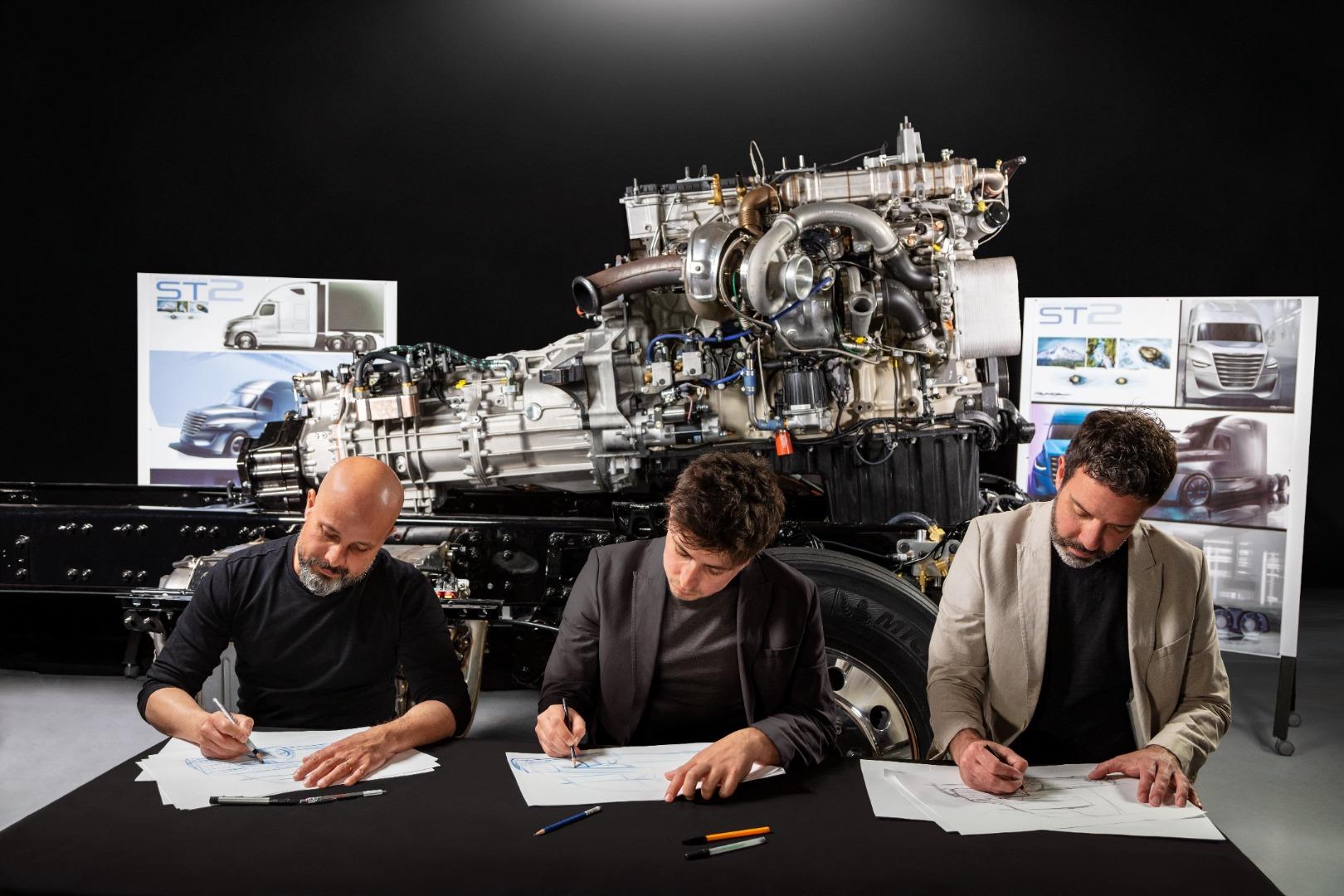
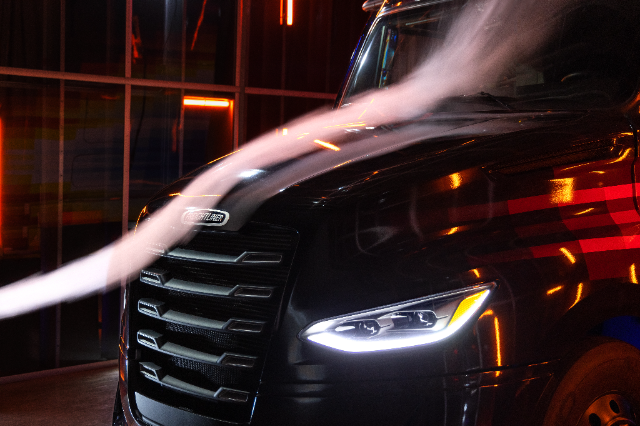
“We wanted to create a shape that makes efficiency exciting,” says Jeff Cotner, chief designer at Daimler Truck North America (pictured above). “The designers imagined the surfaces of the truck being carved away by the wind. Nature has a way of creating the perfect sculptural shape, when the material is light and airy like snow or sand. This was our inspiration in creating the new expressive form language for the Freightliner brand.”
The result is a design that reduces the aerodynamic drag of SuperTruck II by more than 12% over SuperTruck I. #respect
Next stop: powertrain
So, this SuperTruck has low-resistance tyres and it’s aerodynamic. But another important box needed to be ticked too, namely powertrain. In this regard, the SuperTruck II features the most efficient powertrain Freightliner has integrated into a truck. It delivers a 5.7% fuel consumption reduction over SuperTruck I.
The motor in question, a non-certified prototype Detroit 13-litre engine, features two-stage turbo and interstage cooling and a 13-speed overdrive transmission. One key powertrain feature of SuperTruck II is split cooling. This system consists of high and low temperature cooling circuits, working in tandem with two-stage turbocharging and Exhaust Gas Recirculation (EGR) cooling on the engine. Together, these technologies result in further efficiency gains – enabling more aggressive down speeding.
SuperTruck III is coming
While the Freightliner SuperTruck II is revolutionary, as they say in the classics: “That’s not all, folks.” SuperTruck III is coming! The Department of Energy’s third programme will fund five vehicle manufacturers – Paccar, Volvo, Daimler, Ford and General Motors – with a combined $127 million to pioneer electrified medium- and heavy-duty trucks and freight system concepts to achieve higher efficiency and zero emissions.
All will be revealed in 2027; watch this space for more details!