
Is Lexus good for families?
Today’s Lexus range consist mostly of sedans and SUVs, so those models should be fairly suitable for families by default. But not all modern Lexuses are equally good in this role, and the 2 coupés in the range will really struggle with family duties. We look at the current Lexus range, to see which ones would be good for families.




The current range
The first Lexus models, dating from the late-1980s, were four-door sedans, and this body shape remained a mainstay for the Japanese premium brand for the best part of a decade. But then they hopped onto the growing SUV wave, and created some of their best-selling models as a result.
Today’s Lexus range contains only 3 sedans and 2 coupés, with the 4 SUVs overshadowing their traditional siblings in the sales charts. The 3 sedans cover the compact executive, medium-sized executive and large luxury sedan classes, respectively, and they are joined by two related 2-door coupés and a convertible as speciality offerings.

Four distinct SUV/crossover classes are represented, ranging from compact to extra-large, and the range-topping LX is properly off-road-capable as well, being derived from the big-body Land Cruiser 200. The LX is rather old by now, though, and is due for replacement by a Land Cruiser 300-based model in the very near future.
Practicality and space

Lexus IS
This is the smallest Lexus sedan currently on sale, and aims to provide a distinctive alternative to cars like the BMW 3 Series, Mercedes-Benz C-Class, and Audi A4. But, while it has a 4-door body style, the Lexus IS differs from the norm by offering only one drivetrain – a 2.5-litre petrol/hybrid arrangement, rather than its opponents’ selections of petrol- and diesel units.
Being quite compact in size and endowed with RWD, the IS does not boast excellent packaging efficiency. The front-seat occupants will be happily ensconced in their leather-lined cocoons, but rear-seat passengers will struggle with compromised leg- and headroom. So, as soon as the children grow taller, they will complain about the lack of space, and taller rear occupants will struggle to clear the roof as they enter or exit the car.
The luggage compartment at the tail end of the Lexus IS is surprisingly large, though, measuring a useful 450-litres. However, the boot opening is quite small, so you may struggle to load bulky items like prams and bicycles.
Related: The new Lexus IS takes some getting used-to, on account of its hybrid powertrain.

Lexus ES
This one is the value leader, and arguably the best-balanced Lexus out there. The ES is a fair bit larger than the IS, and adopts front-wheel drive to optimise packaging efficiency.
The result is an extraordinarily spacious sedan, capable of handling 5 large adults and their luggage (454-litres of it) with ease. It is also super-comfortable, with a cushy ride, comfy seats, and low noise levels. The downside is that the Lexus ES is decidedly less sporty to drive than the IS, but that doesn’t really matter in the context of a family car.
Related: We loved the comfort and quiet of the Lexus ES in this review.

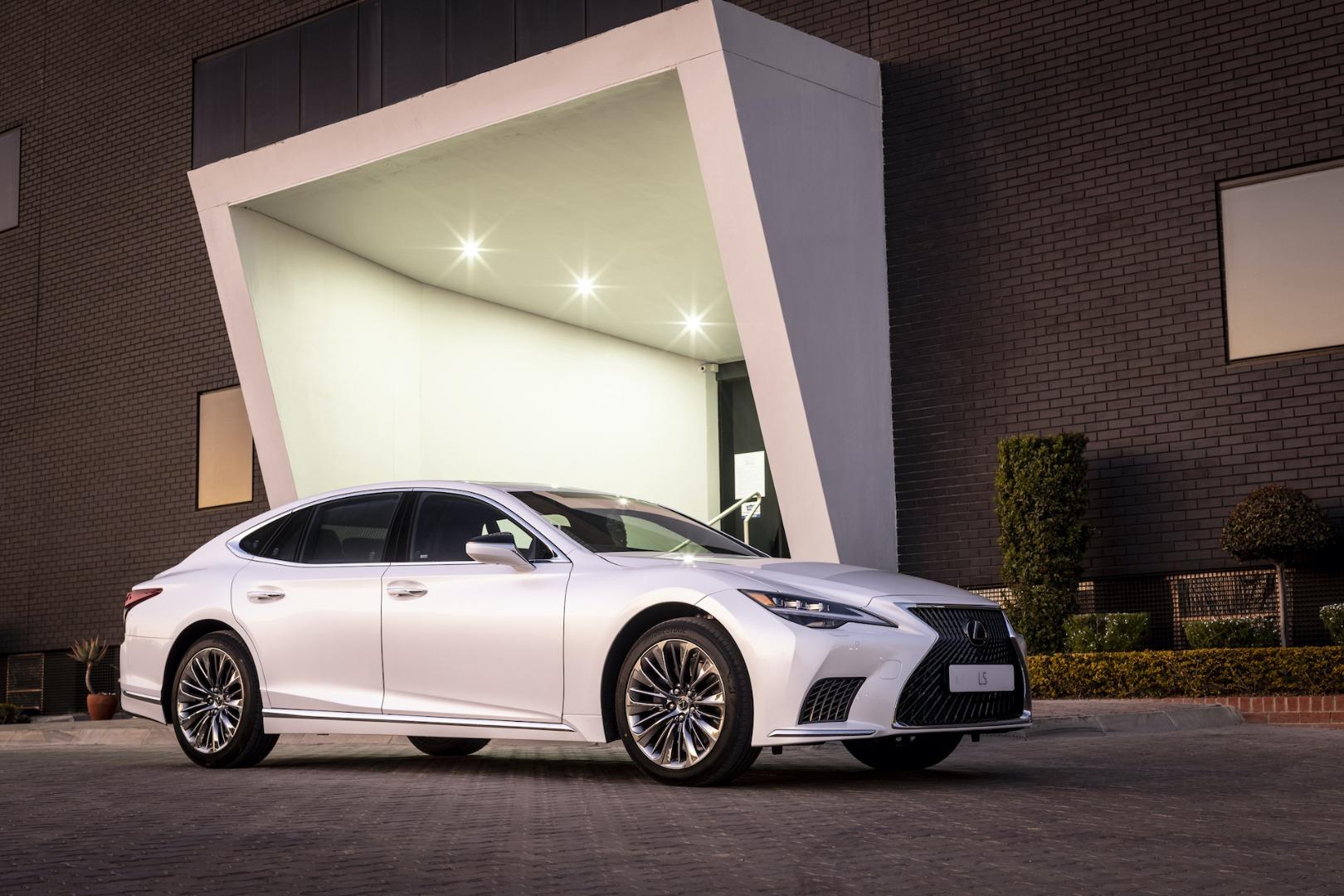
Lexus LS
The range-topping Lexus sedan, and longest-running model name in the company’s portfolio, is certainly practical enough to be an excellent family car. The Lexus LS can carry 480-litres in the boot, and there’s an abundance of stretch-out space in the lavishly-appointed cabin.
This is the Lexus to choose if you want to treat your family to real luxury, because the LS plays in the super-saloon class with considerable conviction. It’s lined in leather from top to bottom, and features standard niceties such as a 23-speaker sound system and heated, electrically-adjusted rear seats; and separate rear-seat entertainment in the top-trim variant.
Related: Find out more about the Lexus LS 500 in this review.

Lexus RC and LC
While they are undeniably stylish and fun to drive, neither of the Lexus coupés nor the convertible cut the mustard as family transport. They’re both pretty cramped in the rear seating area, and buckling-in a toddler in a child seat will need a lot of contortion.
Furthermore, their luggage compartments are pretty useless: The LC500 coupé has only 197-litres of cargo volume (the convertible has even less) , and the RC’s 366-litres is only accessible through a narrow aperture. For these reasons, the Lexus coupés and convertible are discounted as family transport for the remainder of this article.
Related: Top 3 things you need to know about the Lexus RC.

Lexus UX
This is Lexus’s smallest SUV/crossover, so it’s obviously not the absolute best for family duties in its range. However, the elevated seating position and clever packaging yields enough space for 4 average adults in the cabin.
The downside comes in the luggage compartment, where a cargo volume of only 265-litres makes the UX less than ideal for carting around strollers and other kiddie-paraphernalia. Consequently, it is the next Lexus model to fall out of contention in this article.
Related: The Lexus UX is a quiet and agreeable companion, even if it’s not hugely spacious.

Lexus NX
The next Lexus SUV is a fair bit larger than the UX, and is much better-suited to family use. Redesigned for 2022, the new NX has a more-spacious cabin than before, and its luggage volume of 520-litres is likewise a lot more useable than its smaller sibling’s.
Related: Find out more about the first-generation Lexus NX in this video review.

Lexus RX
This is more like it: The latest iteration of Lexus’s best-selling SUV is a family vehicle par excellence. There’s a spacious cabin, with enough room for 5 large adults in base trim (with the RX 350L adding 2 more occasional seats for a total capacity of 7 seats), and a reasonably-useful boot.
In 5-seater format, the Lexus RX can swallow 453-litres, while the 7-seater can handle 432-litres with the rearmost seats folded away. Use all 7 seats, and the RX 350L can only handle 211-litres, though, so you’ll have to decide whether you’d want to transport a large luggage load or as many passengers as possible...
Related: Even with its assertive looks, the Lexus RX is still a very considerate car.

Lexus LX
It’s a behemoth, but its sheer size also means that the Lexus LX offers lots of space for passengers and luggage alike. The LX is a 7-seater as standard, with the rearmost seats being at least useable for average-sized people, but in this configuration, there’s only 259-litres available for cargo.
Much better to drop the third seating row and use it in 5-seater mode, then, because doing so swells the luggage compartment to a generous 701-litres. That’s enough for all your family’s cargo needs, while still offering masses of room for inside as well.
Related: Is the Lexus LX good for new drivers?

Safety
This is the one area where all Lexus perform exceptionally well. They all have 5-star NCAP crash test ratings, and a minimum of 8 airbags across the board (although most models have 10 airbags). Safety features also abound, including the latest available semi-autonomous driving aids, automatic emergency braking, parking sensors and cameras, ISOFIX child seat anchors, and LED headlights.

Comfort and convenience
Seeing as a comprehensive specification sheet is one of Lexus’s key selling points, it is a given that all Lexus models are equipped with everything you could desire as standard. Family-use conveniences include plenty of USB ports, available rear-seat entertainment systems, hands-free access, and powered tailgates, making most Lexus models extremely helpful to a stressed parent.

Verdict
Family users will be more than happy with most of Lexus’s larger vehicles, although the coupé models won’t feature on their shopping lists. Among the brand’s mainstream models, the only one that really won’t be good for families is the compact UX, due to its tiny boot, but the other SUVs and crossovers will all do just fine. And if you want a sedan and still need to be frugal, a Lexus ES is about as perfect as your family and your wallet could desire.


