
Totally Taycan: Porsche’s first all-electric sportscar driven in SA
It’s not every day that you’re invited to drive one of the fastest accelerating production cars on sale in South Africa, which also just so happens to be the only all-electric Porsche within the brand’s current line-up. This was an opportunity to experience what a performance-oriented electric car feels like and whether the imminent electric future can capture some of the magic of the internal combustion engine-powered machines from the very same marque.


But wait, it says ‘Turbo’?
Before I get into the nitty-gritty of what is one of the most fascinating products I’ve ever driven, let’s address the proverbial elephant in the room when it comes to model designations. You see, the Taycan range on sale locally comprises of three models, starting with the Taycan 4S, which as a model makes sense, because it is four-wheel drive, differentiating it from the upcoming rear-wheel, drive base model Taycan.
Then we get to the upper echelons of the range where the Turbo and Turbo S reside. This is where the confusion may set in for some, you see, there isn’t a turbocharger present in any Taycan models, but instead, a battery-electric drivetrain which in four-wheel drive models feature a permanent-magnet synchronous motor on each axle. The use of the Turbo and Turbo S badges represents the pinnacle of the non-GT Porsche line-up, signifying that these offer the best performance within the range, creating uniformity across the Porsche range, which oddly, makes sense to me.
Related: Hybrid vs Electric: Which one is the best choice for you?

Unique electric
The Taycan is unique among electric vehicles because it makes use of 800-volt technology versus the current (pardon the pun) industry norm of 400-volts. The doubling of the operating volts has several benefits which include the ability to save space and weight through less cabling, the reduction of charging times as a result of less current being required to achieve a given power level while also requiring less current pull during performance driving, allowing for cooler operating temperatures.
The model that I was exposed to at the press event, the Turbo S, was fitted with the Battery Plus Package which features 33 cell modules with 12 individual cells in each, making for 396 in total and a capacity of 93.4 kWh. This provides a claimed driving range of between 388 and 412km, according to the WLTP test cycle, equating to 26.9 kWh/100km.
Related: Which electric car has the longest range?

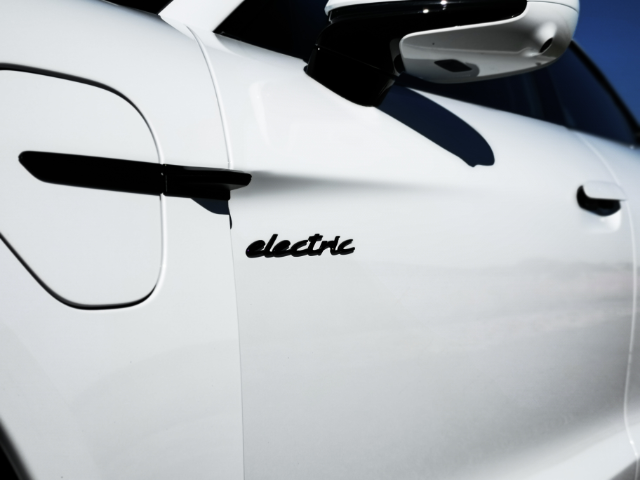
The question though is just how fast can a Taycan charge from nearly empty to full, or near full? Well, the claim is that it can charge at 270 kilowatts if a fast charger is used, which Porsche claims will get the car from below 10% to 80% in around 22 minutes. The car features an AC charging port on both sides of its front end while models fitted with the Performance Battery Plus will be able to charge using DC (direct current) which Porsche claims can provide up to 100km of additional range in just 5 minutes.
At the local press conference, we were presented with the vision for local customer charging habits and planned infrastructure. The brand envisions that between 70-80% of charging will take place at home, using a standard 22kW charger, enabling a full charge in 4.5 hours. The other 20-30% will comprise of 22kW destination and convenience charging while the use of fast 270kW chargers situated along highway routes during extended trips could secure a significant amount of range in under 30 minutes.
Related: How suitable are electric cars to South African conditions?
A new mindset
One gathers that the Taycan, like many electric cars, should be treated as a large and admittedly expensive mobile phone when it comes to the adoption of habitual charging practices. It also provides those with a more eco-conscious approach to performance with a product made in a “Zero Impact Factory”.
There are also fun facts to share with your buddies at the braai when they’re questioning the water, soil and air pollution associated with the mining of lithium carbonate which will make its way into your Taycan’s battery pack, such as the fact that its floor covering is made from ECONYL, a recycled plastic material from old fishing nets.
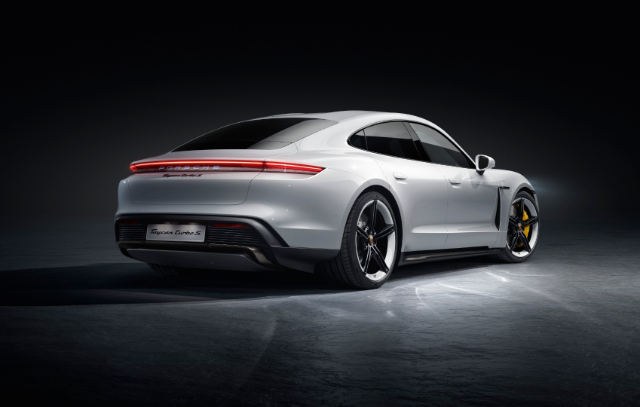
Driving the Taycan Turbo S
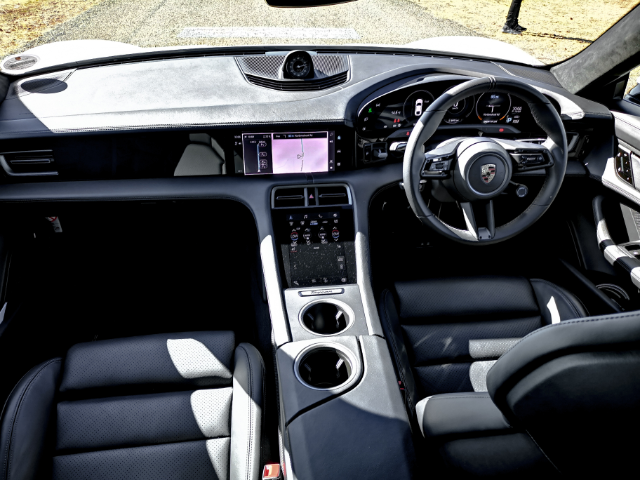
Despite the three-model-strong line-up, the folks at Porsche were wise to provide journalists with generously specified versions of the flagship Turbo S models to drive throughout the press event, which included four journalists per rotation versus the usual twenty or so as we all adhered to strict social distancing protocols.
Since my time with the Taycan was brief, I wasn’t going to try and achieve maximum range, but instead, explore its impressive performance, so I cannot tell you if that range claim is achievable in the real world. I made use of all of the driving modes, including Range mode, which limits you to 110 km/h, which is where I could see the car easily passing 300km on a single charge, however, the temptation to feel the enormous clout of torque proved too much for this writer.
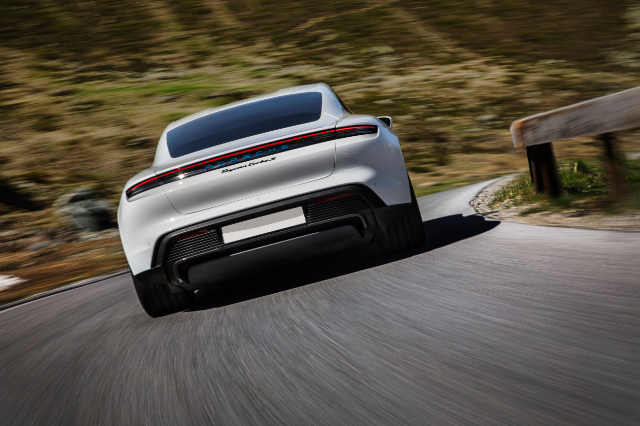
I approached my drive in the Taycan armed with a wealth of experience accumulated from watching a copious number of YouTube video surrounding Porsche’s potent flagship electric car. I as discovered though, there isn’t anything that can prepare you for the savagery that 460 kW and 1050 N.m provides in the way of thrust when you first fully depress the accelerator pedal.
The acceleration is made more manic by an ‘overboost’ function enabled by a bespoke inverter, allowing the car to produce 560 kW and 1050 N.m during acceleration runs using Launch Control. This allows the Taycan Turbo S to sprint to 100 km/h in 2.8 seconds and 200 km/h in 9.8 seconds. To try and express what this feels like is difficult, but to put it into perspective, during the first few meters of acceleration, this car exerts 1.2 g of accelerative forces, more than skydiver experiences during a free-fall.
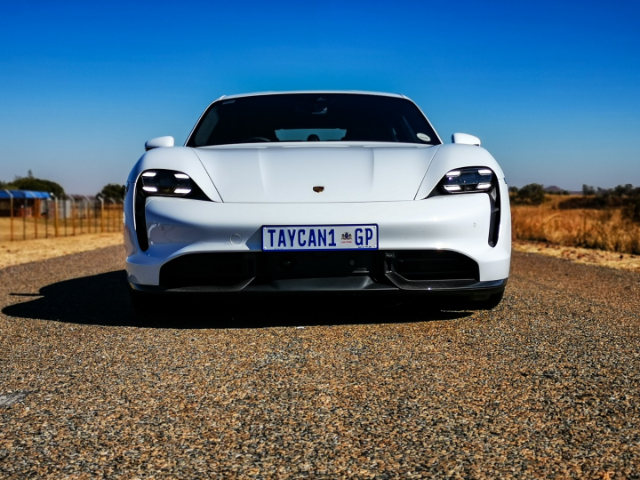
The front-end features a single gear ratio while at the rear there is a two-speed transmission, one which assists with lower speed acceleration while the other assists in high-speed driving, ensuring a top speed of 260 km/h. In the stopping department the Turbo S comes with carbon-ceramic brakes as standard which work in unison with the vehicle’s electric motor energy regeneration programme, ensuring a longer brake lifespan.
The stunning acceleration and almost telepathic overtaking ability of the Turbo S is just one aspect of what the discerning potential performance EV owner is after, what about the ride, the handling, the sound? To address the latter, well, there isn’t much sound unless you’re in Sport Plus mode, which when selected produces the so-called Electric Sport Sound, which is what I’d image George Jetson’s car would sound like if he had a penchant for motorsport.

The handling of the Taycan will surprise anyone who reads that it tips the scales at over 2.3-tons with a driver on board. The surprisingly neutral balance and direct front-end of the Taycan come courtesy of a low centre of gravity thanks to the fact that its battery pack is located under the occupant cell as well as what must have been exhaustive work by engineers during the development process.
My Turbo S test car featured Porsche Active Suspension Management (PASM), a three-chamber air suspension and rear-wheel steering which combine to produce a decidedly sporty drive. Just don’t expect smoky drifts and the sort of power-induced oversteer you may experience in a 911 that shares the same badge, the kilo-newton metre of torque would obliterate the tyres.
When it comes to comfort, the Taycan excels for many of the same reasons, its air suspension, all-electric drivetrain and importantly, its aerodynamic efficiency. For the anoraks like me, the Cd(drag coefficient) value is 0.22 in the Turbo and 0.25 in the Turbo S, meaning that the relative silence, the slippery nature of its body and its supple suspension make it rather relaxing when you’re not utilising its warp drive-like accelerative abilities.
The rest of the range
The more attainable models within the Taycan range are no less impressive, but I’m certain that the Turbo S will still grab the headlines. For the more sensible among us, the Taycan 4S provides more than enough grunt, producing 320 kW and 640 N.m with the Performance Battery or 360 KW and 650 N.m with the Performance Battery Plus, allowing for a 0-100km/h sprint time of 4.0 seconds. With the aforementioned battery pack upgrade, the 4S also provides between 386 and 463km of range on a single charge, but features a maximum of 225 kW of charging power.
The Turbo model produces the same 460 kW as the Turbo S but offers less on the ‘overboost’ front with 500kW and 850 N.m. It will still sprint to 100km/h in just 3.2 seconds and has superior range to the flagship with between 382 and 450km available on a single charge.
Verdict
The Taycan is a phenomenal engineering exercise, but then again, at over R4.0-million for the flagship model sans options, it had better be. The order books are open, with the first customer cars expected to be delivered locally during the fourth quarter.
The electrified future isn’t all doom and gloom, it’s just different, in fact, as a road car and a daily driving proposition, the electric car is a wonderful solution not only for inner-city pollution but also for the driver, who can enjoy effortless personal mobility. With brands like Porsche committing to the internal combustion engine for special cars such as the 911 GT3s of the world and with exciting electric cars a reality, we can now have our cake and eat it, if we have the financial means to do so of course.
Pricing
| Porsche Taycan 4S | R2 562 980 |
| Porsche Taycan Turbo | R3 401 980 |
| Porsche Taycan Turbo S | R4 002 980 |
Recommended next:
Which Porsche 911 is better: one with a turbo, or one without?
Porsche Cayenne Coupé (2020) Review
The Porsche 911 Targa 4S Heritage Design - Steeped in History