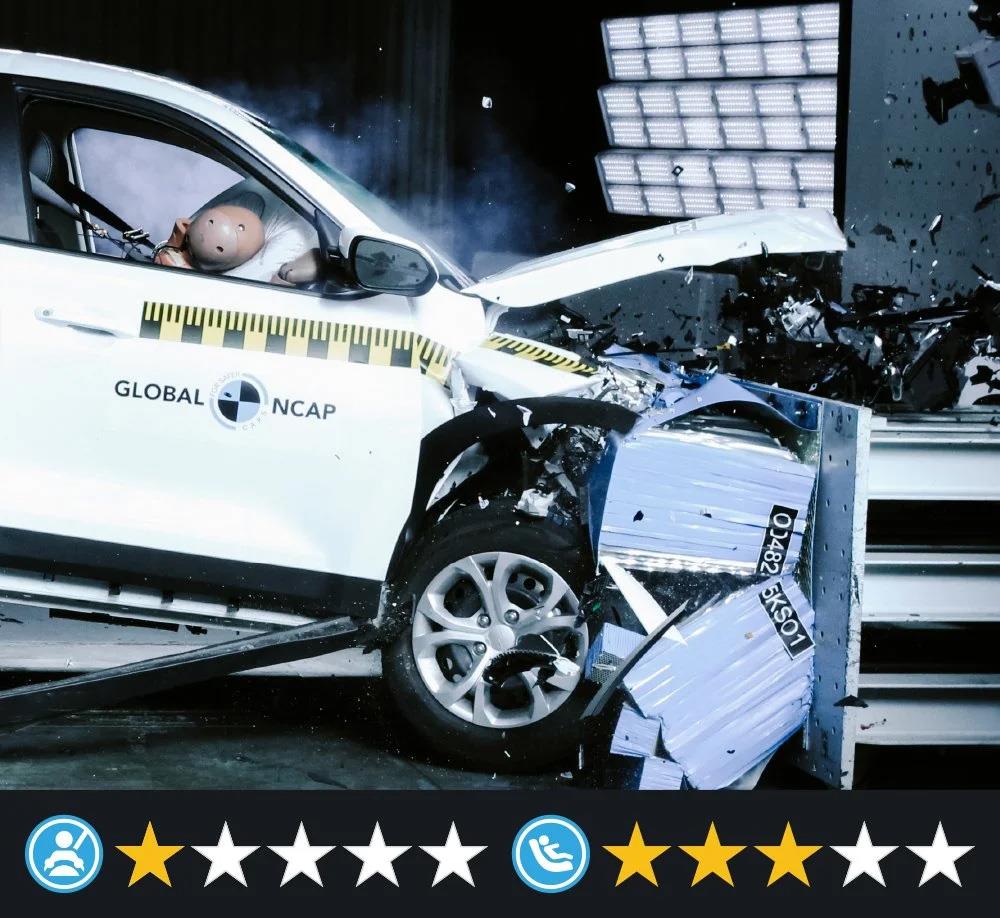
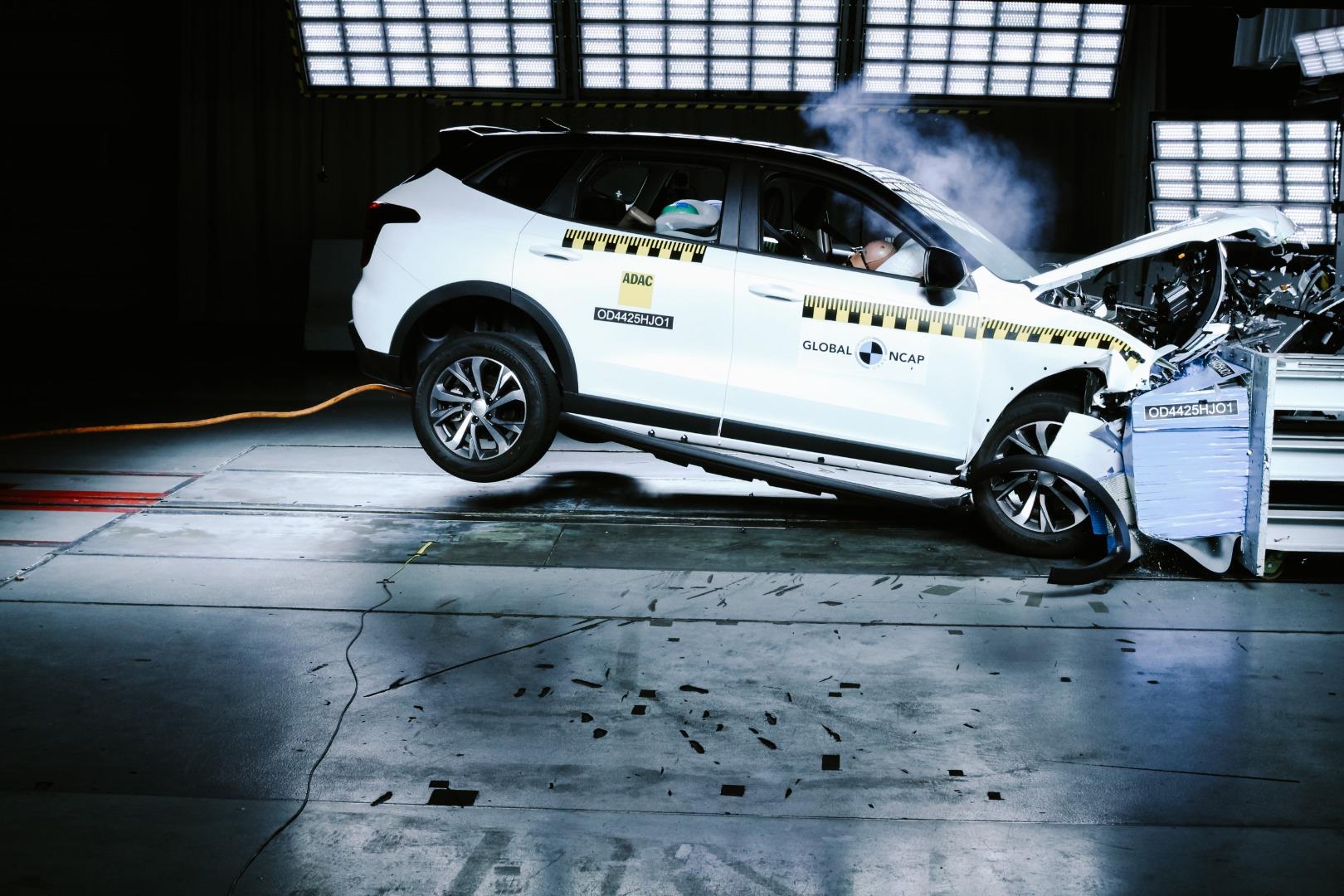
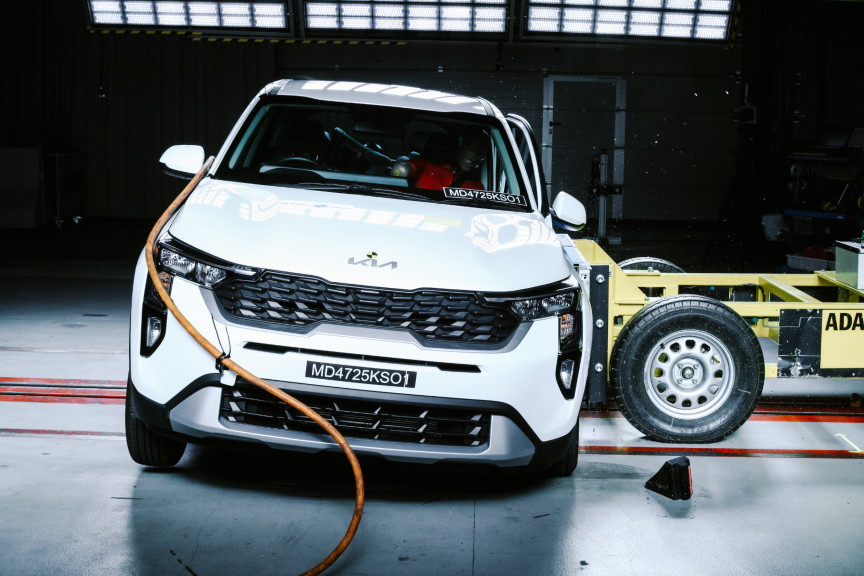
The current-generation Kia Sonet and Haval Jolion were recently safety tested as part of the AA South Africa (Automobile Association) #SaferCarsForAfrica campaign. Recent crash tests by the institution have revealed a trend in the safety of entry-level vehicles in this price bracket.
Related: Hyundai responds to Grand i10 zero-star safety shock
#SaferCarsForAfrica is a campaign launched in 2017 by Global NCAP (New Car Assessment Programme), in collaboration with the AA, aimed at promoting safer vehicles across the African continent. This campaign is supported by the FIA Foundation and Bloomberg Philanthropies.
To test these vehicles, the programme purchases two versions of each car anonymously for crash testing, then sends them to Germany for assessment. The vehicles are then subjected to a series of tests done by Global NCAP.

Kia Sonet: Score and Assessment
Adult: ★
Child: ★★★
The Kia Sonet is fitted with ESC as standard, but the variant tested just had two airbags and showed structural concerns. The footwell area and bodyshell were found to be unstable and unable to withstand further loading. In the side-impact test, the poor chest protection limited the rating to one star, but the abdominal protection was sufficient. Because side head protection airbags aren't fitted as standard, the pole impact test wasn't conducted. Regarding Child Occupant Protection, the dummies received full protection, but the omission of 3-point seatbelts in all seating positions, the lack of a Passenger Airbag disabler switch, and a low Child Restraint System resulted in three stars for Child Protection.
You can read the full assessment here.

Haval Jolion: Score and Assessment
Adult: ★★
Child: ★★★
The Jolion has ESC fitted as standard. Frontal impact tests showed that the Jolion provided good protection for the head, neck, and chest, but knee protection was marginal. It also offered good protection in the side, movable barrier test. Again, the side pole test wasn't conducted as the model tested didn't come with side airbags as standard. For Child Occupant Protection, the dummies were fully protected in the dynamic test, though the lack of adequate markings and a Passenger Airbag Disabler switch resulted in only a 3-star rating.
You can read the full assessment here.

AutoTrader was given the opportunity to discuss the results with AA South Africa CEO Bobby Ramagwede, to delve deeper into the emerging trend of low-star ratings for budget vehicles.
Do you regard this as a surprising result for both vehicles?
The jaded me would say no. But it is surprising again, because I'm looking at it through the lens of a consumer who assumes the car they're buying is safe, only to discover it has such a material failing. Let's start with the Kia Sonet, for instance.
This continuous failure of the footwell is indicative of a real structural issue that seems to be consistent across many entry-level vehicles, particularly those assembled or manufactured in India or China, this is what the data is showing. So it doesn't matter how many airbags we throw at that car, that failure point will continue to fail. You could litter that car with 8 airbags. It would still fail at that point.
[Regarding the Haval Jolion] Having decent ESC is probably the second most influential safety factor to a vehicle, second to the seatbelt, so kudos to Haval for having a good ESC system.
We're also happy that it's got a decent amount of airbags, but again, for you to score 2 stars, where 3 stars is our threshold bare minimum for safety, keeping in mind that when we say 3 stars, we're looking at all the passive safety features. Once you start graduating beyond 3 stars, you're looking at active features, and I'm less interested in that. I want to know that if you're in an accident, particularly a side impact accident, which is a growing type of accident in numbers, you will either come out alive or your injuries will be minor. At this rate, the cars that we've been testing of late, these two cars as well, if you were to end up in that accident, there's a very good chance that you would not come out in a particularly good state.

Are there no differences in the safety packs for the Indian market vehicles versus the South African market ones? Is it all the same across the board?
The Indian market has done well in raising consumer awareness to the extent that the consumer there has outright refused to buy vehicles with fewer than 4 airbags.
What this programme is highlighting is that territories like Australia, New Zealand, Europe, are getting the uprated version of the vehicle, whilst territories like India and South Africa are sort of leaning on the minimum legislation standard as the safety standard, and those two, more often than not, should not be viewed as the same thing. One is a legality, and the other is a moral issue.
Two airbags stopped being enough for Europe many, many years ago. I don't understand why it's enough for South Africa, but that said, the same manufacturers who manufacture 6, 8, 10 airbag vehicles are manufacturing 2 airbag vehicles for South Africa and manufacturing higher numbers of airbags for the same vehicle in other territories.

Regarding safety features, who — at least in AA's eyes — should ultimately bear the cost for safety? And should the government raise the standard safety policy?
First prize is for government to raise the policy, then you'll never see a vehicle with a two-star rating land on South African roads in the absence of government doing the right thing."
The next most responsible character is the manufacturer. I'm often quoted saying, cut the sunroofs and put the safety features in. Stop offering sunroofs. A sunroof can cost anything between R10 000 and R17 000 depending on which model it's being installed into."
That same R17,000 can go towards ensuring that safety features are standardised across all of their models. OEs are very quick to argue economies of scale and cost sensitivity. Well, if you have a single cookie cutter and you're manufacturing the same car everywhere — with the exception of left and right-hand drive — it becomes cheaper as the volume increases. So just expand on the Australia–New Zealand line and ship those vehicles into South Africa as opposed to creating distinct products for two different markets whose differentiator is safety.
Are any other initiatives being put in place to educate road users, including pedestrians?
Let's start by touching on this. So you get advanced driving, which is generally provided by your larger-end OEMs in the form of high-performance driving. So we're entering that space right now to create more defensive and reality-based driving as a course, ahead of advanced driving, and this comes off the back of the fact that K53 does not prepare you to drive. It teaches you how to operate a vehicle but not how to drive in real traffic settings.
I often say to people, unless you can drive the four cars around you, you can't drive, and that's what we're trying to solve for. So that's one tip with regards to addressing driver behaviour.
You're spot on about infrastructure. We have an ongoing lobbying campaign to the state to address the state of roads and the appropriateness of road design, to create distinct segregation between motorists and the most vulnerable pedestrians. If you look at the number of road accidents that we have, the vast majority of them involve a pedestrian. So if I could get the pedestrians off the road, It will probably trim down the number of road accidents to a large extent.
The next is to trim down the risk factors that cause these accidents. Dodging a pothole has become a very common cause for an accident, and this is where we actively engage the Department of Transport and Public Works to accelerate not just the patching of potholes — because that's treating the symptom — but the actual rollout of the transformation of how roads are built in South Africa. We still build roads for the 1990s. The average car is 20% heavier than what it was in the 1990s. We have more trucks on the roads, more trucks entering suburbia. Not too long ago, I saw a Checkers truck hauling two trailers, and I thought to myself, but this road wasn't designed for you.
...In fact, we take it one step further. We go as far as looking at the holistic transport ecosystem and dabble in spaces that we're traditionally not known for. I'm the first to say bring rail back. In fact, bring freight rail back, and after you bring freight rail back and remove the trucks from the roads, bring passenger rail back to decongest the roads and give people options and modality of transportation.
It would sound counterintuitive for the Automobile Association to say get the cars off the road, but I would prefer a more balanced number of vehicles on the roads. There's a place for the motor car, there's a place for the minibus taxi, and there's a place for the train. Until we have a complete ecosystem, we're going to continue to see situations where other factors like condition of the road and driver behaviour play a really big role in road fatalities, injuries and accidents.
The #SaferCarsForAfrica programme has been running for 10 years. In that time, they have tested more than 34 cars, and only one car, the Mahindra XUV3XO, has scored 5 stars the Mahindra XUV3XO. An Indian-built SUV that breaks the narrative that Indian-built cars are unsafe. Looking at the ratings for African-market vehicles, there is a direct correlation between the number of airbags, standard baseline safety features, and safety rating. The AA advises that new car buyers should check the number of airbags and the vehicle's safety rating. Take that all into consideration before making a final decision.