First Drive: Hyundai Palisade (2021) SUV - Large and in charge
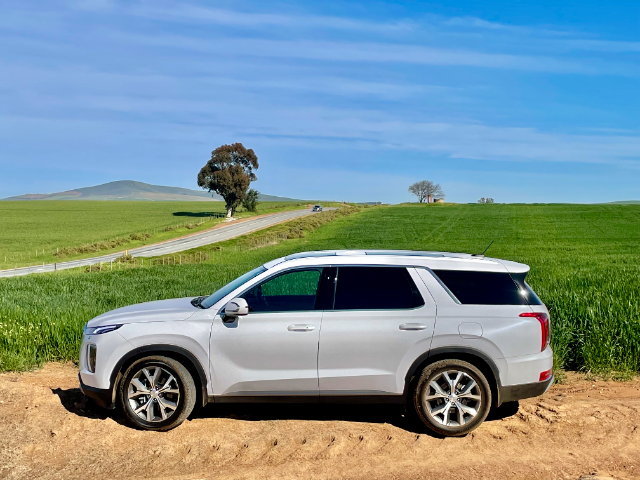
Hyundai's largest, most luxurious SUV, the Palisade, has landed in South Africa. Sporting three rows of seats, some good old-fashioned American styling, and an astounding array of standard features, this mammoth SUV has already captured the imagination of those who are serious about glamorous road-trips and prep-school carpooling. We got behind the wheel (and into the back seats) of the new Palisade for a quick trip from Cape Town to Worcester.


What is it?
The Palisade was introduced at the 2018 Los Angeles Auto Show and competes in overseas markets with big-brand SUVs such as the Kia Telluride (with whom it shares a platform), Honda Pilot, Toyota Highlander, and Ford Explorer. It's slightly bigger than the recently refreshed Hyundai Santa Fe and more lavishly appointed. You can choose between a seven- and an eight-seater, depending on the size of your family. It's the closest in size to a Toyota Land Cruiser 300 (one of its many, more-expensive natural competitors) and also goes up against the Volvo XC90, Audi Q7, BMW X5, VW Caravelle and Touareg as well as the Mercedes-Benz GLE and Land Rover Defender.

That's a premium line-up! How does it fare in terms of space and comfort features?
The Palisade is big on specifications, and much like Lexus, everything is thrown in at no extra cost, which is more than you can say about the German and British brands. To fully experience our 8-seater Palisade's spacious, comfortable cabin, we were four to a car on our test route to Bosjes Wine Estate. A colleague and I stretched out in the middle row which boasts heated seats, and Hyundai's claim of having class-leading legroom in the second row of the Palisade seems pretty legit.

The seats also slide and recline should more space be required. The front seat-backs also have one USB outlet each, bringing the total to seven on board, with another two up front and two right at the back for the third row. Now this is something one could get used to!
Speaking of the third row, it's surprisingly un-cramped. But most surprising of all is the amount of boot space when all seats are upright. Other cabin highlights include climate control and diffusion type air-conditioning vents in the 'ceiling' that are quieter, and don't blow at you at full force unless you want them to. The double sunroof is another lovely extra that doesn't cost money.

The Palisade also features rear-door window blinds, one-touch access buttons to the rear, a 12-way power seat for the driver, and an 8-way power seat for the front passenger. Should you opt for a seven-seater, the second row gets two captain seats that are ventilated and heated.

As for the dashboard layout, it's quite different from what we see every day (in a good way), but reminds me of what's on offer in the Volkswagen and Land Rover families, or rather a combination of the two. I do love the shift-by-wire transmission (an 8-speed auto) with its three buttons for Drive, Neutral and Reverse on a faux brushed aluminium background; it not only saves space but contributes to the clean and uncluttered, contemporary look. You press the button of choice and off you go.
The Palisade also offers wireless smartphone mirroring on a giant touchscreen for Apple CarPlay or Android Auto functionality, and there's a wireless charging pad as well. None of this is usually a free option in the other brands.

What's it like to drive the Palisade?
We were about 60 km away from the lunch venue when I finally had my chance to hop in behind the wheel. The Palisade is all-wheel-drive but will send power to wherever its needed the most, thanks to Hyundai's Drive and Terrain modes with settings for snow, mud, and sand, as well as the more everyday Sport, Eco, Comfort or Smart (the latter adapts to your unique driving style) that is selected via the rotary dial atop the centre tunnel. When you turn the dial, the image thereof is displayed in the TFT screen between the speedo- and odometer.

The Palisade has no low-range transfer case, so you're never going to have Land-Cruiser-like off-road abilities, but it's not like the Palisade is ever going to see the rough stuff anyway. We encountered a couple of gravel sections along our route and the Palisade's suspension soaked up the corrugations well, but higher-profile tyres would probably ride a bit better.

Back on the highway I switched to Sport mode as the steering felt a bit over-assisted in Comfort mode. It tightened it somewhat, and throttle response became slightly more zealous, but not by much. Sport mode also sends half of the torque to the rear wheels "for greater agility", says Hyundai. Smart mode is aimed at saving fuel and therefore the power is sent mainly to the front. After the previous driver had gunned it, our average fuel consumption also went up from around 8 litres per 100 km to 10.

The 2.2-litre CRDI turbodiesel with 142kW and 440Nm does a fine enough job of propelling the large behemoth into the future, but acceleration is more Stegosaurus than Tyrannosaurus Rex. As I keep saying, the Palisade is a cruiser, not a bruiser. And even when you're in a rush, the cabin is so quiet that it feels like you're going 90 km/h on the highway. If you need to get away from it all, a drive in a Palisade may just do the trick.

Hyundai also used more high-strength, hot-stamped steel on the bigger Palisade than the Santa Fe to keep body-roll to a minimum, and it's evident when you're pushing on and navigating bends. I would have liked to spend more time behind the wheel of the Palisade than I did in the second row, but there are only so many hours in a launch, and it's not often that one gets a chance to enjoy what's on offer in the rest of the vehicle as well.

What about safety features?
It goes without saying that a car like the Palisade has a five-star safety rating from the authorities. Apart from the usual bells and whistles (and seven airbags), safety equipment on the Palisade includes blind spot detection, rear-cross traffic alert and rear occupant alert. The latter prevents the driver from forgetting a child or pet in the car, or will alert parents if a child has locked themselves in the car by mistake. The Palisade also features a Safe Exit Assist system that prevents passengers from opening car doors when there's oncoming traffic.
Pricing and Verdict
While the Hyundai Palisade may not have a talent for rock-crawling, track-racing, or towing super-yachts to the harbour, it's much, much more affordable than its competitors and offers much more in terms of standard tech and spec, but not so much on the semi-autonomous side of things, however. Both the seven- and eight-seater Palisade models retail for R999 900. Then there's also the top-spec Kia Grand Sedona 2.2 CRDi SXL for R930 995, but it's not quite as outdoorsy.
I think I may have found a new favourite...