Could trucks be replaced by drones?
Anyone who lives or works in Sandton will tell you this: on a typical day, peak-hour traffic is a nightmare. The roads turn into slowly moving parking lots. Imagine if all the delivery vehicles were removed from that nightmare traffic – and goods were delivered by drone instead? This is not some fanciful futuristic notion; a so-called “heavy-lift drone” has already made its debut flight.


City centres are no-go zones
While the pandemic has changed traffic patterns markedly, typical city centres all over the world are known for one thing: congestion. And this is only going to get worse. This is thanks to the fact that people are moving from rural to urban areas.
According to the World Economic Forum, 56.2% of the global population now lives in cities – versus 30% in 1950. As a result, megacities (cities with a population of over ten million people) have popped up everywhere. According to the United Nations, the world now has 28 megacities – versus two in 1950. This trend shows no signs of abating; in fact, authorities on the matter believe that two-thirds of the world’s population will live in cities in the next 15 to 30 years.
All those people require food, healthcare and other consumables – and those goods need to reach them somehow.
Changing times

Until now, those goods have reached city dwellers in a bakkie, van or truck (and, to a lesser degree, in a train). That won’t be a viable solution in future – because of the challenges related to congestion. Naturally, emissions are a concern too – however many delivery vehicles will go the electric route.
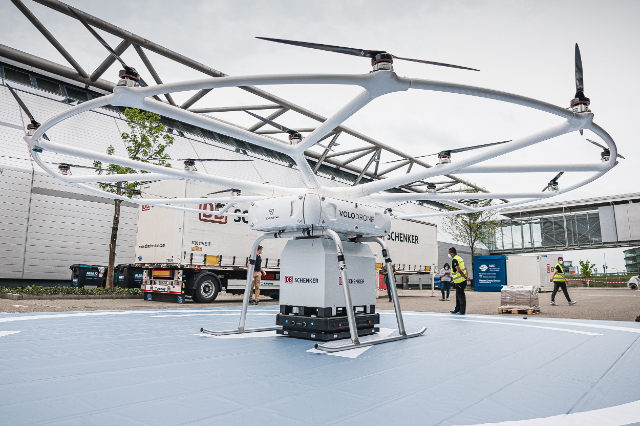
But imagine if, instead of using roads, the delivery vehicle could fly through the sky? This has already happened in Hamburg, Germany. This month, the ITS World Congress 2021 took place in that city (fondly referred to as the Venice of Germany) and the star of the show was Volocopter’s electric heavy-lift drone – the VoloDrone – which conducted its first public flight.

Together with its partner and investor, DB Schenker, Volocopter – a pioneer when it comes to urban air mobility (UAM) – demonstrated the VoloDrone’s seamless integration into the logistics supply chain with an end-to-end cargo transport demonstration.
The three-minute test flight took off at 3:02 pm at homePORT Hamburg and reached a maximum altitude of 22 meters. The electric heavy-lift utility drone was equipped with a loadbox in between its landing gear. First, the demonstration teams secured a Euro-pallet sized load to the box under the VoloDrone. Then the drone brought the box to a DB Schenker fully electric Cargo Bike and landed safely. Once the payload had been transferred successfully, the Cargo Bike delivered its cargo to the final destination, marking the completion of the entirely electric, multimodal last-mile delivery.
Meet the VoloDrone

The star of this demonstration – the VoloDrone – is an uber-cool invention. The drone itself is 9.15 metres in diameter, 2.15 metres high, and it has a 600-kilogram maximum take-off weight (MTOW). It can carry a payload of up to 200 kg. The drone has a range of up to 40 kilometres and it is 100% electrically powered – meaning it’s totally emission-free. It can be piloted remotely or flown in automated mode on pre-set routes.

While the benefits of using the VoloDrone for last-mile deliveries in megacities are obvious, this is not its only intended application. Volocopter believes that its drone will be ideal for serving challenging missions across industries ranging from agriculture, logistics, and infrastructure to public services, offering time and cost advantages compared to existing solutions. It can, for instance, be used to transport heavy packages to remote locations, protect crops in agriculture, lift voluminous parts on buildings on construction sites … and it can be used in any other application where ground transportation is challenged by difficult accessibility.
Innovative take-off and landing platform
DB Schenker isn’t Volocopter’s only partner in this venture. It is also working with Austrian vehicle manufacturer Schwarzmüller, which has come up with the Mobile Vertipad, a trailer that converts into a mobile take-off and landing platform for the VoloDrone.
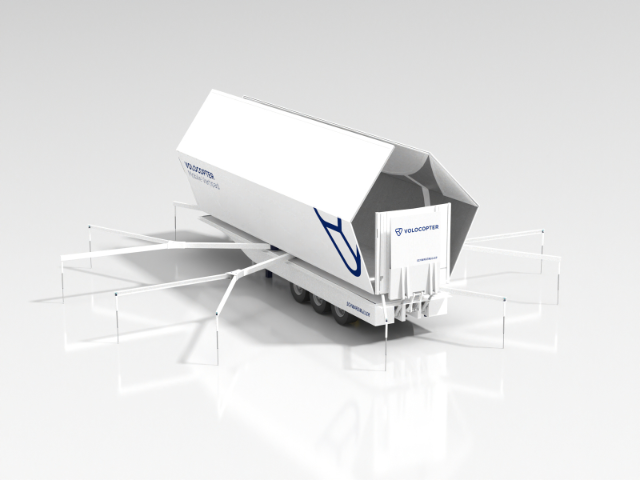
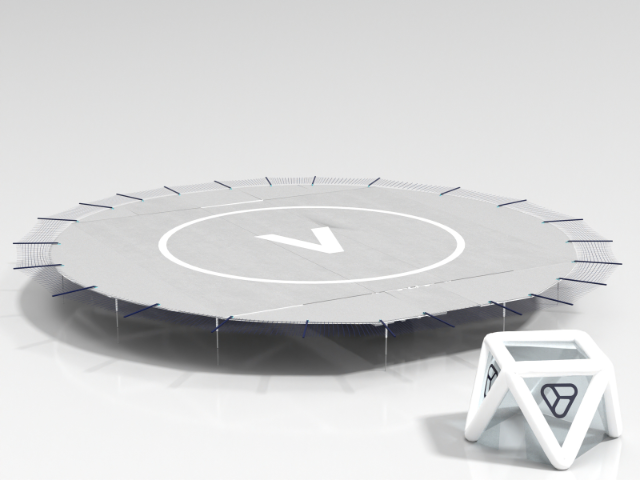
The Mobile Vertipad has the normal dimensions of a typical conventional long-haul trailer: it is 12 metres long, 2.4 metres wide, and 3.9 metres high. A loading container is built on top of the chassis to hold the VoloDrone. At the push of a button, the trailer can unfold into a platform and turn into a launchpad and loading ramp. This is a two-step process. First, a substructure made of metal profiles extends from the chassis. Then, the container unfolds its walls using the origami principle, creating a circular platform 20 metres in diameter. It is dismantled as quickly as it is constructed and can be moved to any location by truck tractor.
Testing of the Mobile Vertipad – which also made its debut at the ITS World Congress 2021 in Hamburg – will commence in early 2023.
Next stop South Africa?

So, there you have it: a futuristic drone for last-mile deliveries and an even more futuristic launchpad. Next stop South Africa? We don’t see why not. The country’s highways – the N3 and N1 in particular – will continue to be populated by trucks. But don’t be surprised to see a drone deliver your online shopping in the not-too-distant future.