
Why the Jeep Renegade could be a used-car bargain
Seeing as most mainstream manufacturers offer a compact SUV/crossover these days, it’s clear that buyers have never before had such a wide selection of possible purchases. This leads to slow-ish new sales volumes for the baby Jeep, and also depresses this range’s resale values. We crunched the numbers to demonstrate why a Renegade could offer great used-car values – provided you remember a few basic rules.



The Jeep Renegade arrived on local shores in 2015, bringing Jeep’s familiar styling cues with cute detailing to the compact SUV segment, and notching up steady but comparatively low sales figures since then. It received some small styling and trimming changes, along with new infotainment in 2019.
How much did this update affect the resale values on the small Jeep? We decided to have a look at this range’s initial value retention to find out, and stumbled upon some unexpectedly good news for bargain hunters.
Related: Get all the details on the updated Jeep Renegade Longitude (2020) in this review.

Checking out the listing pages here on AutoTrader, we narrowed-down our selection to 2015 model year Renegades with less than 100 000 km on the clock (representing the industry average yearly mileage’s upper limits), and compared their averaged current (used) market values to what they cost new. Value retention is expressed as a percentage of the new price, and the lowest percentage will correspond to the fastest depreciation.
All bar one of the 2015 Renegades were in 1.4T Limited manual trim, with the exception being a single, otherwise-identical Limited automatic. As a result of this small sample size, the only one over which we can really cast a verdict is the Limited manual, but that’s fine – it’s the one you really want, anyway.
Related: Click here for more details about the Jeep Renegade’s initial range expansion.

2015 Jeep Renegade 1.4T Limited manual
New Price: R 375 990
Current Market value: R 208 164
Value retained: 55.4%
Lots of stuff for not a lot of money
“Limited” trim was the only Renegade derivative available at launch, but the range has since been expanded to encompass (ha!) automatic variants, along with two trim levels below it in the range hierarchy and one above. It’s pretty well-specced even in today’s terms, with niceties like a partially-digital instrument cluster, colour touchscreen infotainment system with navigation, available rear-view camera, dual-zone climate control, lane departure warning, blind spot monitoring, and cruise control included as standard right from the beginning.
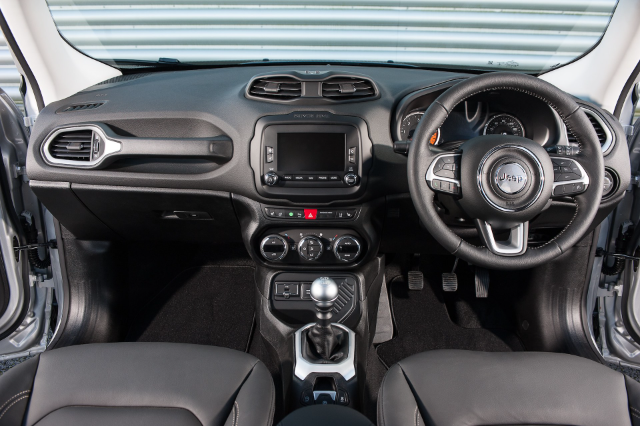
Power was (and mostly still is, at the time of writing) supplied by a 1.4-litre turbopetrol, featuring variable valve lift and timing. Fiat, who developed and builds the engine, calls it the 1.4T MultiAir, and it’s been employed across models as diverse as the Alfa Romeo MiTo, Fiat (Grande) Punto Evo, and Fiat 500X.
In the Renegade, it produces 103 kW and 230 Nm, feed to the front wheels through a 6-speed manual gearbox. The 2.4-litre petrol (with a 9-speed automatic gearbox) and dual-clutch automatic for the 1.4T followed later. It’s all still nice and contemporary, then – provided you follow the golden rule: stick to the manual gearbox for the best ownership experience.
Related: We compared Jeep Renegade engines, and the efficiency crown goes to...

Why the manual?
As mentioned earlier, the 1.4T could (and still can) also be ordered with a 6-speed dual-clutch gearbox (DCT). Generally speaking, these transmissions work great when they’re new, but frequent pullaways (such as it would experience in city-bound driving) could have a dramatic influence on their durability. As a result, DCTs often don’t age very well.
By the time a Renegade 1.4T automatic has depreciated to the price of a small hatchback, it’s at the age where the chances are that the expensive clutch packs or the mechatronics unit could need attention soon. Unless you can find one (at a reasonable price) that’s already had the transmission repaired, that is – in that case, go right ahead!
The other automatic option is fitted to the 2.4-litre 4x4 Trailhawk, and it’s the widely-used but largely unloved ZF 9-speed unit (also seen in the current Jeep Cherokee and Compass, and some Jaguar Land Rover products). We haven’t sampled its latest iteration (as used in the Trailhawk) yet, but prior experience with this transmission has shown us that it will likely deliver hunting downshifts and a restless shuffling up and down its many ratios in normal driving. See why manual is the way to go?
Related: Everything you need to know about the early Jeep Renegade.

Any other potential issues?
As with any man-made object, there’s potential for failure at some links in the mechanical chain, which is why it’s recommended that buyers (especially of out-of-plan cars) invest in mechanical breakdown insurance. In most cases, this can be financed with the car’s purchase transaction, so it only adds a little to the monthly instalments.
In the case of a manual-gearbox Jeep Renegade, there are two main (possible) mechanical risks. The first involves the MultiAir system, which may present operational difficulties as it ages. It’s relatively easily repairable by a competent mechanic, but it won’t be cheap – unless you’re equipped, experienced and prepared to do it yourself.
The second risk involves the turbocharger, which may also be approaching the end of its design life. Repairing this could set you back from R 8 000 upwards (although it will likely be closer to at least R 15 000) – hence the need for the mechanical breakdown insurance, just to stay safe.
Related: What is covered by the Jeep Renegade’s new-car warranty?

The value proposition
The average current value of a 2015 Jeep Renegade Limited manual is R 208 164, which is about what you’d pay for an entry-level small hatchback nowadays. That’s a lot of car for rather little money. An old Jeep Renegade is very nicely equipped and adequately powerful, even by modern standards. And, on top of that, they’re dirt cheap now, especially as their 6-year/100 000 km maintenance plans come to an end.
Looking at newer Limiteds show similar value propositions to 2015-edition cars, with 2016 model year Renegades still retaining 66% of their new-car value, and 2018 examples also hovering around 67% value retention – likely still with some maintenance plan left. The take-away here is that the Jeep Renegade tends to lose about a third of its value over the first 3 years, and then remains stable until moment its service plan expires at 6 years or 100 000 km.
Related: The Jeep Renegade has some Italian siblings - here are the top 3 things you need to know about the cute Fiat 500X here.

Verdict
This opens two options for buyers interested in a used Renegade. The first one is to buy a new-ish used one with either gearbox at a bargain price and drive it for two years, before (hopefully) selling it on with some maintenance plan left for roughly what it cost you. Alternatively, they could screw their eyes closed, buy a cheap-cheap manual used Renegade alongside some mechanical breakdown insurance, and enjoy it for as long as you want. Either way, it’s a win.
*Pricing was accurate at the time of writing, but may change without prior notice.
Recommended Next:
Shop for new and used Jeep Renegade cars for sale here.