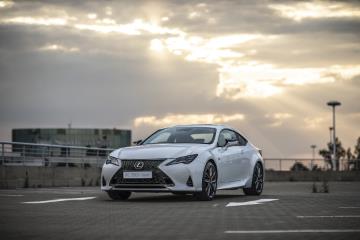
Lexus RC 350 vs Audi S5 vs Mercedes-Benz C300 Coupé: here's our winner!
With distinctive styling and roaring naturally-aspirated engines, the Lexus RC range presents a unique proposition for mid-sized coupé buyers. In fact, it’s one of the few survivors of its genre, and serves as a (relatively) attainable halo car in its range. But how well does it compare to its opponents? We pitched the Lexus RC against the Audi S5 and Mercedes-Benz C300 coupé to pick our winner.



Ignored heros
In a motoring landscape where even SUVs and fastback four-door saloons can have the “coupé” label slipped into its name, genuine coupés – the type with two doors – are becoming few and far between. This situation is even more apparent here in South Africa, where the 2-door coupé body style hasn’t been popular for decades anyway.
Keeping this fact in mind makes one all the more grateful that our market still receives some of the few remaining new coupés from around the world. These offerings are, almost without exception, lovely both to drive and to behold, and they deserve more attention in the marketplace than they’re presently receiving.

Using the Lexus RC as a reference point, we selected two other premium-brand coupés with roughly similar pricetags (about R 1-million at the time of writing) but wildly divergent attributes. We tried to keep the price spread as tight as possible, which eliminated the BMW M440i xDrive and Mercedes-AMG C43 coupé as possible opponents, on account of the cheapest of them being at least R 185 000 dearer than the Lexus. In contrast, the Audi S5 coupé, which did make the cut, is only R 42 500 more expensive than the Lexus RC 350 in F Sport trim.
To complete our trio, we selected the Mercedes-Benz C300 coupé as the third contender, even though it’s due for replacement soon and really competes slightly downmarket from the Lexus. It’s almost the default alternative around this price point, really, with the whole market sub-segment to itself.

Both BMW’s and Audi’s 4-cylinder petrol coupés have significantly lower outputs and cost a lot less, so they fight in a different class (going up against the C200 coupé instead). And, thanks to turbo-charged torque, the Mercedes C300’s real-world performance won’t be that far off the Lexus’s, especially at Gauteng altitudes. In fact, it may even be quicker...
Related: We reviewed the Audi A5 2.0 TFSI quattro and came away impressed with its good manners.
Let’s see how they compare
Engine, performance and consumption
This is the “entry level” in the RC range, with the smallest engine in its current line-up. It’s still a pretty big engine by modern standards, mind you, and has easily the largest displacement in this comparison. There’s a 3.5-litre, naturally-aspirated V6 up front, sending 232 kW and 380 Nm to the rear wheels through an 8-speed torque converter automatic gearbox. The Lexus’s engine is a howler, mind you – peak torque only arrives at 4 800 r/min, and the power curve doesn’t drop before 6 600 r/min.

Good thing that this V6 sounds so good, though, because it’s not quite as quick as you may imagine. Sprinting from 0 – 100 km/h in a claimed 6.3 seconds and with top speed of 230 km/h, the base Lexus RC clearly demonstrates that it doesn’t really want to act like a sports car. It’s also the thirstiest car here, with a claimed (and optimistic) average consumption of 9.1 ℓ/100 km.
Apart from the fact that it also employs a V6 engine and an 8-speed automatic, almost every aspect of the Audi’s drivetrain is the polar opposite to that of the Lexus (and, for that matter, that of the Mercedes). There’s a smaller (3.0-litre) V6 under the bonnet, and it relies on turbo boost to produce its superior outputs of 260 kW and 500 Nm – by far the highest numbers in this trio. It’s also claimed to be marginally more frugal than the Lexus, with an official (and again, unlikely) average consumption of 8.8 ℓ/100 km.

This plentiful supply of ponies is guided to the tarmac via a ZF 8-speed automatic gearbox and Audi’s quattro AWD system, making the Audi S5 our performance champion in this group, and by a large margin. It dashes to 100 km/h in only 4.7 seconds, and its top speed is governed at 250 km/h.
Disrespect the Mercedes-Benz’s combination of a turbo 2.0-litre 4-cylinder, 9-speed automatic and RWD at your own peril, though, because it packs a mean punch for its size. With the aid of 48V mild-hybrid technology, quoted system outputs of 200 kW and 370 Nm means that the slimmer ‘Benz C300 has almost exactly the same power-to-weight ratio as the thick-set Lexus(131 kW/ton vs 133 kW/ton). All this, and it’s the most frugal car here as well: the C300 is claimed to need only 6.7 ℓ/100 km on average, which makes it today’s efficiency leader.

The end result is that the high-tech C300 gets to 100 km/h a bit quicker than the bellowing RC350 F-Sport, while its slippery aerodynamics helps it on to an Audi-matching top speed of 250 km/h. This earns the Mercedes-Benz an undisputed second place in the performance department – comfortably ahead of the Lexus but lagging behind the Audi.
Related: Which Mercedes-Benz C-Class is better, petrol or diesel?

Standard equipment
The Lexus RC 350 isn’t the quickest thing you can get for the money, then, but it compensates with its specification sheet. In traditional Lexus fashion, the RC 350 F Sport is loaded with toys, and just about everything you could desire is fitted as standard.
Multi-zone climate control, adaptive LED headlights, adaptive cruise control, blind-spot monitoring, a rear-view camera with parking sensors on both ends, navigation, a thundering 17-speaker premium audio system (by Mark Levinson), adaptive suspension, and electric adjustment (with memory) for the heated front seats are but a few of the Lexus RC’s standard treats, while many of these items can only be found on the others’ option lists.

This gives the Lexus a hands-down victory in this department. It's not that the German cars are in any way spartan, mind you, and their cabins are also lovely places to spend time – it’s just that some of their standard equipment omissions are difficult to accept in this price bracket.
Things like lane-keeping assistance, blind-spot monitoring, navigation and adaptive cruise should really be standard equipment in million-Rand premium-brand cars, and yet, they’re all optional on both the Audi and Mercedes. In mitigation, the Audi does have (adaptive) matrix LED headlights and electric seat adjustment as standard, which elevates it to second place in the equipment race.
Related: The top 3 differences between the latest (facelifted) Lexus RC and its predecessor.

Safety
All three contenders have excellent safety credentials, with 5-star Euro NCAP crash test ratings for the Audi and Mercedes-Benz, and “Good” ratings from the IIHS across the board for the Lexus – the highest possible score in the (American) Insurance Institute for Highway Safety (IIHS) test program.
Stability control, ABS with EBD, and ISOFIX child seat anchors (outer rear seats in the Lexus and Mercedes-Benz, outer rear plus front passenger seats in the Audi) are common among them all, while occupants are cushioned by 6, 7 or 8 airbags in the S5, C300, and RC 350, respectively.

However, the Lexus has an edge over these opponents in the safety stakes as well, and it circles back to that more-complete standard features list. The Lexus’s safety kit includes lane keeping assistance and blind-spot monitoring as part of the base package, whereas you need to pay extra to get those in the German cars. This hands the Lexus RC 350 F-Sport its second category win, and leaves the Mercedes and Audi in second- and third places, respectively, based purely on their airbag counts.
Related: Lexus RC-F vs BMW M3 vs Audi RS5 – Which one has the lowest running costs?

Practicality
Nobody buys a 2-door coupé for its practical attributes, but let’s give this criterion a cursory look just the same. Front-seat occupants will obviously have more than ample space in all three of these cars, but those in the rear seats will be considerably less satisfied. That’s only to be expected, given those arching rooflines and tapered body shapes.
Being the smallest car overall (and having the shortest wheelbase) doesn’t help the Lexus in this department, and neither does it favour luggage space. All three cars feature split-folding rear seats, but the Lexus has the smallest load volume in this group. The Audi has the largest boot, but the Mercedes-Benz’s longest wheelbase is slightly better for those unfortunate creatures in the rear seats. Overall a win for the Audi here, with the ‘Benz a close second and the Lexus a distant third.
Related: Lexus RC vs BMW 4 Series vs Audi S5 – which one has the lowest running costs?

Price and value proposition
As mentioned, the Mercedes-Benz C300 coupé is the least-expensive car in this group at R 960 200, and by a large margin, too. It undercuts the Lexus by almost R 90 000, but this pricing advantage is quickly eaten up by the need to add options just to achieve equipment parity with the RC 350 F-Sport. However, if a buyer is prepared to forego some luxury- and cosmetic kit, they may find an attractive balance of attributes in the cheaper, quicker basic C300 AMG Line coupé.
Jumping to the other extreme, the Audi S5 coupé (R 1 094 000) is the most expensive car in this group, but the gap between it and the Lexus isn’t massive (about R 43 000). Once again, some option boxes will need to be ticked to get to the same equipment level, but at least the Audi compensates by being a huge lot quicker than both the Lexus and the Mercedes-Benz. It’s also a lot less expensive than its natural rival from Mercedes-Benz (the C43 coupé), and seems like good value in this context.
Related: Audi S5 vs Mercedes-AMG C43 4Matic vs BMW M340i– which one has the best infotainment system?

Warranties and maintenance plans
This is another area where Lexus mops the floor with the Germans, with a warranty and a maintenance plan that both run for 7 years or 105 000 km. The Audi’s warranty only runs for one year and the Mercedes-Benz’s for two years, but neither has any mileage restriction (for what that’s worth over such a short timespan).
They do recover some lost ground with their maintenance plans, however, which run for 5 years or 100 000 km for both. That’s good, but nowhere near the excellence of the Lexus aftersales package. Score another win for the Lexus, then.
Related: What’s the difference between a warranty, service plan, and maintenance plan?

Let’s recap the important numbers:
|
|
Lexus RC 350 F-Sport |
Audi S5 TFSI coupé quattro |
Mercedes-Benz C300 AMG Line |
|
Engine (cyl/size) |
V6, 3.5-litre |
V6, 3.0-litre turbopetrol |
4-cylinder, 2.0-litre turbopetrol |
|
Power/Torque |
232 kW/380 Nm |
260 kW/500 Nm |
200 kW/370 Nm |
|
Transmission |
8-speed automatic |
8-speed automatic |
9-speed automatic |
|
Kerb Weight |
1 740 kg |
1 690 kg |
1 525 kg |
|
Length (mm) |
5 080 |
5 165 |
4 879 |
|
Airbag count |
8 |
6 |
7 |
|
Load Volume |
374 litres |
450 litres |
400 litres |
|
0-100 km/h* |
6.3 seconds |
4.7-seconds |
6.0-seconds |
|
Top Speed * |
230 km/h |
250 km/h |
250 km/h |
|
Ave Consumption* |
9.1 ℓ/100 km |
8.8 ℓ/100 km |
6.7 ℓ/100 km |
|
List Price |
R 1 051 500 |
R 1 094 000 |
R 960 200 |
* Manufacturer's official claimed figures.
Pricing was accurate at the time of writing and includes all taxes, but may change without prior warning.

Verdict
Similar body styles and closely-grouped price tags aside, these three cars will appeal to very different buyers because they do the same thing in very different ways. Let’s look at the complete Lexus package first: It’s on the pricey side of its segment, but offers the best aftersales package around, the most-complete equipment list, excellent safety credentials, and fantastic build quality in exchange for that sizeable pricetag. It’s also genuinely entertaining to drive, thanks to excellent handling, sharp steering and a rorty soundtrack.
Why does the RC 350 F-Sport end up in third place, then? Because it’s too expensive and too thirsty for the performance on offer. If those factors don’t matter that much to you, you’ll be more than happy with the Lexus RC 350. If those things are important but you want a Lexus at any cost, we’d suggest springing an extra R 361 500 for the V8-engined RC-F with its 351 kW and 530 Nm instead: it has the power to properly take advantage of the sterling chassis dynamics, and sounds even more charismatic.

The matter of charisma is what relegates the Mercedes-Benz C300 to second place in this comparison – or rather, its lack thereof. The 4-cylinder engine is a fine and efficient thing, but it will never sound as good or be a smooth as a "six". However, its performance and efficiency compensates for the absence of a rousing soundtrack, and its (relative) bargain pricing makes for a compelling package, good enough to push it into an honourable second spot.
But in the end, it’s the Audi’s balance of sheer all-condition speed, civility, and practicality that nudges it into the first place here. In reality, the Audi S5 should not even be compared to these opponents, because it punches way above its pricetag. Seen in this light, it’s a more-affordable alternative to both the Lexus and its other German performance-brand opponents (AMG and M’s “second-tier” line). It’s fast for the money, well-made and high-tech, has unbreakable traction and high style, and deserves to be named the winner here.
Related: What is covered by the Lexus RC’s manufacturer warranty?

Recommended Next:
Shop for new and used Lexus RC cars for sale here.
Shop for new and used Audi S5 cars for sale here.
Shop for new and used Mercedes-Benz C-Class coupé cars for sale here.