There's something almost sacred about the diesel bakkie in South Africa. Like complaining about traffic or defending your rugby/soccer team's latest loss, it's woven into our cultural DNA. But while we've been debating which brand builds the toughest truck, a quiet revolution is under our bonnets. Enter the hybrid bakkie, with enough torque to tow your prejudices and fuel economy that will make environmentalists smile. But the real question is: Will South African buyers embrace this change, or will we cling to diesel like a favourite pair of jeans until they're worn through?

What NEV (new-energy vehicle) bakkies are available right now?
Because South Africans are traditionalists, the HEV and PHEV bakkies are still few and far between. Here's what we have so far.
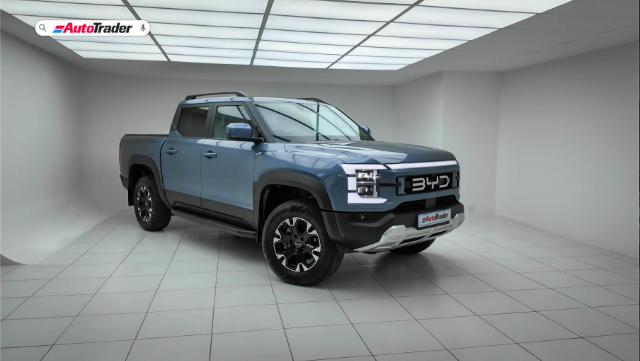
BYD Shark 6 PHEV
At R959,900, this most recently launched (and only) plug-in hybrid delivers 321 kW and 650 Nm while sipping electrons for up to 100 km of pure electric driving. It combines efficiency with genuine performance - a combination that would have seemed impossible five years ago. Its 29.58 kWh battery charges in about 33 minutes on DC fast charging (55kW) or over several hours on 7kW AC charging:
Charging scenarios for daily use:
- Full charge (0-100%): ~4.25 hours
- Top-up (25-100%): ~3.2 hours
- Quick boost (25-80%): ~2.5 hours
- Overnight charging: Perfect for daily use patterns
GWM P500 HEV
The full self-charging hybrid option, priced from R999,900 with the luxury features to match, combines a 2.0-litre turbopetrol with electric assistance for 255 kW and 648 Nm. With a 3,500kg towing capacity and genuine 4x4 credentials, it proves you don't need diesel to do serious work.
Real-world testing reveals it's not as efficient as you'd imagine. While GWM claims 9.8 l/100 km on average, it's closer to 12 l/100 km. Some tests struggled to achieve below 13!

Toyota Hilux 2.8 GD-6 48V MHEV
Toyota's mild hybrid approach adds 48-volt assistance to its proven 2.8-litre diesel. This provides better fuel economy and smoother operation without scaring the traditionalists too much. Mild-hybrids are not really seen as new-energy vehicles, however. This is because they cannot run on electric power alone and do not offer the same fuel efficiency or emission reduction level as true hybrids (HEVs) or plug-in hybrids (PHEVs).
During our time with the Hilux, where we mainly drove in town with a little highway driving, our average came to 9.3, but there are other pros to having a mild-hybrid system on board. If you'd like to learn what they are, read my review on the Toyota Hilux 4x4 Raider model here.
What's coming soon
JAC T9 PHEV
This bakkie was set to launch during the second quarter of 2025, but is now only appearing early next year. The T9 PHEV brings serious numbers: Its 2.0-litre turbo-petrol engine combines with dual electric motors for a combined output of 290 kW and 670 Nm. With a substantial 31.2 kWh battery pack and 3,500kg towing capacity, it's positioning itself as a direct challenger to established players. The comprehensive ADAS package and fast-charging capability (full charge in 1 hour 25 minutes on DC) suggest JAC isn't just playing catch-up.

Chery Himla
Due in 2026, the Chery Himla will initially launch with a 2.3-litre turbodiesel producing 120 kW and 420 Nm, with pricing around R500,000. However, Chery is actively developing a PHEV powertrain for the Himla. Given the brand's impressive PHEV SUV lineup in South Africa, including the Tiggo 7 PHEV, Tiggo 8 CSH Hybrid, and Tiggo 9 PHEV, a hybrid Himla could follow soon after the diesel launch. This would potentially bring PHEV technology to a more accessible price point, although JAC's pricing shouldn't be too steep either, as it doesn't quite have the same premium bakkie status as the big guns from Ford, Toyota, Volkswagen and Isuzu, etc.

The Ford Ranger PHEV situation
Built here, but not sold here - yet
Ford builds the Ranger PHEV right here in Silverton, Pretoria, but it's currently export-only, with no confirmed timeline for local sales, but we do expect it to be sold here in the not-too-distant future. The specifications are impressive: a 2.3-litre EcoBoost paired with a 75kW electric motor, delivering 207kW and 697Nm of torque. With 49km of electric-only range and fuel consumption of just 2.9L/100km, it's engineered to be both a workhorse and a lifestyle bakkie.
The standout feature is Ford's Pro Power Onboard system, essentially turning your bakkie into a mobile power station capable of delivering 6.9kW. In a country where loadshedding taught us to appreciate backup power, that's useful technology.

Where hybrids are winning
As leisure bakkies
A PHEV makes financial sense if your bakkie spends most of its time in city traffic or doing short suburban runs. The upcoming JAC T9's 31.2 kWh battery suggests meaningful electric-only range for urban work, while the BYD Shark 6 already proves the concept works. Charge overnight on cheaper Eskom tariffs, run silently through the suburbs, then switch to hybrid mode for longer trips. (The BYD didn't do too badly in the off-road tests we witnessed, but if you want an extraordinary off-roader, the petrol-powered Raptor is where your money should go.)
The performance factor
The Shark 6's claimed 0-100km/h in under 6 seconds, demolishes most diesel bakkies, while the incoming JAC T9's 670 Nm combined output suggests similar performance potential. Unless you have the money for a thirsty Ford Ranger 3.0T V6 double cab Raptor 4WD, now selling for R 1 270 000, which will do the same sprint in 6.7 seconds.
Related: Watch these two bakkies battle it out in our Shark 6 vs Raptor drag race.

Where diesel still dominates
Serious commercial operations
For genuine heavy-duty work, such as mining operations, commercial farming, and construction fleets, diesel remains king, and these operators aren't typically considering lifestyle-oriented PHEVs anyway. The purchasing decisions here are driven by proven reliability, service network coverage, and total cost of ownership over hundreds of thousands of kilometres. The incoming Chery Himla's diesel-first approach acknowledges this reality.
Adventure and remote leisure travel
Charging infrastructure becomes relevant for leisure buyers who venture into remote areas for camping, hunting, or cross-border adventures. The BYD's fast charging (33 minutes on DC) makes it feasible to top up at the last charging station before heading into the wilderness. In hybrid mode without charging, real-world testing shows around 7.9L/100km—competitive and/or better than most diesel bakkies.
However, diesel's refuelling simplicity still wins for extended trips like Cape Town to Upington with a caravan or cross-border adventures into Africa. Planning charging stops adds complexity that leisure travellers might not want on holidays.
Related: New Isuzu D-Max X-Rider Black (2025) Roadtrip Review
Load carrying considerations
Battery packs add weight and can affect payload capacity. PHEVs' substantial batteries will impact payload more than diesel alternatives. Every kilogram matters if you regularly max out your bakkie's carrying capacity.
Related: Ford Ranger Buyer's Guide (2011 to 2022)

What happens next?
Expect more mild hybrid options in established diesel lineups as manufacturers hedge their bets. PHEV adoption will most likely accelerate among urban users, while diesel maintains its grip on traditional commercial applications.
The verdict
The future isn't about choosing between electrons and diesel - it's about choosing the right tool for the job. And increasingly, that tool might have a charging port alongside its fuel cap.
Heavy-duty commercial and remote adventure applications will likely stick with diesel for now, but the gap will narrow as battery technology improves and charging infrastructure expands. The real catalyst will be local pricing and dealer support. Urban fleets, lifestyle buyers, and operations with predictable routes and charging access may be switching faster than expected.