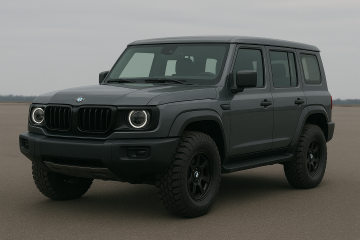
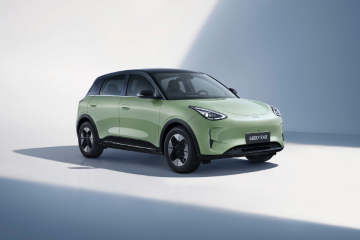
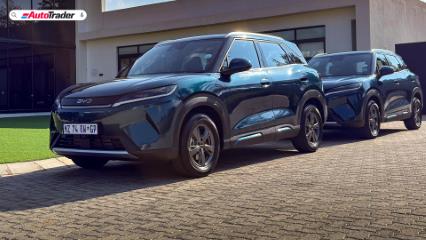
Comparing the Geely E2 and BYD Dolphin Surf on real-world South African highway ranges.
Compact electric cars are fast becoming the go-to urban commuting solution in SA. The only real roadblock is, of course, the price and how much car you get for your money. We check out two of the top contenders to see how they stack up.



The battle for the title of South Africa's most affordable EV has turned into a fascinating heavyweight match between two Chinese automotive giants. In one corner, we have the newcomer: the Geely E2, which recently snatched the crown with a starting price of just R339,900. In the other, the pioneer that paved the way for budget EVs locally: the quirky BYD Dolphin Surf Dynamic, priced from R341,900 (Comfort) to R393,900 for the larger-battery Dynamic spec tested here.
Related: Is a sub-R400k EV any good? 2026 BYD Dolphin Surf Dynamic Review
Both cars promise an eco-friendly revolution for the daily commute, but how do they handle the ultimate South African automotive equaliser? We compared our test-drive data, and this is how they stack up in real-world highway range.
Geely's E2 makes electric mobility more appealing

Claims vs. Reality
Before we hit the road, it’s worth looking at what these manufacturers claim on paper under laboratory conditions (WLTP cycle) versus what you will actually get when maintaining a steady 120 km/h with the air conditioning fighting off the local heat (Dynamic Range)
| Specification | Geely E2 (Aspire/Apex) | BYD Dolphin Surf (Dynamic) |
| Price (From) | R339 900 | R341 900 (R393 900 as tested) |
| Battery Capacity | 39.4 kWh | 38.8 kWh |
| Claimed WLTP Range | 325 km | 295 km |
| Power / Torque | 85 kW / 150 Nm | 55 kW / 135 Nm |
| Driven Wheels | Rear (RWD) | Front (FWD) |
On paper, the Geely starts with a clear mathematical advantage. Despite having almost identical battery capacities, Geely claims an extra 30 km of range. It also offers a significantly more robust powertrain, delivering 30 kW more than the compact BYD.

The Highway Test
Highways are notorious for killing EV efficiency. Without the benefits of stop-and-go regenerative braking, maintaining high speeds forces electric motors to work continuously against wind and rolling resistance.
Driving the BYD Dolphin Surf Dynamic
Stepping into the Dolphin Surf, you are met with a distinctly futuristic "Ocean Aesthetics" cabin, though hard plastics remind you where the budget was managed. On the highway, the Dolphin Surf makes no secret of its city-car DNA.
With just 55 kW on tap, pushing the Dolphin Surf up to 120 km/h requires patience. The vehicle features a strict electronic limit of 130 km/h, meaning overtaking long trucks on an incline requires careful planning.
Highway Consumption: Our real-world testing showed the Dolphin Surf's efficiency dropped to an average of 16.5 kWh/100 km on the highway.
Real-World Highway Range: With its 38.8 kWh Blade battery, this translates to a true open-road range of roughly 210-220 km before you are desperately hunting for a GridCars charging station.
Driving the Geely E2
Swapping into the rear-wheel-drive Geely E2 reveals a completely different highway character. Built on Geely’s advanced GEA platform, the E2 feels substantially more planted and confident at national speed limits.
With 85 kW and 150 Nm, it reaches 120 km/h effortlessly and delivers the mid-range punch needed to navigate highway traffic comfortably. Like the BYD, it features a range-optimising top-speed limiter (clipping its wings at around 137 km/h), but getting there is far more composed.
Highway Consumption: Surprisingly, despite being more powerful and carrying a 1,300 kg kerb weight, the Geely E2 is incredibly efficient. While Geely conservatively claims 15.2 kWh/100 km, our highway test run hovered at an impressive 14.2 kWh/100 km.
Real-World Highway Range: Thanks to its excellent energy management, the E2's 39.4 kWh pack delivers a realistic highway range of 250-260 km.

Charging performance
When the battery finally runs low, both vehicles offer solid fast-charging capabilities to get you moving again during a road trip coffee break.
The Geely E2 can accept up to 70 kW at a DC fast-charging station, allowing it to complete a 30% to 80% charge in a prompt 25 minutes. Geely also sweetens the deal by bundling a complimentary home wallbox charger, an emergency cable, and a R7 500 charging voucher if financed through Geely Finance.
The BYD Dolphin Surf utilises BYD's renowned ultra-safe Blade Battery technology. It supports DC fast charging that can replenish the battery from 30% to 80% in roughly 30 minutes.

Cabin Comfort and Tech
Beyond the battery tech, these two cars offer vastly different environments for a long drive:
The Geely E2 focuses on screen real estate and premium comforts. A massive 14.6-inch central touchscreen dominates the dashboard, paired with an 8.8-inch driver display. The top-spec Apex model brings synthetic leather, electric driver seat adjustment, and a full suite of Advanced Driver Assistance Systems (ADAS), including Adaptive Cruise Control, which is a massive blessing on long highway stretches.
The BYD Dolphin Surf counters with a smaller 10.1-inch screen, standard cruise control (non-adaptive), and a more basic two-speaker audio system on lower trims. However, it boasts an incredibly tight turning circle and highly practical cabin ergonomics, even if rear luggage space is somewhat compromised compared to the Geely's 375-litre boot.

Verdict
If your driving is strictly confined to urban environments and you appreciate standout styling and a 5-star Euro NCAP heritage, the BYD Dolphin Surf remains a highly compelling, characterful gateway to EV ownership.
However, when it comes to the real-world South African highway test, the Geely E2 emerges as the definitive victor. For less money out of your pocket, it delivers more power, better high-speed stability, superior standard driver assistance technology, and an extra 40 km of usable real-world highway range. It is an impressive milestone in making the practical EV reality accessible to the local public.
AutoTrader Note: Neither of these compact contenders was explicitly engineered to be an inter-province cross-country cruiser. They are city commuters at heart. However, local buyers demand versatility, and both models prove that a weekend trip from Johannesburg to Pretoria or a run down to the coast is entirely feasible with minimal planning.