Motorcycle boots vs. work boots: The critical difference in crash protection
It goes without saying that you need to protect your feet when riding, but not all shoes are created equal. Even a boot designed to protect your feet on a construction site may not provide adequate protection in a bike accident.


Many motorcycle riders fail to wear the appropriate footwear when riding. Although it may seem nonsensical that there would be a significant difference between footwear designed to protect your feet in one space and footwear intended for another, surely safety footwear is created equally?
Related: How important are motorcycle boots?
While high-quality work boots are tough, there is a fundamental philosophy of safety that separates them from motorcycle-specific boots. Work boots are designed for static, localised hazards, like dropping a hammer on your toe. In contrast, motorcycle boots are engineered for dynamic, high-energy events such as sliding down asphalt at 80km/h. Here is the breakdown of the critical differences in crash protection.Essential motorcycle gear for South African riders

Torsional rigidity
This is arguably the most important distinction.
Work Boots: Designed for flexibility so you can walk, kneel, and climb. In a crash, this flexibility allows your foot to twist violently ie; torsional rotation, often leading to snapped ankles or spiral fractures.
Motorcycle Boots: Engineered with transverse rigidity. They often feature internal or external bracing to prevent the foot from bending or twisting in ways it shouldn't. They are designed to keep your foot and ankle as a rigid unit.

Abrasion resistance vs. durability
Work Boots: Built for longevity against daily wear and tear. While the leather is thick, it isn't always treated for high-speed friction.
Motorcycle Boots: Use leather or synthetics specifically tested for slide time. A standard work boot might burn through in 1–2 seconds of sliding on pavement; a CE-rated motorcycle boot is tested to withstand significantly longer, preventing "road rash" from reaching the bone.
Fastening systems and retention
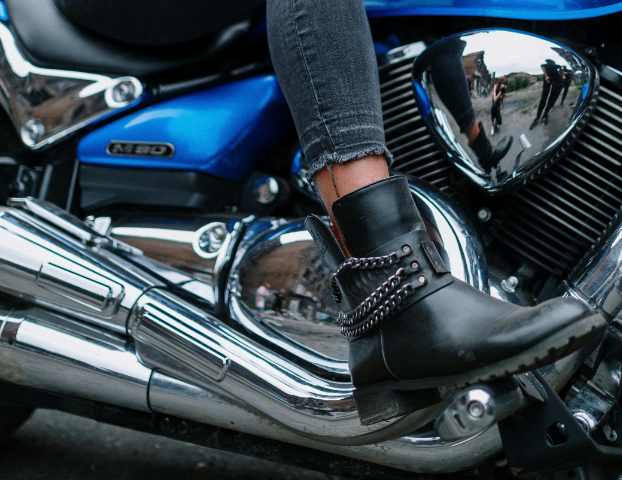
Work Boots: Mostly use laces. In a crash, laces can snag on footpegs, or worse, the friction of a slide can melt or snap the laces instantly, causing the boot to fly off. A boot that isn't on your foot provides zero protection.
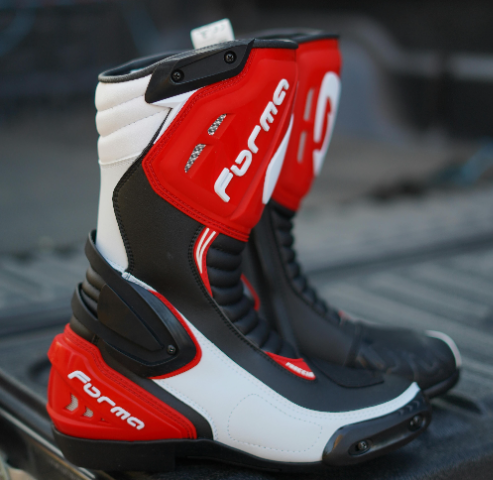
Motorcycle Boots: Utilise recessed zippers, heavy-duty buckles, or Velcro covers. These are designed to stay secure even during the violent tumbling and high-friction sliding of an accident.

The steel-toe myth
Work Boots: The steel toe is designed for crush protection from above. In a motorcycle crash, if your foot is caught between the bike and the road, the shearing force can actually cause the steel cap to shift or deform, potentially causing more harm than good.
Motorcycle Boots: Usually feature reinforced composite or TPU toe boxes. These are designed to absorb and distribute impact energy across the entire boot rather than just protecting against a falling object.
Comparison Summary
| Feature | Work Boots | Motorcycle Boots |
| Primary Goal | All-day walking comfort | Impact & slide protection |
| Ankle Support | Minimal/Flexible | High (Torsional Stiffness) |
| Closures | Laces (Snag/Break risk) | Buckles/Zippers (High retention) |
| Testing Standard | ASTM/CSA (Industrial) | EN 13634 (Motorcycle Specific) |
| Sole Rigidity | Flexible for walking | Stiff to prevent crushing |
How to check for real protection
If you are looking for new gear, check the inner tongue for a CE EN 13634 label. It will show four numbers (e.g., 2 2 2 2), which rate the boot on height, abrasion resistance, impact cut, and transverse rigidity. Level 2 is the highest rating for each.