

United we are stronger
Here in South Africa, we’re rather paranoid about cooperating with our competitors in any way. To be frank, the Competition Commission has put the fear of God into us all.
But, on the international stage, things are quite different. In fact, we have seen many so-called “unlikely marriages” in the commercial vehicle world of late. Back in 2017, power management company Eaton and engine maker Cummins announced a joint venture to produce automatic transmissions for commercial vehicles.
More recently – in October 2019, to be exact – commercial vehicle manufacturers Traton Group and Hino Motors signed a global procurement agreement “in order to maximize the global procurement synergies between the two companies”. In the same year, Ford and Volkswagen announced that they would team up to make small trucks and delivery vans. The companies’ first bakkie is coming in 2022.
The collaboration trend has continued this year. Honda and Isuzu Motors have signed an agreement whereby they will work together and develop commercial trucks powered by hydrogen fuel cells.
Last week BYD and Hino Motors signed a strategic business alliance agreement with a focus on collaborating in the development of commercial battery electric vehicles (we’ll tell you more about this next week). And now Volvo and Daimler have announced that they will work together to produce fuel cells (we’ll share more details later in this article).
All these collaborations are no coincidence. The commercial vehicle world (and indeed the greater automotive world) is finding itself in a time of massive development. Some say that we will see more change in the next 10 years than in the last 100.
Accordingly, truck manufacturers have to make huge investments in things such as connectivity, autonomous driving and alternative power trains. It’s kind of handy if some of those bills are shared – which is exactly what Volvo and Daimler are doing.
Unpacking the Volvo/Daimler deal
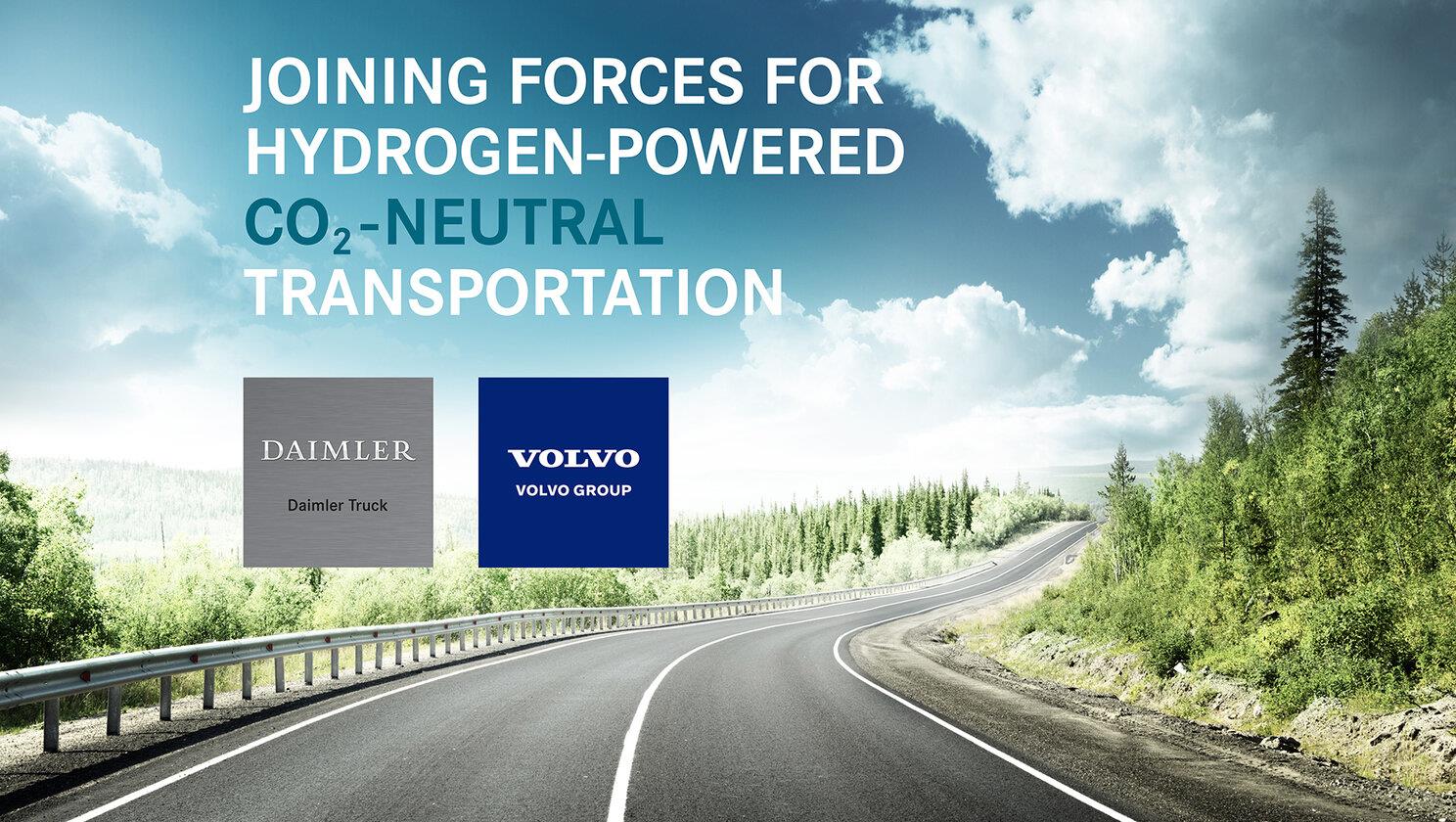
In a tangible sign of the faith of Daimler and Volvo in hydrogen propulsion, the two companies are creating a joint venture for the large-scale production of fuel cells.
Numerous companies are already going down the hydrogen path. As we have already reported, Anglo American has begun development of a hydrogen-powered truck that will be used here in South Africa, while Iveco and Nikola have revealed a new truck called the Tre that will feature hydrogen propulsion. And Hyundai has lifted the lid on its HDC-6 Neptune concept truck, which is powered by hydrogen.
As David Cebon, Professor of Mechanical Engineering in the Cambridge University Engineering Department, notes, hydrogen offers many benefits. For instance, a hydrogen truck can be refuelled in approximately the same time as a diesel truck and the operating range and operating patterns are similar.
Mindful of these benefits, Daimler and Volvo have now signed a preliminary non-binding agreement to establish a new joint venture (JV). The intention is to develop, produce and commercialize fuel cell systems for heavy-duty vehicle applications. The Volvo Group and Daimler Truck AG will be 50/50 partners in the joint venture, which will operate as an independent and autonomous entity. Daimler and Volvo will remain competitors in all other areas of business.
Both companies are upbeat about prospects for the JV. “Transport and logistics keep the world moving, and the need for transport will continue to grow. Truly CO2 neutral transport can be accomplished through electric drive trains with energy coming either from batteries or by converting hydrogen onboard into electricity. For trucks to cope with heavy loads and long distances, fuel cells are one important answer and a technology where Daimler has built up significant expertise through its Mercedes-Benz fuel cell unit over the last two decades,” says Martin Daum, Chairman of the Board of Management Daimler Truck AG and Member of the Board of Management of Daimler AG.
“This joint initiative with the Volvo Group is a milestone in bringing fuel cell-powered trucks and buses onto our roads,” he adds.
Martin Lundstedt, Volvo Group President and CEO, agrees. “Electrification of road transport is a key element in delivering the so-called Green Deal, a carbon-neutral Europe and ultimately a carbon-neutral world. Using hydrogen as a carrier of green electricity to power electric trucks in long-haul operations is one important part of the puzzle, and a complement to battery electric vehicles and renewable fuels.
“Combining the Volvo Group and Daimler’s experience in this area to accelerate the rate of development is good both for our customers and for society as a whole. By forming this JV, we are clearly showing that we believe in hydrogen fuel cells for commercial vehicles. But for this vision to become reality, other companies and institutions also need to support and contribute to this development, not least in order to establish the fuel infrastructure needed,” he says.
Impact in South Africa
Given the fact that the JV has just been announced, it’s hard to predict the impact on the South African market. But it should be positive. As Joe Pretorius, Brand Manager Volvo Trucks in South Africa, points out: “Although it's still very early in the process and a final agreement needs to be signed, we hope to see this technology in our trucks arrive in South Africa one day.”
Michael Dietz, CEO Daimler Trucks & Buses Southern Africa, concurs. “Daimler Trucks is clearly committed to the goals of the Paris Climate Protection Agreement and thus to the decarbonization of its industry. Having CO2-neutral transport on the road by 2050 is the division’s ultimate goal,” he says.
Dietz is highly supportive of the JV. “Making fuel cell technology work is no small undertaking for any company. Thus, we’re convinced that combining the experience of both Daimler and Volvo is the right thing to do for us, our customers and for society as a whole,” he notes.
According to Dietz, the agreement is also a call for action to others. “We made our move to show our commitment to this technology. In order to make CO2 neutral vehicles competitive in any country, we will also need regulatory steering measures to improve the business case for our customers, including the crucial infrastructure for generating, storing and distributing hydrogen. So, it’s up to others to join us now. Together, we will be able to accomplish this task,” he notes.
According to Dietz, no business model for CO2 neutral trucks has been conceivable for the foreseeable future – even in the triad markets – until recently.
“There was no sign of a market opportunity there because it would have been uneconomical for our customers to invest in such vehicles. But we can now see that something is happening, especially in the triad markets. That is why we are initially focusing on these markets.
“As soon as we see opportunities emerge for other markets of highest importance such as here in South Africa, we want to lead the industry there as well. Based on our strong commitment and long-term experience, together with our dedicated partners, we will be in the best position to do so,” he concludes.
So, CO2 neutral trucks could be on South Africa’s roads sometime soon – and they could certainly be powered by hydrogen.