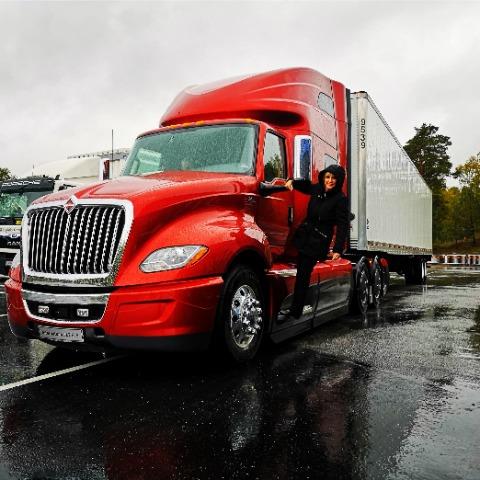
Go hydrogen go!
Some people aren’t big fans of hydrogen. Tesla’s Elon Musk, for instance, has dismissed this technology – he famously calls the fuel cells “fool cells”. And, to be honest, there has been enormous focus on electromobility – not just at Tesla but at other automotive manufacturers too.
As Prof. Christian Sattler, head of the Solar Process Engineering Department at the Institute for Solar Research of the Deutsches Zentrum für Luft- und Raumfahrt (German Aerospace Centre and Dresden Technical University), notes: “In view of the broad trend towards electromobility, or more precisely battery-powered electric mobility, other alternative drives seem to be disappearing from the general consciousness.”
Sattler says that this is a mistake. “Battery-powered electric vehicles are certainly well suited for urban traffic: the routes are manageable, and the charging infrastructure is well developed. But for longer distances and heavy vehicles, batteries make little sense due to their relatively short range and high weight. Lorries, trains and ships can barely be operated with batteries,” he points out.
The solution, says Sattler, is hydrogen. “For long distances and heavy weights, e-mobility with hydrogen and a fuel cell as an energy converter is an ideal drive,” he notes.
Sattler isn’t the only fan of hydrogen; it seems that the tide could be turning in its favour. Suddenly, a number of industry captains are starting to sing its praises. We’ve already written about hydrogen trucks that are being developed by Nikola and Hyundai, for instance. And now we’re going to see this technology being implemented in South Africa too …
Hydrogen truck to be tested at Mogalakwena mine
Anglo American has already begun development of a hydrogen powered truck, which will be revealed this year (2020) and will be tested at the company’s Mogalakwena platinum mine. Located near the town of Mokopane in the Waterberg District, the mine was established in 1993 and it is the largest open pit platinum mine in the world. It has an annual output of 1.1 million ounces which, in the mining world, is considered massive. So too are the trucks being used there – 300-tonne vehicles are not unusual.
The fact that a mining company (and not a truck producer) is developing the truck certainly is (unusual) though. Engie, a French energy services company, is partnering Anglo in this initiative.
According to Julian Soles, Anglo American’s head of technology development, mining and sustainability, the truck is not being developed from scratch. “We are retrofitting one large mining truck with a total of eight 100kW Ballard FCveloCity heavy duty modules,” he explains.
Headquartered in Canada, Ballard is a global manufacturer of fuel cells, which are being used in buses, commercial trucks, trains, marine vessels, passenger cars, forklift trucks and unmanned aerial vehicles.
Soles won’t reveal the make of truck being retrofitted. “We cannot mention the manufacturer as we have ongoing commercial discussions with them and they prefer for us to not mention them for now,” he explains.
He also won’t disclose the cost of the project or the range of the truck. “The range is dependent on the mine, energy balance and refuelling scheme that is implemented,” he reports.
He does, however, confirm that it is a 300-tonne vehicle, and that it is most unusual. “This is the first time a truck of this size and load capacity has been converted to run on hydrogen,” he reveals.
Soles says that this is not a lone hydrogen truck. “We expect to deploy similar trucks at other Anglo-American operations. Commercialisation plans are also being developed; our goal is to introduce this solution to the industry so that it’s available to everyone,” he reveals.
According to Soles, the truck offers massive environmental benefits. “The truck will boast zero emissions; currently the trucks of this size emit between 400 to 450 kg of CO2 equivalent per hour whilst operating,” he reports.
While delivering the same performance as diesel trucks, the hydrogen trucks will be less noisy and boast lower maintenance costs.
The hydrogen is being generated on site by a 3.5MW electrolyser supplied by a Norwegian company called Nel Hydrogen Electrolyser. The electrolyser splits water into hydrogen and oxygen using electrical energy.
An American company called Plug Power has been appointed to build a full compression, storage, and dispensing system to service the new hydrogen-powered vehicle. Plug Power’s system – as unique as the hydrogen truck itself – will be the largest refuelling system built by the company to date, with a planned output of 1 000kg per day. “We are targeting to refuel 160kg of hydrogen in 10 minutes,” says Soles.
It certainly seems as though Anglo’s hydrogen powered trucks are the way of the future for the mining industry. “Due to the high utilisation and power requirements for the haul trucks, we believe today that a hydrogen and battery solution offers the best solution to meet those requirements,” Soles maintains.
Anglo American Chile CEO Aaron Puna clearly agrees. “Every truck that we buy in the future, depending on the success of Mogalakwena, will be targeted as a hydrogen, autonomous-ready truck,” he recently told Mining Weekly Online.
So, South Africa is leading the way!