President Ramaphosa’s EV incentive announcement sparks positive response from truck companies
President Cyril Ramaphosa’s recent announcement that the South African government is considering incentives to encourage the purchase of electric vehicles (EVs) has been met with optimism.


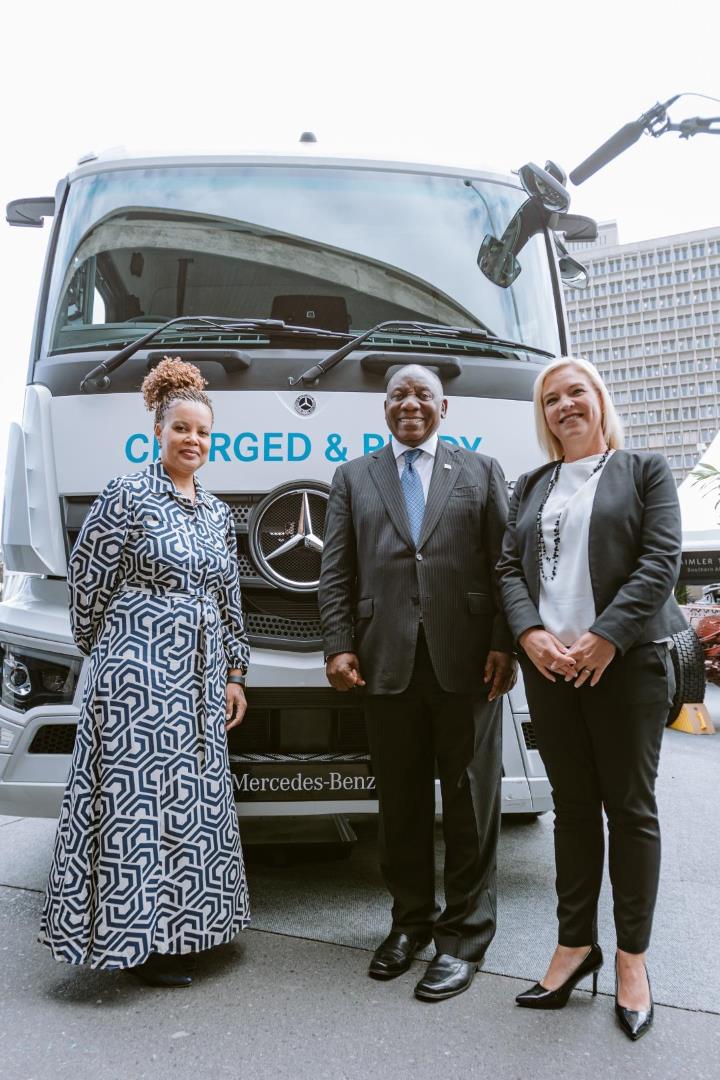


At the South African Auto Week in Cape Town on 17 October, Ramaphosa highlighted that the government is looking at introducing incentives for both automotive manufacturers and consumers. These potential measures, which could include tax rebates or subsidies, aim to stimulate the adoption of EVs in South Africa.

Significant step
Maretha Gerber, President and Group CEO of Daimler Truck Southern Africa, has welcomed the potential incentives.
“This is a significant step towards fostering a more sustainable transport future in South Africa. While prudent transport operators always factor in the total cost of ownership (TCO) when making decisions, the higher upfront costs of EVs remain a significant hurdle for many consumers. By addressing this, these incentives have the potential to make EVs more accessible, which would not only bolster sales but also support the country’s transition towards greener, more efficient transport solutions. At Daimler Truck Southern Africa, we remain dedicated to contributing to the dynamic transformation of the automotive industry,” says Gerber.

Waldemar Christensen, Managing Director of Volvo Trucks South Africa, has also expressed optimism. “We were especially heartened by his remarks that consideration must be given to incentives for manufacturers as well as tax rebates or subsidies for consumers to accelerate the uptake of EVs.”
Christensen believes that this can only be good for the industry as a whole. “The fundamental difference between the passenger car/light commercial segment and the heavy/extra heavy commercial segment is that the heavy commercial OEMs all build for the local market, whereas the passenger car segment builds for both local and international markets. This means that there is an existing demand for new energy vehicles that local passenger car OEMs can build for at scale. One must also keep in mind that the industry white paper mentioned by the President was more focused on the passenger car market.”
Local demand needed
When it comes to the heavy commercial side, Christensen says it is pertinent that local demand needs to be stimulated to make local manufacture viable. “The NAAMSA HCV NEV Committee has suggested a number of actions to government to help stimulate local demand. This includes reducing import duties for a limited period and making permanent allowances to road legislation to accommodate the technical limitations of new energy heavy commercial vehicles, such as allowing an additional 1m to a truck/trailer combination,” he says.

Erik Bergvall, Managing Director of Scania Southern Africa, has expressed hope that the incentives will extend to the heavy commercial vehicle sector.
“Scania welcomes President Ramaphosa’s announcement that the government is considering new incentives for EVs. This is a positive step towards fostering a sustainable transport ecosystem in South Africa. All incentives that can support the development of more sustainable transport are beneficial and needed. We hope that heavy commercial vehicles will also benefit from such incentives, particularly in terms of rolling out the necessary charging infrastructure for heavy-duty vehicles, which will be crucial to the sector’s transition,” says Bergvall.
Infrastructure challenges
EV imports are currently taxed at 25%, while internal combustion engine vehicles are taxed at 18%. A tax rebate could bring these duties in line and make EVs more competitive with their fuel-burning counterparts. But a tax rebate won’t resolve the issue of the non-existent charging infrastructure.

Presidential Spokesperson Vincent Magwenya, has hinted that private sector could play a role. “One big issue is the rollout of recharging infrastructure and that is where the private sector can play a big part,” Magwenya said.

This raises concerns about whether the government expects businesses to develop their own charging infrastructure or if a broader national network is in the works.
Power supply and renewable energy solutions
South Africa’s electricity challenges add another layer of complexity to the adoption of EVs. The national grid is currently ill-equipped to support widespread EV charging, particularly for heavy trucks. The transition to EVs will require alternative solutions, such as off-grid charging stations powered by renewable energy.

Companies like Zero Carbon Charge are already working on solutions, with plans to build 120 fast-charging stations for cars and trucks across the country. However, this infrastructure will take time to develop.
As South Africa moves towards a greener transport future, the success of the government’s plans will depend on the strength of the proposed incentives and the speed at which the supporting infrastructure is developed. If both are done well, transport operators may see both environmental and financial benefits from investing in electric trucks.