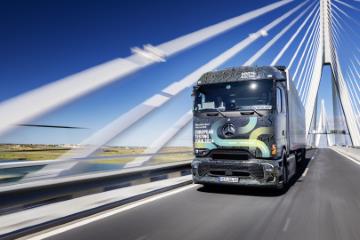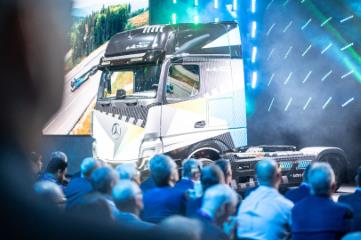


The trophy was presented to MAN Truck & Bus at the IAA Transportation exhibition in Hannover, Germany, on September 16, 2024. This accolade marks a significant milestone for the company, which will be the first European truck manufacturer to introduce a small series of trucks powered by a hydrogen combustion engine.
Alternative to battery-electric vehicles
The MAN hTGX, equipped with a hydrogen combustion engine, has been recognised for its potential to revolutionise road freight transport by offering a viable alternative to battery-electric vehicles, particularly in specialised and heavy-duty applications.
Dr Frederik Zohm, Executive Board Member for Research & Development at MAN Truck & Bus, has expressed his delight upon receiving the award. "We are particularly pleased to receive the International Truck of the Year jury's award. With the hydrogen combustion truck MAN hTGX, we are offering a useful addition to our battery-electric vehicles, thus rounding off our zero-emission product portfolio for special markets and heavy-duty applications. By being classified as a ‘zero-emission vehicle’, the hTGX makes an important contribution to the decarbonisation of road freight transport," says Zohm.

This achievement underscores MAN’s commitment to leading the way in the development of innovative transport solutions with reduced environmental impact. The hTGX’s victory also highlights the company’s consistent performance in pushing the boundaries of automotive technology, with this being the third time MAN Truck & Bus has won the Truck Innovation Award. Previous wins in 2024 and 2019 were for projects in autonomous driving and automated construction site safety vehicles, respectively.
Tested in Austria
The International Truck of the Year jury – which decides on the winner of the Truck Innovation Award each year – was recently invited to Saalfelden, Austria, to drive the vehicle.
The MAN hTGX impressed the International Truck of the Year jury with its diesel-like performance, which is delivered by the 16.8-litre H4576 six-cylinder in-line hydrogen engine. During rigorous road tests in Saalfelden, the truck demonstrated outstanding driveability and a near-zero carbon footprint, thanks to its efficient hydrogen combustion technology.

The truck's range of approximately 600km is made possible by a 56kg hydrogen pressure tank, which operates at 700 bar. This, combined with a simplified exhaust gas after-treatment system, ensures the hTGX is both practical and efficient for long-haul transport. The small series, initially comprising around 200 units, is set to be delivered to customers across Germany, the Netherlands, Norway, Iceland, and selected non-European countries in 2025.
New chapter in decarbonisation
The MAN hTGX's recognition by the International Truck of the Year jury is not just a testament to its technical capabilities, but also to its potential impact on the future of heavy-duty transport. "MAN's hTGX opens a new chapter in decarbonising road transport. It can be the vehicle of choice for heavy-duty applications, such as in the construction sector, in challenging climatic conditions,” says Gianenrico Griffini, Chairman of the International Truck of the Year.

This sentiment reflects the broader industry’s anticipation of hydrogen technology playing a crucial role in the transition to sustainable transportation. While battery-electric vehicles currently lead the charge in urban and regional transport, the hTGX offers a complementary solution for scenarios where battery power may not be as effective or feasible.
Looking ahead
MAN Truck & Bus’s investment in hydrogen technology is part of a long-term strategy to diversify its zero-emission vehicle offerings. The hydrogen combustion engine in the hTGX is based on the proven D38 diesel engine, providing reliability and ease of maintenance while leveraging decades of MAN's expertise in hydrogen as a fuel.

A vehicle with a hydrogen combustion engine is not entirely zero-emission in the same way that a battery-electric vehicle or a hydrogen fuel cell vehicle would be. The primary byproduct of hydrogen combustion is water vapour, which is not a pollutant. However, because the combustion process occurs at high temperatures, it can also produce nitrogen oxides (NOx).

Despite this, the introduction of the hTGX aligns with upcoming EU CO2 regulations, which classify hydrogen combustion trucks as zero-emission vehicles. Hence, the truck will contribute to fleet CO2 targets, and it will come with financial incentives such as toll reductions in certain countries.
As MAN continues to develop and refine its hydrogen technology, the hTGX represents just the beginning of what could be a broader adoption of hydrogen-powered vehicles in the commercial sector.
“The MAN hTGX’s win at the Truck Innovation Award 2025 is more than just a victory for MAN Truck & Bus. It signals a pivotal moment in the journey towards sustainable transport, where hydrogen combustion engines may become a cornerstone of zero-emission logistics solutions in the years to come,” concludes Griffini.