Attended by key government officials, industry leaders, and environmental advocates, the event underscored the intersection of green innovation, public-private collaboration, and local economic empowerment.
VIPs gather at plant
Among the dignitaries present were the Deputy Minister of Transport, Honourable Mkhuleko Hlengwa; MEC for Economic Development, Tourism and Environmental Affairs, Reverend Musa Zondi; Executive Mayor of eThekwini, Councillor Cyril Xaba; and key industry figures from NAAMSA and the Automotive Industry Transformation Fund.
In his opening remarks, Jan Aichinger, Managing Director of MAN Truck & Bus SA, set the tone for the day by reminding attendees of the responsibility carried by the transport sector. “Responsibility is what we are asked to take,” he said. “Not only do we feel responsible about how we produce and how we deliver our services, but we also feel responsible for the products we generate and the emissions of our products.”
Carbon-neutral manufacturing: A South African first
Aichinger revealed that MAN’s global fleet emits as much CO₂ annually as an industrialised country like the Netherlands — a sobering reality that the company is determined to change. “MAN has committed to reduce its carbon footprint in production to become CO₂ neutral by 2030,” he announced. “We are proud to share that the very first production site to achieve that milestone is our MAN Pinetown production here in South Africa.”
The facility now generates more energy than it consumes, feeding excess solar power back into the grid. “The solar system installed on the roofs of this plant is generating a maximum of 810 MWh per year. We are feeding 484 MWh p.a. back into the grid,” Aichinger said.
100 Electric buses ordered
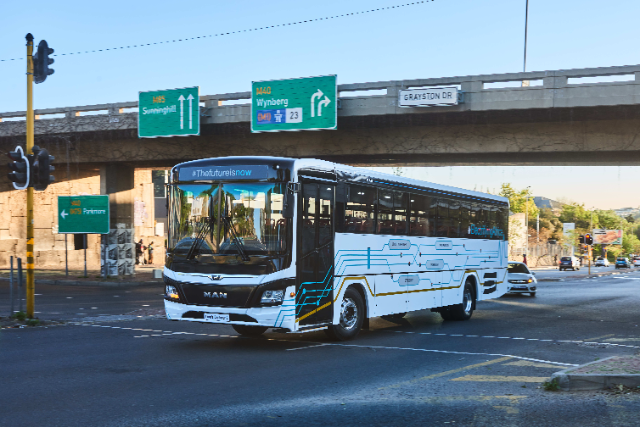
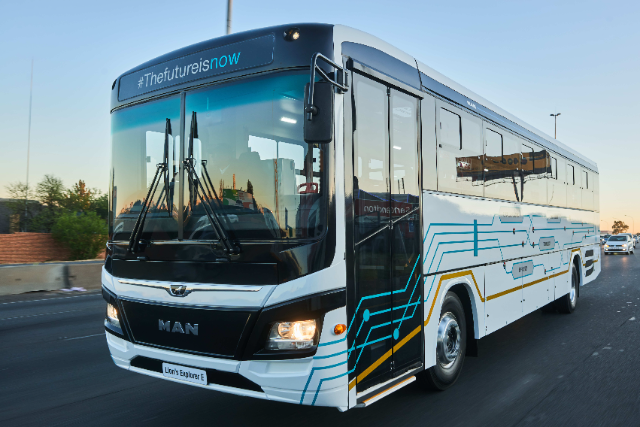
But Earth Day was not just about manufacturing milestones. The day also saw the announcement of a significant order: “Today we are intending to sign a Memorandum of Understanding for the delivery of not less than 100 buses to our long-term customer, Paruk,” said Aichinger, referring to the locally engineered, homologated, and produced MAN Lion’s Explorer E, the company’s flagship electric commuter bus.

Deputy Minister Mkhuleko Hlengwa applauded the initiative as a timely intervention in both environmental and economic terms. “This plant serves our dreams to have cutting-edge infrastructure to serve the needs of South Africans,” he said. “Congratulations are in order today, and may your company, shareholders and all people of the province and this city enjoy the benefits of this investment.”

Hlengwa linked the development directly to South Africa’s policy goals. “As a department, we aim to develop a long-term, multi-modal transport system that ensures accessible, affordable, safe, and efficient infrastructure while considering environmental sustainability,” he said. “This includes electric vehicles, biofuels, and non-motorised transport options.”
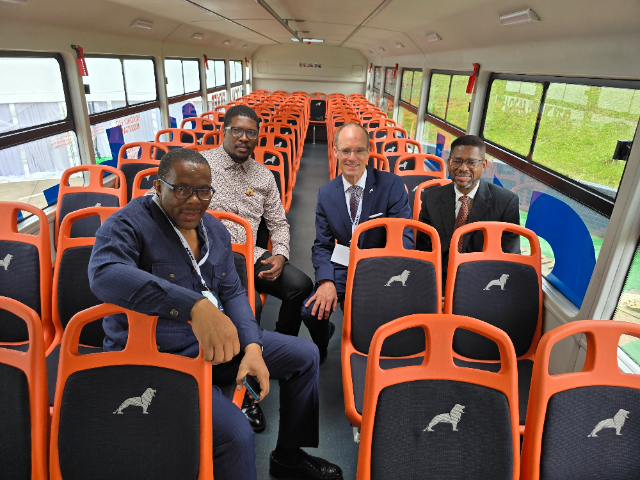
He also emphasised the broader socio-economic role of the initiative: “Growing an inclusive economy will always carry implications for the development of people... This plant and other manufacturing plants such as the Gibela factory from which we manufacture our new commuter passenger trains are examples of the type of private sector participation we are promoting.”
Investing in people and skills for a green future
Beyond production, Aichinger highlighted MAN’s investments in skills development and inclusion. “MAN is training between 60 and 80 apprentices per year... providing between 50 and 70 Yes-4-Youth students as well as 30 to 50 graduates a chance to enter the market,” he said. “We are filling the pipeline with more than 40% of these being female.”

Opening a new chapter in the automotive industry also requires a completely new skills set. “I was already mentioning the investment in our engineering team. Entering into electromobility however means entering in the handling of high voltage. Conventional buses and trucks operate with 24V. With e-mobility, this changes dramatically to up to 800V. Obviously, we needed to get our teams both in the manufacturing sites as well as in the workshops trained for that new environment. A total of 20 of them have reached an expert level and almost 300 of our employees have been provided with basic training. The production flow had to be changed, and all our sites had to be equipped with respective safety measures. In other words, MAN is ready to open this new chapter,” Aichinger pointed out.
Policy changes needed to accelerate progress
Aichinger was candid about the legislative challenges facing the sector. “South Africa remains in the year 1996,” he said, referring to the outdated Euro 2 emissions standard. “Meanwhile the world has moved to Euro 6. We need the South African government to set new standards.”

Both Aichinger and Hlengwa agreed on one critical point: the future of mobility depends on joint commitment. “We at MAN are committed to invest further into reducing greenhouse gases... in technology, in infrastructure as well as in people,” Aichinger stated.

Hlengwa concluded by affirming government’s support: “Your efforts go beyond the mere provision of public transport... they go into sustaining livelihoods and developing people.”
As the 55th Earth Day drew to a close, MAN’s message was clear: sustainable transport is not just possible, it is already in motion. But it will require sustained cooperation between industry and government to ensure South Africa doesn’t get left behind.