Renault’s all-new trio (the Trafic, Goelette and Estafette), the Kia PV5, Isuzu’s D-Max EV, and the Farizon SV were undoubtedly the stars of the show.
1. Renault Trafic, Goelette and Estafette E-Tech
Renault, a longstanding player in the LCV arena, returned to the CV Show with an ambitious electric trilogy built on an all-new platform and the brand’s Software Defined Vehicle (SDV) architecture. Developed by Flexis (which also exhibited at the show) and produced at Renault’s Sandouville plant in France, these three new vans each serve a unique niche within the professional market.

The Trafic E-Tech retains its legacy as a versatile all-rounder, now boasting a futuristic design, advanced software, and a range of up to 450km (WLTP) on the long-range battery. Practicality is core to its design, with up to 5.8m³ of cargo space, ultra-fast charging at 800V, and a refined driver interface complete with dual digital displays.

The Goelette E-Tech targets customisation, offering multiple factory variants including chassis cabs and high-volume boxes. With reinforced axles allowing payloads up to 1.4 tonnes, it’s ideal for users requiring specialist conversions – whether refrigerated delivery, mobile workshops, or multi-person crew setups.

The Estafette E-Tech, meanwhile, is purpose-built for urban logistics. At 2.6m high, it allows drivers to stand upright in the cargo bay. Its high-tech, ergonomic cockpit and thoughtful touches – such as elbow-operable side doors and roller-shutter rear access – redefine ease of use for last-mile deliveries.

What binds this trio together is not just their electric drivetrain, but the integrated digital ecosystem. From predictive maintenance and over-the-air updates to vehicle-to-grid (V2G) functionality, Renault is setting the groundwork for commercial vehicles to operate as intelligent, fleet-integrated tools rather than isolated transport units.

The Trafic, Estafette and Goelette will be available in Europe from 2026.
2. Kia PV5
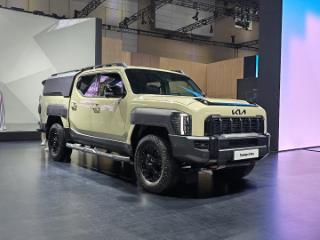
Kia’s first foray into the UK commercial market with its PV5 was another major talking point at the show. The PV5 isn’t simply a new model; it’s the vanguard of Kia’s broader PBV (Platform Beyond Vehicle) strategy, supported by a new network of dedicated commercial centres across the country.

Built on the E-GMP.S electric platform, the PV5 is available in Cargo and Passenger variants, with two battery options offering ranges of up to 247 miles. Clever touches include a rear step height of just 419mm, best-in-class cargo volume of 5.17m³, and rapid 10 to 80% charging in under 30 minutes.

Designed with delivery and fleet efficiency in mind, the PV5 also offers native app integration through Android Automotive, long service intervals, and a bespoke wheelchair-accessible version already in development. With prices starting at £27,645 (plus VAT) and eligibility for government grants, it offers a compelling value proposition.

Kia’s commercial ambitions are long-term, with further PBV models – PV7 and PV9 – already in the pipeline. As Kia transitions from passenger car success to commercial fleet relevance, the PV5 stands as a highly configurable electric van ready to compete. Pre-orders for PV5 Cargo and PV5 Passenger commenced in the UK on 1 May 2025.
3. Isuzu D-Max EV
The Isuzu D-Max EV broke new ground at the show as the first all-electric bakkie in Europe offering genuine commercial-grade credentials: a 3.5-tonne towing capacity, over 1-tonne payload, and full-time 4x4. Its world premiere took place at the exhibition.

Powered by a 66.9kWh battery and dual motors producing 140kW and 325Nm of torque, the D-Max EV offers a WLTP range of 263km. It’s capable of water wading, off-road traction via Rough Terrain Mode, and comes in two high-spec trims modelled after the brand’s existing DL40 and V-Cross diesel equivalents.

Isuzu has made key upgrades to support the EV platform, including a De-Dion rear suspension for improved comfort and handling, as well as modern infotainment systems with wireless smartphone integration. Targeting sectors such as construction, agriculture, and utilities, the D-Max EV signals Isuzu’s commitment to sustainable workhorse solutions without compromising usability or resilience.

With deliveries slated for early 2026 and pre-orders starting later this year, it’s a clear evolution for a brand known for its rugged diesel DNA.
4. Farizon SV
Making its UK debut under the Jameel Motors banner, the Farizon SV stood out not just as a van, but as a flexible platform ready for work. Whether it’s a temperature-controlled delivery van or a tech-enhanced cargo mover, the Farizon SV is a blank canvas for fleet customisation. Farizon is the commercial vehicle division of Chinese company Geely, which also owns Volvo Cars.

Built with drive-by-wire technology and a cell-to-pack battery system, the SV features class-leading interior space and payloads, thanks in part to its pillarless side access and ultra-low floor. Its LFP or NMC batteries offer a variety of ranges to suit fleet needs, while a strong standard spec – 360-degree cameras, heated steering, and ADAS features – sets it apart.

Key to Farizon’s appeal is its partnerships. Paneltex, Motexion, and Locks 4 Vans are all on board to provide refrigeration units, lining, and security enhancements, showing a willingness to collaborate and adapt to real-world applications from launch. The Farizon SV is already available to order in the UK, with prices starting at £45,000 OTR (ex VAT).