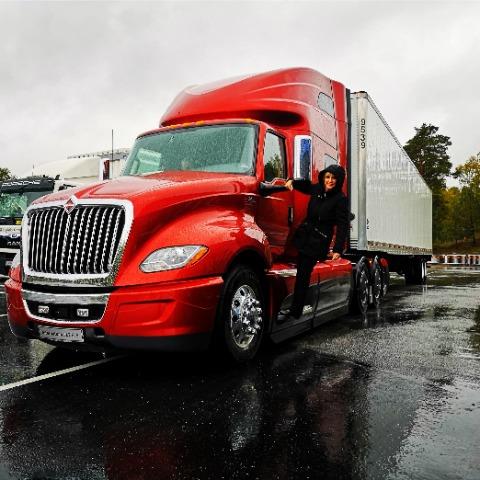
Can an electric truck circle the globe? One driver plans to find out
A German truck driver and content creator is preparing for a year long journey that could redefine what the world believes is possible for battery electric long haul transport. Tobias Wagner – known online as Elektrotrucker – will attempt to circumnavigate the globe in a Mercedes Benz eActros 600, putting electric freight technology to the test across deserts, mountain passes, motorways and some of the most remote regions on Earth.


If successful, it will be the first recorded global circumnavigation completed in a fully battery electric heavy duty truck. The expedition, supported by Mercedes Benz Trucks, is scheduled to begin in the European autumn of 2026 and will cover an estimated 45,000km through more than 35 countries. Remarkably, the team expects the journey to require fewer than 80 charging stops – a figure that will raise eyebrows among operators accustomed to the realities of long distance logistics.

Why South Africa will be watching
For South African fleet owners, logistics managers and long haul operators, this expedition is super interesting – because local transport operators have yet to embrace e-mobility en masse. South Africa’s economy relies heavily on road freight. Thousands of diesel trucks move goods daily along the country’s major corridors – Gauteng to Durban, Cape Town, Gqeberha and beyond. But unlike Europe, where electric truck pilots and charging corridors are expanding rapidly, South Africa faces a more complex landscape: limited charging infrastructure, high vehicle acquisition costs and persistent concerns about range reliability on long distance routes.

The country’s unique operating conditions amplify these challenges. A Johannesburg to Cape Town run can exceed 1,400km, far beyond the typical daily distances covered by European long haul operators. Add load shedding, grid instability and the sheer scale of South Africa’s geography, and it is easy to understand why electric trucking has yet to gain meaningful traction locally. This is precisely why Wagner’s global journey matters. His route will include regions with patchy infrastructure, unpredictable terrain and extreme climates – conditions that mirror many African operating environments. For South African operators, the expedition could offer rare, real world insight into how electric trucks cope when the road ahead is anything but predictable.

A real world test, not a controlled showcase
Unlike carefully choreographed demonstration drives, this project is designed to expose the eActros 600 to the full spectrum of real world challenges. Wagner will navigate well developed freight corridors as well as isolated stretches where charging access may be limited or non existent. The aim is to answer practical questions that fleet managers everywhere – including in South Africa – are asking:
- How far can a heavy duty electric truck realistically travel between charges?
- How reliable is charging infrastructure outside major urban centres?
- What operational compromises, if any, are required?
- Are the perceived limitations of electric trucking rooted in technology, or in infrastructure gaps that can be solved over time?

Wagner is no stranger to electric transport. He has already driven battery electric trucks across 22 countries, accumulating roughly 200,000km of long haul experience. For the past two years he has worked full time for German logistics company Nanno Janssen Spedition, which is transitioning its fleet from diesel to electric and investing heavily in its own charging network.
A purpose built expedition vehicle
The eActros 600 selected for the journey rolled off the production line at Mercedes Benz’s Wörth plant in April and is now undergoing specialised modifications. These include a spare wheel carrier with an integrated mobile charging unit, single tyres, additional front mounted lighting and a custom motorhome style living module from Bliss Mobil. This will allow Wagner to live, work and document the expedition from the truck itself.
The eActros 600 features battery capacity exceeding 600kWh and a claimed operating range of around 500km in fully loaded long haul applications. Because the expedition vehicle will run significantly lighter than a typical freight combination, its real world range could be substantially higher. The eActros 600 has already generated considerable interest. Since entering series production in late 2024, it has been deployed in more than 15 European countries. Prior to launch, it completed a 15,000km test route through 22 countries and a demanding winter endurance programme in Northern Europe. It was also named International Truck of the Year 2025.
What does it mean for South Africans?
Wagner emphasises that the expedition is not about breaking records but about challenging assumptions. The goal is to determine whether the obstacles facing electric trucking are technological limitations or simply infrastructure and planning challenges that can be overcome. For local transport operators, this journey will provide a glimpse into a future that is approaching faster than many expect. If an electric truck can cross deserts, mountain ranges and remote regions with limited infrastructure, then the idea of electric long haul transport operating between Johannesburg, Durban and Cape Town becomes far less abstract.

Wagner’s expedition will not solve South Africa’s energy constraints or build the charging network the country needs. But it may do something equally important: provide proof that electric trucking is not a distant European experiment, but a viable technology capable of handling the world as it truly is – uneven, unpredictable and demanding.