Exhibiting at IAA this month
The company is called Neste, and it will be exhibiting at the IAA, which takes place later this month in Hannover, Germany. Ahead of the exhibition, the company’s Vice President of Sales, Peter Zonneveld, addressed the world’s leading commercial vehicle journalists at the International Press Workshop in Frankfurt – and what he said was quite fascinating!

But, before we get onto the contents of his presentation, some background on the company…
Introducing Neste
According to Zonneveld, the company was founded in Finland in 1948 to secure oil supply for the country. “We are the world’s leading producer of sustainable aviation fuel and renewable diesel. Our ambition is to make the Porvoo oil refinery in Finland the most sustainable refinery in Europe by 2030. We are introducing renewable and recycled raw materials such as liquefied waste plastic as refinery raw materials,” he told journalists.

In 2021, Neste’s revenue stood at €15.1 billion and the comparable operating profit was €1,342 million. Neste employs some 4 900 employees – and it manufactures renewable products in Finland, the Netherlands and Singapore. “Our aim is to become a global leader in renewable and circular solutions. We are committed to supporting our customers to reduce their greenhouse gas emissions by at least 20 million tons annually by 2030. Neste’s renewable products created 10.9 Mt of GHG emission reduction, equal to an annual carbon footprint of 4.2 M cars in 2021,” said Zonneveld.
The company’s products truly smile on the planet. “Neste’s MY Renewable Diesel reduces greenhouse gas (GHG) emissions by up to 90% compared to fossil diesel. Our MY Sustainable aviation fuel has up to an 80% smaller carbon footprint compared to fossil jet fuel,” he added.
But why are renewable fuels needed?
So, the renewable fuels do an excellent job. But this is the million-dollar question: since we already have electrification in the commercial vehicle industry, why do we need renewable fuels?

According to Zonneveld, electric vehicles won’t solve the planet’s woes. “Sustainable transport requires all low-carbon solutions. We fully believe in electric. But we think renewable fuels are essential options too,” he told journalists.
Furthermore, there is widespread consensus that internal combustion technology has not reached its full potential yet, in terms of efficiency or lower carbon impact. And when it comes to local air pollution, studies have found that the newest internal combustion engines are reaching pollutant levels so low that they are hard to measure, with most particulate matter emissions being produced from the brakess and tyres – not the tailpipe, as one might think.
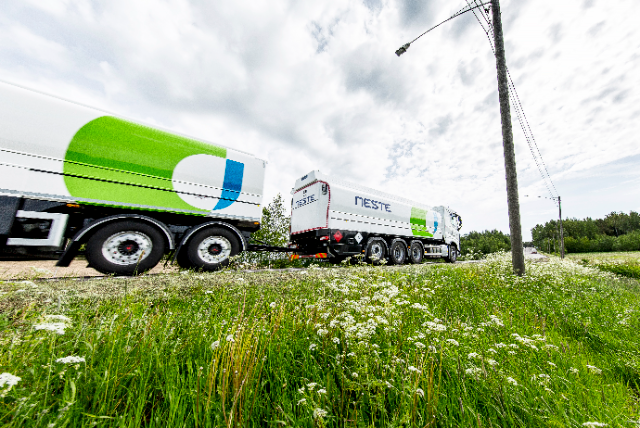
While e-mobility is perceived by many to be the industry’s knight in shining armour, Zonneveld believes that biofuels actually have considerably more potential. “There could be 600m electric passenger vehicles on our road by 2040, replacing around 360 Mtoe of fossil transport fuels. Biofuels, on the other hand, have the potential to replace up to 1,000 Mtoe of fossil transport fuels. Sustainable transport is a huge challenge; we need all the solutions we can get. Both electrification and renewable fuels are needed,” he stressed.
Enter renewable diesel
Renewable diesel certainly appears to be one of those solutions – and a pretty good one too.
Take Neste’s MY Renewable Diesel, for instance. As already stated, it helps to reduce greenhouse gas emissions by 90% compared to fossil diesel. But that’s not all. “It can be used in any diesel engine or any existing infrastructure or equipment – both as a neat product and as a blend (no engine modifications are required). It boasts the highest diesel quality that can lower local emissions compared to fossil diesel (particulates, NOx and CO, for instance). Carbon emissions from the use of renewable diesel amount to zero, as the amount of bio-based carbon dioxide released upon combustion equals the amount that renewable raw material has absorbed earlier,” Zonneveld revealed.

Most importantly, this fuel – which looks like water and, like water, also doesn’t smell – is produced by using 100% renewable raw materials, primarily waste and residues – and there’s more than enough of that stuff around.

Waste and residues in Neste's raw material portfolio include:
- animal fat from food industry waste
- used cooking oil
- vegetable oil processing waste and residues (e.g., palm fatty acid distillate, spent bleaching earth oil, palm effluent sludge)
- fish fat from fish processing waste
- tall oil-based raw materials
- technical corn oil (a residue from ethanol production)
Better than regular diesel
While it has the same chemical composition as fossil diesel, Neste MY Renewable Diesel has some advantages over the good old diesel that we’ve all lived with for decades. For instance, unlike fossil diesel, Neste MY Renewable Diesel contains no aromatics or impurities. This allows the fuel to combust with maximum efficiency. The high cetane number ensures an efficient and clean combustion, which means it keeps the engine cleaner than traditional biodiesel (FAME). Therefore, fleets that use Neste MY Renewable Diesel typically require less maintenance.

Neste MY Renewable Diesel is well-suited for very cold weather conditions (up to -34°C). Its cold performance is better than that of fossil diesel, as the high cetane number gives a better start-up and throttle response.
Neste MY Renewable Diesel can also be stored over extended periods of time without deterioration in quality or water accumulation.
Better than biodiesel too
So, renewable diesel outdoes its conventional diesel counterpart. But what about biodiesel? While both products are produced from waste products, these two fuels have two different production processes that produce two quite different types of end products. We won’t go into those processes here (that would require a completely separate article), but suffice to say that renewable diesel isn’t just the cleaner choice; it’s also the higher-performing choice.

“When compared to biodiesel, renewable diesel is a higher quality end product that provides greater power and efficiency, produces fewer harmful emissions, and can be created, stored, and used by existing infrastructure. Renewable diesel can be implemented right away with minimal or no changes to current refineries or vehicles, all of which is good news for our burgeoning circular economy,” summarises French environmental company Veolia in their blog.
Thumbs-up from Coldplay
Such are the convincing credentials of renewable diesel that even Coldplay is giving it the thumbs-up. The band is on its Music of The Spheres World Tour – and the goal is to cut direct GHG emissions by 50% compared to its previous tour. Neste is providing Coldplay with sustainable aviation fuel to help reduce emissions from air travel, while the company’s renewable diesel is helping to cut emissions from the band’s tour transport and stage power generation.

“We’ve tried to put sustainability at the centre of this tour because it just feels like the only option,” says Coldplay’s Chris Martin.
Maybe one day all transport operators will say the same.