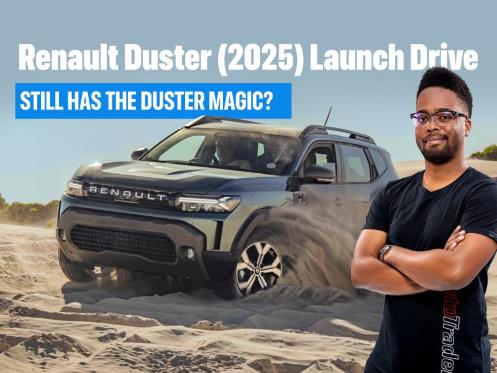
2026 Renault Duster 1.2T hybrid Zen 4WD Road-Trip Review
Renault’s new Duster 1.2T hybrid Zen 4WD promises big‑adventure energy on a compact‑SUV budget – but can a manual, mild‑hybrid 4x4 really handle a loaded South African road trip without fraying your patience? On paper, it’s rugged, efficient and cleverly packaged; in real life, things get decidedly more interesting!


The Duster and I go a long way back. Ever since its launch, I’ve taken quite a few Dusters on December holiday road-trips over the years.
When Renault offered me a Duster in (all-wheel-drive) hybrid guise towards the end of last year, I agreed immediately. This would be the first time I’d have a new-gen, mild-hybrid turbo-petrol Duster in my driveway for a month, and I was terribly curious how this year's test would go. But before we start, here's some essential info.

Renault Duster 1.2T hybrid Zen 4WD: Fast facts
Price: R549 999
Engine: 1.2‑litre, 3‑cylinder turbo petrol mild‑hybrid (1199 cc), 96 kW, 230 Nm
Gearbox/Drivetrain: 6‑speed manual, all‑wheel drive (4WD)
Fuel consumption (claimed): 5.7 L/100 km (combined)
My tested consumption: read more to find out!
Boot: 444 litres (4×4 model, seats up)
Wheels/tyres: 17‑inch alloy wheels, 215/65 R17 tyres
Spare: Full‑size steel spare wheel
Dimensions: 4 343 mm (L) / 1 921–2 069 mm (W, excl/including mirrors) / 1 661 mm (H); wheelbase 2 658 mm; ground clearance 217 mm
Safety: 6 airbags, ABS, ESC, hill‑start assist, tyre‑pressure monitoring, rear PDC and reverse camera, ISOFIX child‑seat anchors, and more
Warranty/plan: 5‑year/150 000 km warranty; 3‑year/45 000 km service plan (15 000 km intervals)
Styling
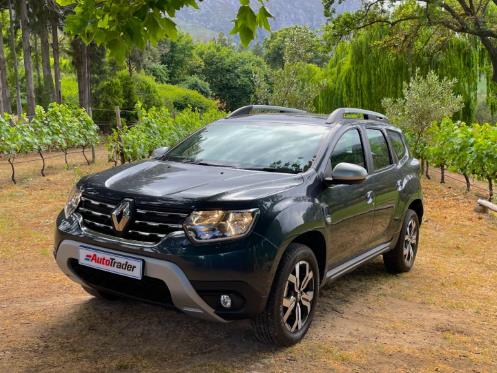
The design team nails the exterior design with a boxy, retro-modern look and curves and indentations in all the right places. It looked fetching in our test model’s 'Cedar Green' metallic colour; it’s not the kind of car you’ll lose in a crowded parking lot.

If I had to score the Duster on design alone, I’d give it a 9 out of 10 for its well-executed ruggedness. The Duster lettering below the bonnet adds a sexy touch.

Interior
The Duster retains its functional layout, with its familiar, robust build quality and comfortable, hard-wearing cloth seats. There are quite a lot of hard plastics inside the cabin, but in Renault's defence, plenty of them are recycled.

The Duster gets a well-sized, high-resolution infotainment touchscreen with volume buttons on top, so the front passenger can also turn music up or down (the driver can control this functionality via buttons behind the steering wheel). The touchscreen displays driving data and scores your driving economy, along with other modes and settings galore. The rearview camera display is quite grainy, but it does the job.

A 7.0-inch digital instrument cluster offers a selection of views; in our mild-hybrid test model, you can see an image of the engine/electric motor/battery at work, and how power is utilised. The 4WD model features off-road driving information, such as lateral tilt, uphill/downhill pitch, and torque distribution, also displayed on the central touchscreen.

Wireless Apple CarPlay and Android Auto are available, and pairing is quick and easy. The system's sound quality is good enough to enjoy the playlist of your choice via your favourite streaming app. Two USB-C ports in front and two in the back sort out charging and connectivity.
Space and Comfort
Ergonomically, most of the layout makes sense, but there are a few design flaws. The centre console armrest is too close to the central cupholders, and the door cards are too narrow to hold anything meaningful, like water bottles.
As for the small binnacle below the air-conditioning controls (Renault thankfully retains these switches instead of making you go diving into the touchscreen), it’s not rubberised, and not angled in such a way that small items don’t fly out when you drive around a corner.

Seating in row two offers decent legroom; at one point, I had two tall teenage boys riding in the back seat, all seated comfortably, with a shorter girl in the middle. There is no fold-down armrest in the centre; however, cup holders are a rarity. Rear air vents are not present, and those in row two complained about it at first, but turning up the air-con cools the whole cabin quickly.

The boot is generously sized at 474 litres, with enough space for 3 days’ worth of camping gear, or holiday luggage for four adults. Young families will appreciate the boot size and height for the easy loading of a baby buggy, with room left for groceries. Isofix points are available and easy to get to.

The Drive
Since the Duster spent a month with us, we had ample opportunity to take it on day-trips. Where we live, there are a multitude of picturesque towns, beaches, and wine farms nearby, and we also used the Duster to get some much-needed admin out of the way in neighbouring towns, like applying for my daughter's ID. It was also our daily driver, and I drove kids around in it until the cows came home.

In town, things aren’t quite as smooth. With the short first gear and the manual–hybrid combo, I often had to concentrate to pull away cleanly in lower gears, but your experience may vary. (My husband agreed on the low-speed jerkiness.) Avoiding Eco mode helps to alleviate this niggle, but only to some extent. I also inactivated the Stop/Start system.
Performance
The 1.2‑litre turbo‑petrol with its mild‑hybrid assist delivers 96kW and 230Nm, which is enough shove for daily driving and gravel‑road exploring, as long as you’re prepared to work the six‑speed manual and keep the revs in the meat of the torque band.
It’s noticeably more refined and quieter than the old diesel, but also more sensitive to load – pack it full of people and luggage, and you'll feel it.
Out on the highway, the Duster enjoyed stretching its legs. Because of the solid engineering and quiet cabin, you had better keep an eye on the speedometer reading or employ cruise control, because you won't realise how fast you're going.

To avoid the Hermanus December traffic, I'd often take a detour via the Karwyderskraal dirt road and Hemel-en-Aarde valley, where the Duster showed off its all-wheel-drive surefootedness on the rutted, gravelly surface. The 4WD Duster has a rotary dial to activate a variety of settings, namely Auto, Snow, Mud/Sand, Off-road (which keeps it in permanent 4WD), and Eco, plus downhill speed control for those hair-raising descents.

It's not quite as accomplished an off-roader as the Suzuki Jimny, so forget about rock crawling, but it's certainly way more capable than your average SUV, thanks to sufficient underbody protection, better approach and departure angles than the previous model, and 217 mm of ground clearance. (There is no low-range transfer case, but as I've mentioned, you can "lock" the wheels into all-wheel drive.)
Fuel Consumption
Driving in traffic raised our consumption to around 8.3 L/100 km, but it never dropped below 8. The official press release states 5.7, but I couldn't get my consumption anywhere near that number. Could the trip computer have been wrong? Possibly, as the petrol lasted longer than the trip computer indicated. Real-world usage is around 6.5-7 L/100 km. (Renault claims 5.7.) My rough estimate is about 650-700 km per (50-litre) tank if you don't gun it. The diesel Duster of yore could drive from Cape Town to Bloem on a single tank!

Safety
The Duster holds a 3-star safety rating with EuroNCAP. To learn more about the Duster's on-board safety equipment, please read: What safety features does the Renault Duster have?

Competitors
The 5-door Suzuki Jimny starts at R437 900 for the 1.5 GL AllGrip 5-door manual. Other rivals include the Suzuki Grand Vitara (Hybrid AllGrip models can be found in the used-car market)/Toyota Urban Cruiser, Mitsubishi Outlander Sport, Kia Seltos, Toyota Corolla Cross, Hyundai Alcazar, Mazda CX-30, Hyundai Creta, Peugeot 2008 and a multitude of Chinese rivals like the Jaecoo J7, Chery Tiggo 7, Jetour Dashing/T1, BAIC Beijing X55/B30 and Omoda C7, to name a few.

Related: Suzuki Grand Vitara First Drive Review
However, if you want a new SUV with 4x4 capability, it's really down to the Jimny or even the bigger Mahindra Scorpio-N in 4XPlor guise (from R587 999 for all-wheel-drive models).
Price
- Renault Duster 1.3T Zen – R 489 999
- Renault Duster 1.3T Intens – R 519 999
- Renault Duster 1.2T Hybrid Zen 4WD – R 549 999

The Verdict
There aren't many cars in this segment that offer decent off-roading skills in such a family-friendly form, so if you live in an area where dirt roads make up part of your daily routine, and you like to visit interesting and/or secluded places with the family on weekends, this Duster still makes good sense.
The now-discontinued diesel duster, however, was one of Renault's most reliable and fuel-efficient models, and the competent 4x4 model's low-end torque was excellent in challenging terrain. Watch this video from 2016 here to see it in action. So, have a look on AutoTrader for a pre-loved one if you'd rather go this route; we'd recommend 4x4 models from 2017 onwards.