
First Drive Impression: Ford unveils revised Ranger – now with Bi-Turbo technology
First Drive Impression: Ford unveils revised Ranger – now with Bi-Turbo technology


By Chad Lückhoff
The updated 2019 Ford Ranger sees the introduction of a new 2.0-litre single and Bi-Turbo engine along with a brand-new 10-speed automatic gearbox and suspension upgrades.
The Ford Ranger is one of those love/hate vehicles. It's a bit like Marmite where either you love it or you hate it. If you hate it, you're probably a Toyota Hilux fan and you don't take kindly to the onslaught presented by the Ranger double cab.
While the Ranger was never my personal pick of the litter (and neither is the Hilux for that matter), there's no denying that it is a rather accomplished bakkie. It's come a long way in the time its been with us and the fact that South African built Rangers are exported to 148 countries is testimony the fact that it is a quality product.
New Engines.
Getting down to the main reason we're here; the new engines on offer.
The ranger is now available with an all-new 2.0-litre turbo diesel engine in two flavours, a single-turbo configuration for XLT 4x4 and 4x2 double cab models and a Bi-Turbo version for the double cab Wildtrak models.
This single-turbo engine produces 132 kW and 420 Nm torque, surpassing the performance that is offered in the existing 2.2-litre TDCi engine. Where the 2.2 TDCi was known for having a rather lazy get-up-and-go at engine speeds just above idle, the 2.0 and its variable-geometry turbo fills in these gaps and provides a greater sense of urgency on pull away.
The pick of the litter is undoubtedly the 157 kW and 500 Nm Bi-Turbo offering that is now an option in the Wildtrak. The sequential turbocharger setup ensures that low rev torque doesn't suffer at the cost of high-end power with the smaller of the two turbos feeding into the larger turbo, covering the rev range and providing a more linear power delivery.
We found the Bi-Turbo setup to be rather agreeable with more than sufficient low-end torque delivery and a smooth progression into the higher rev ranges with less drop-off as we approached the red line.
The 2.0 SiT (the designation for the single turbo XLT) still managed to provide adequate torque in the lower end with the drop off only marginally more noticeable up top when compared directly to the BiT Wildtrak.
For the moment, these new engines will be offered alongside the current 2.2 and 3.2 Duratorq engines, offering the customer a choice of power plants. These will still be mated to the existing 6-speed automatic gearbox.
New Gearbox.
Helping smooth things over is the all-new 10-speed automatic gearbox that one will find coupled to the new 2.0-litre engines.
This joint-venture project with GM will see more Ford models running this advanced cog-swapper and we can expect to see it in the new Mustang (due for local release later this year) as well as the F150 and Gm using it in the likes of the Camaro.
Multi-speed gearboxes (and by that, I infer gearboxes with more than 6-speeds) are often plagued by too many noticeable changes, both with the up and downshifts. The new gearbox in the Ranger, I will admit, is better than anticipated, with only certain instances where gradient and throttle application had it hunting for two or three gear momentarily before settling into a cog. Ford has run over 6 million kilometres programming the gearbox and this effort is evident as in daily application the shifts are smooth and performed in the background.
Suspension Tuning.
One of the detractions in the Ranger for me was the rather jittery ride, especially evident when negotiating uneven surfaces. The tautly strung rear end would hop and jostle over the corrugations, often unsettling the entire vehicle as the oscillations amplified.
With the update, Ford has moved the front anti-roll bar and shifted the bump stop dampers to provide a better front end feel. Further improvements have been made to the dampers so that each engine derivative receives a dedicated spring rate, tuned for the specific engine and gearbox combination.
These changes are by far the most noticeable improvements to the Ranger with the skittish nature now a thing of the past. I would hazard to say that the suspension is almost too supple now and those that are accustomed to the ride presented by unladen double cabs will need a few kilometres before accepting that the new setup is in fact, not broken. It rides more like an SUV than a bakkie now – and that's a good thing.
Minor Cosmetics.
Only a few small cosmetic changes have taken place with some changes to the grille, bumper and alloy wheel selection. The changes are better felt in the lower spec models where chrome bumpers are now a no-cost option on the models that previously sported unpainted bumpers.
HID headlights and LED Daytime Running Lights are now a standard feature on the Wildtrak.
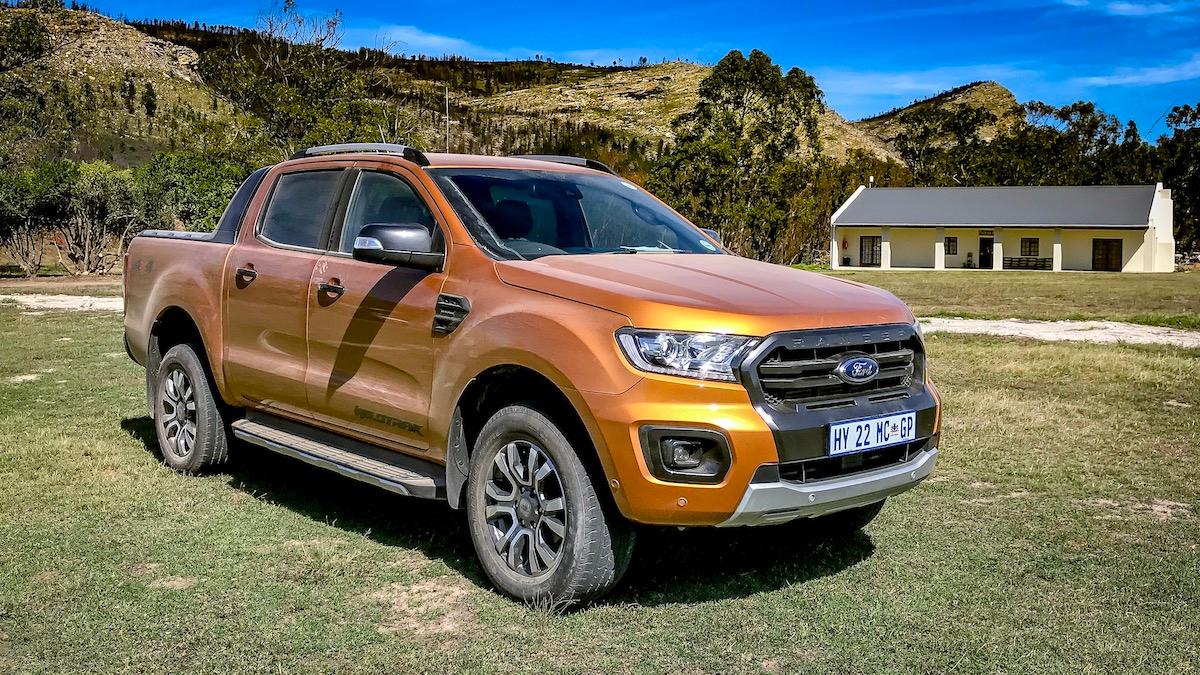
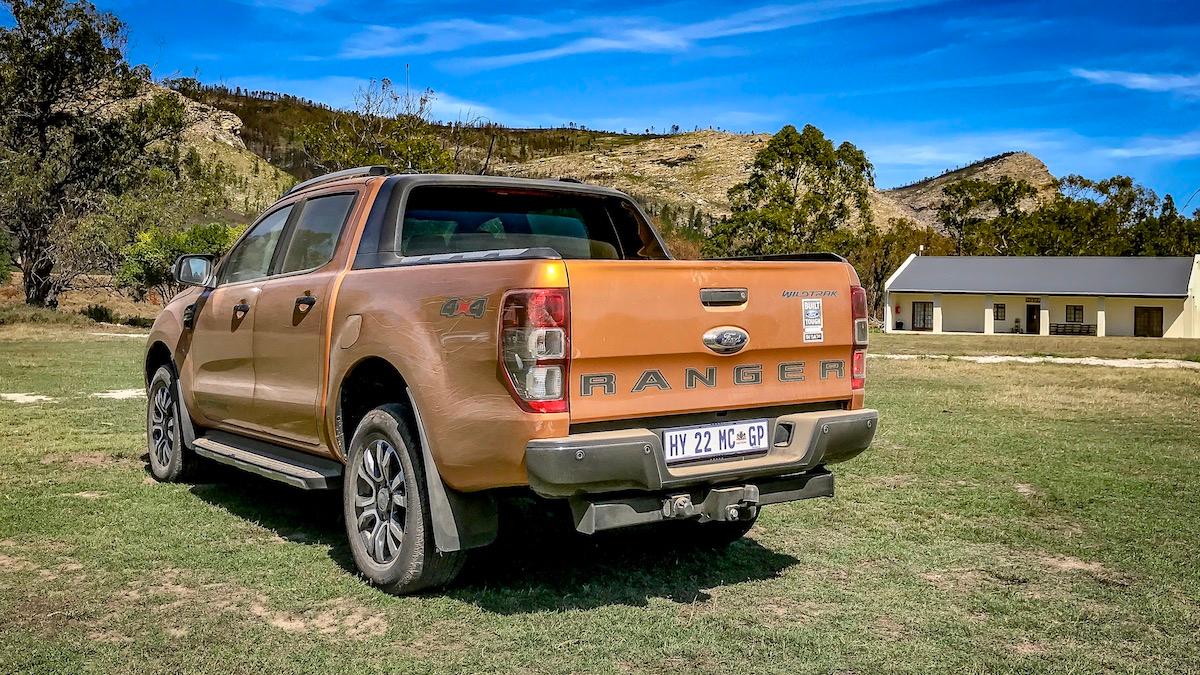
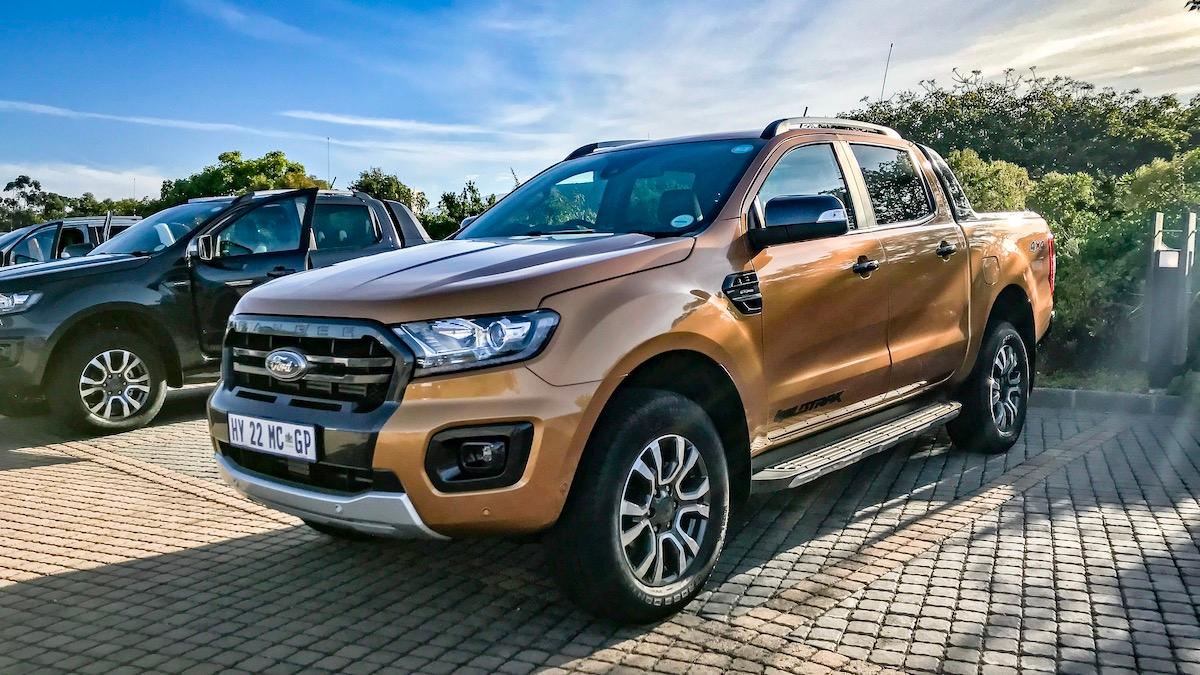
A new colour, Saber Orange is available on the Wildtrak, and this sees it paired with dark chrome elements in the interior and a full black, partial leather upholstery with orange stitching, adding to the premium look and feel that Ford is aiming for.
Improved safety, security and convenience.
Ford has listened to the plights of their customers and has further bolstered their Rangers with improved comfort, safety and most importantly, security.
Depending on the model selected, the Ranger is now fitted with a Cat 1 Thatcham-spec alarm system, spare wheel lock, improved door lock mechanisms and alarm horn protection.
Noise levels are also drastically improved. Ford did this by fitting laminated acoustic side glass and a noise cancellation system that works rather well, especially when combined with the quiet operation of the new engines.
A host of safety systems are also present including Electronic Stability Control (ESC) with Traction Control (TC), Trailer Sway Control (TSC), Hill Start Assist (HSA), Hill Descent Control (HDC), Adaptive Load Control (ALC) and Roll Over Mitigation (ROM).
Semi-Automatic Parallel Park Assist is now standard fitment on the Wildtrack as well as Adaptive Cruise Control with Forward Collision Alert, Lane-Keeping Alert and Lane-Keeping Aid, and Auto High Beam Control.
Pricing.
The pricing has remained largely unchanged with only minor adjustments taking place.
Single Cab
| 2.2 TDCi Base 5MT 4x2 | R287 100 | |
| 2.2 TDCi XL 6MT 4x2 | R359 800 | |
| 2.2 TDCi XL 6AT 4x2 | R372 300 | |
| 2.2 TDCi XL 6MT 4x4 | R411 400 | |
| 2.2 TDCi XLS 6MT 4x2 | R390 900 | |
| 2.2 TDCi XLS 6AT 4x4 | R449 200 | |
| 3.2 TDCi XLS 6MT 4x2 | R401 800 | |
| 3.2 TDCi XLS 6AT 4x4 | R460 100 |
SuperCab
| 2.2 TDCi Base 5MT 4x2 | R336 500 | |
| 2.2 TDCi XL 6MT 4x2 | R381 400 | |
| 2.2 TDCi XL 6AT 4x2 | R393 800 | |
| 2.2 TDCi XL 6MT 4x4 | R429 300 | |
| 2.2 TDCi XLS 6AT 4x2 | R426 400 | |
| 2.2 TDCi XLS 6AT 4x4 | R472 400 | |
| 3.2 TDCi XLS 6MT 4x2 | R424 900 | |
| 3.2 TDCi XLS 6MT 4x4 | R480 900 | |
| 3.2 TDCi XLT 6AT 4x4 | R568 600 |
Double Cab
| 2.2 TDCi Base 5MT 4x2 | R350 000 | |
| 2.2 TDCi XL 6MT 4x2 | R409 400 | |
| 2.2 TDCi XL 6AT 4x2 | R428 800 | |
| 2.2 TDCi XL 6MT 4x4 | R455 300 | |
| 2.2 TDCi XL 6AT 4x4 | R474 700 | |
| 2.2 TDCi XLS 6MT 4x2 | R455 100 | |
| 2.2 TDCi XLS 6AT 4x4 | R508 400 | |
| 2.0 SiT XLT 10AT 4x2 | R514 300 | |
| 2.0 SiT XLT 10AT 4x4 | R570 200 | |
| 3.2 TDCi XLT 6MT 4x2 | R542 600 | |
| 3.2 TDCi XLT 6AT 4x2 | R571 400 | |
| 3.2 TDCi XLT 6MT 4x4 | R604 800 | |
| 3.2 TDCi XLT 6AT 4x4 | R617 300 | |
| 3.2 TDCi Wildtrak 6AT 4x2 | R609 800 | |
| 2.0 BiT Wildtrak 10AT 4x2 | R632 300 | |
| 2.0 BiT Wildtrak 10AT 4x4 | R678 200 |
All models come standard with Ford Protect, comprising a four-year/120 000 km comprehensive warranty, three-year/unlimited distance roadside assistance and five-year/unlimited km corrosion warranty. A six-year/90 000 km service plan is included, with 15 000 km service intervals.
Ford Ranger vs Toyota Hilux vs Nissan Navara: Which one is the best value for money?
Which Ford Ranger trim holds its value the best?
Will the 2019 Ford Ranger double cab be a good fit for your family?