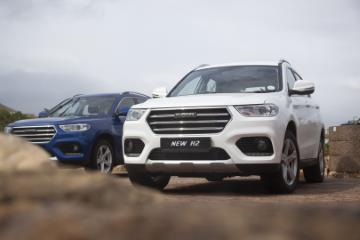
Which Haval H2 trim holds its value better?
South African buyers have taken the Haval H2 to heart and turned it into one of this brand’s most popular offerings. And why shouldn’t they? The H2 looks attractive has a comprehensive spec sheet across the range and can be had for very little outlay. But how does the used-car market feel about this Chinese offering? Let’s see which Haval H2 holds its value better.



Haval’s H2 first arrived here in mid-2017, as one of the first in a series of high-value challenger SUVs tasked with establishing the brand in our market. At launch, there were three available trim levels (since cut back to two), each with a choice between manual and automatic transmissions. The brand’s growth since then has been phenomenal and now comprises a much wider range of SUVs and crossovers.
Related: The top 3 Haval H2 features that stand out from the competition.

To determine how well these early H2s maintained their resale values, we rounded up the selection of 2018-model Haval H2s listed on AutoTrader. We then compared their averaged current market values to what they cost when new, to determine their percentage of retained value. The mileage cap was set at 20 000 km per year (meaning 10 000 km for a 5-year-old car), corresponding with an industry-average annual mileage.
For today's comparison, we have chosen 2018-models with less than 100 000 km, because the sample size is a bit wider. If you have decided to pull the trigger on one of these pre-owned H2s and are looking to sell your car, remember that AutoTrader can give you an Instant Offer!
Related: This early review of a Haval H2 Luxury automatic (correctly) predicted this model’s future success.

2018 Haval H2 City manual
New Price: R 259 900
Current Market Value: R 233 083
Value retained: 89.68%
This is a surprising result for the entry-level H2, but this impressive value retention must be seen against the backdrop of a very small sample size: there were only 8 examples of this variant listed on site at the time of writing. It looks promising for the range as a whole, though – if the low-spec, manual variant seemingly retains a lot of its initial value, the higher-spec ones may perform even better.
2018 Haval H2 City automatic
New Price: R 294 900
Current Market Value: R 254 755
Value Retained: 86.4%
The same caveat applies to the 2018 Haval H2 City automatic: there were only five listed at the time of writing, so this small sample size may render any verdict as inconclusive. 84.8% value retention for that single City automatic still runs its manual sibling close, however...
2018 Haval H2 Luxury manual
New Price: R 300 900
Current Market Value: R 246 566
Value Retained: 81.9%
The manual derivative of the H2 in Luxury-trim appear to be the models that lose the most value, however, a figure of over 80% over the course of five years is still impressive.

2018 Haval H2 Luxury automatic
New Price: R 319 900
Current Market Value: R 269 804
Value Retained: 84.3%
The top-level automatic H2 has the largest sample size, with 13 examples fitting our criteria on site at the time of writing. While the 84.3 % value retention of these high-trim H2s is less impressive than the apparently stronger showing of the City derivatives, the chances are that any deviations from its norm can be attributed to statistical anomalies.
Related: Apart from sloppy gearbox programming, our second review of a Haval H2 still found a lot to like.

Verdict
With at least 81.9% value retention in the range, the earliest Haval H2s still command impressive resale values after five years. In fact, that figure is closer to what we’d expect from a two-year-old car, and quite far beyond our expectation for a Chinese challenger brand. From what can be deducted from a very limited data set, it would appear as though there’s another reason to add to the Haval H2’s purchasing checklist, on top of a low purchase price and plenty of equipment: good resale value. That is a nice surprise indeed.
Related: We compared the Haval H2 to the Ford EcoSport and Renault Duster, and come to a surprising conclusion.