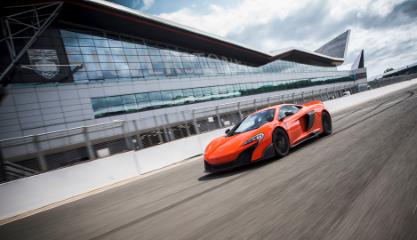
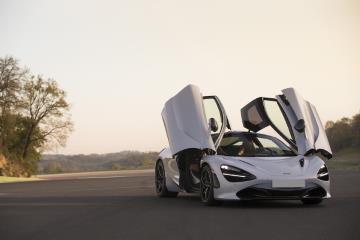
What are the top 4 differences between a new McLaren Artura and a used McLaren 570S?
For most of the decade since McLaren returned to road car production, their entire product line-up was based around a single platform, albeit with different propulsion systems, suspension arrangements and body styles. The new Artura is a rather different beast, however, and heralds the arrival of a new generation of McLaren sports- and supercars.



There’s no denying that McLaren got a lot of mileage from their first modern-era platform, putting it to good use in everything from the early 12C to the P1 hypercar. The same applies to their twin-turbo V8 engine, which produced anything from 397 to 588 kW, depending on the application.
But technology doesn’t stand still, so the time has come for the old architecture to be replaced. Let’s look at the changes by comparing the outgoing McLaren 570S (and current McLaren GT) to the new McLaren Artura.
Related: Shop for new and used McLaren sports cars for sale here.

1. Next-generation carbon-fibre tub
It’s not as though the old 570S employed an archaic design for its centre section, mind you: the old car’s carbon tub (housing the passenger cell and providing attachment points for the suspension and drivetrain) weighed only about 75 kg in its initial form, and applied proper race-car engineering in its construction.
But there’s always room for improvement, so the new Artura’s tub boasts increased stiffness, improved safety structures, and provides protection for the fuel tank and battery packs. And, in spite of these advances, it only weighs about 2 kg more than the old one. This is partly due to improved material technology, but also reflects recent advances in carbon-fibre construction techniques.

2. Good-bye V8, hello V6 hybrid!
Make no mistake, the old twin-turbo McLaren V8 (family code name M838T) was a powerhouse of note, generating close to 600 kW from a maximum of 4-litres of displacement. In fact, the flat-plane V8 was a key part of the blistering P1 hypercar’s mechanical make-up, where it operated with electric augmentation to produce total system outputs of 740 kW and 1050 Nm in GTR- and LM trim.
In the 570S, the V8 delivered “only” 419 kW and 600 Nm, however, and was denied any form of electrification. For the new Artura, McLaren drew upon the expertise gained with the P1, and employs electrification to boost the performance of their new, downsized powerplant.
The plug-in electric system can deliver up to 70 kW and 225 Nm, and acts as a “torque filler” to smooth-out the highly-strung new engine’s torque delivery. It also allows up to 30 km of all-electric driving range, courtesy of a 7.4 kWh lithium-ion battery pack. On the petrol side of the Artura’s drivetrain is a new twin-turbo V6 displacing 3.0 litres, good for 430 kW and 584 Nm.
Getting that much power out of a 3.0-litre engine implies rather heavy turbo boost and a bias towards top-end power (also illustrated by the V6’s 8 500 r/min red line), which would likely also lead to a lot of turbo lag and sluggish throttle response in isolation. This is where the electric motor’s instantaneous torque delivery jumps in to help, sharpening the engine’s responses while those big turbos get up to speed.

3. From 7 speeds to 8... but no reverse gear!
With a new engine and the addition of hybrid technology, it makes sense that the Artura’s transmission also received an upgrade. The 570S (and all the other McLarens of its generation) employed a 7-speed dual-clutch automatic, but the new car ups the ratio count to 8. Benefits of adding that extra forward gear includes stronger acceleration, a wider overall ratio spread, and improved fuel efficiency.
But there’s an interesing catch: the Artura’s new gearbox doesn’t even feature a reverse gear. Instead, reversing duties are taken up by the electric motor, thus saving weight in the transmission (and possibly also creating the extra room needed to accommodate the 8th forward ratio).

4. McLaren finally adopts a limited-slip differential
While some recent track- or race-focused McLaren models employed a limited-slip differential (or had one available on request), their road-going line-up always had to make do without this traction-enhancing hardware. Instead, McLaren developed their brake-actuated torque- and stability management system to act like a limited-slip diff (LSD). But with the new Artura, the engineers finally caved and fitted an electronically-controlled torque-vectoring differential.
Acting like a traditional LSD when power is being sent to the tarmac, it can also selectively slow down the rear wheels to sharpen steering response and improve stability in corners. Against a stop watch, the difference between the old (brake-actuated) system and the new (properly-controlled LSD) setup may not be all that noticeable, but in terms of driving sensations, the new car should be even more responsive and driver-friendly than the old one.