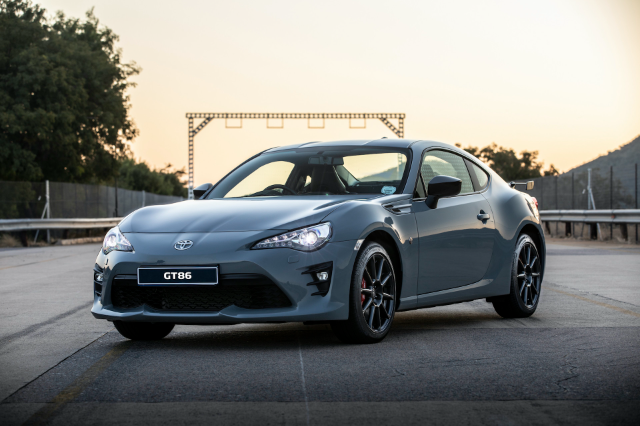
Top 3 things you need to know about the Toyota 86
Even though the Toyota 86 is really a Subaru BRZ in disguise, there’s no denying that the Toyota-branded product has met with greater worldwide success than its near-identical twin. There’s a new generation coming soon, following the same recipe but enhanced in a number of key areas. Let’s investigate the top 3 things you need to know about the Toyota 86 - how it was, and what's to come..



Few people expected Toyota to return to the realm of rear-wheel drive sports cars, a market segment they abandoned before the start of the 21st century. But, after linking up with Subaru to produce the Toyota 86/Subaru BRZ twins, they’ve experienced enough success to justify a follow-up to their (relatively) affordable RWD driver’s car.
Not only is there a new 86 on the way (with its local release currently pencilled-in for early 2022), but for its second round, it will be accompanied by two other driver-focused GR-branded, high-performance Toyotas: the phenomenal GR Yaris, and the brutal GR Supra. It’s nice to see Toyota catering for the enthusiast market again, proving that they can make keen drivers as happy as they make those buyers who simply need durable and reliable transport.
Related: Shop for used Toyota (GT) 86 cars for sale here.

1. The next one should be quicker...
The upcoming Toyota GR 86 (instead of GT 86) will not have a crowded field of opponents to face when it arrives here, as it will be one of very few remaining cars in its class. That didn’t keep Toyota from upgrading the mechanical specification for the second generation, however, with the 86’s engine getting a displacement hike from 2.0- to 2.4-litres for a useful serving of extra performance.
There’s still no turbocharger in sight, because Toyota believes that this kind of car really needs a naturally-aspirated power unit, but the extra capacity does elevate the engine’s outputs from 147 kW and 205 Nm to about 173 kW and 250 Nm. Local specifications will be confirmed closer to release, but these preliminary output claims represent a handy increase over the first-generation model, and should alleviate much of the “it needs more power!” criticism levelled at the old car.

2. Continuous upgrades for the first-generation 86
The GT 86 no longer features in Toyota’s new-car price list, and the new GR 86 is yet to arrive, which means that you can only buy a used, first-generation 86 at the moment. When shopping for a GT 86 in the used-car market, it’s worth remembering that the first-generation car received a number of updates over its 8 years of local availability.
While the drivetrain and body shell has remained essentially unchanged, the supporting bits haven’t. The suspension was upgraded in various stages, to incrementally enhance steering response, stability, and body control; and some mild restyles and updated lighting designs were adopted in 2015, 2017, and 2019. The last facelift also brought improved brakes, with larger-diameter discs and Brembo calipers all round.
In similar vein, the cabin received a number of updates through the years, with improvements to trim materials, standard equipment levels and newer infotainment systems being progressively introduced. This means that the GT 86 got better with each revision, so, if your budget allows, opt for the newest GT 86 you can find. However, if you’re keeping an eye on your wallet, an earlier example will provide much the same driving thrills for a much smaller outlay.

3. It’s all about the driving experience
This isn’t the car to buy if you value bland speed: a previous-generation Polo GTI would run rings around even a manual GT 86 in a drag race, for example. Opting for an automatic transmission (as was available pre-2019) will prolong the 0 – 100 km/h acceleration time from the manual’s 7.6 seconds to 8.2 seconds, so if simple acceleration is your thing, you would likely be happier in a used hot-hatch instead.
But this picture changes when you throw some track day fun (or general driving dynamics) into the equation, because everything about the 86 was designed and calibrated to make its driver smile when the road turns twisty. For an experienced pilot, the combination of comparatively light weight, a high-revving engine, low-set driving position and RWD handling balance results in a driving sensation unlike anything else at its price point.
That is the main reason for buying a Toyota 86, really. It’s neither very fast nor very practical, but for someone who wants something that looks and drives likes a traditional sports car at a relatively affordable price, those factors are likely of secondary importance. Driving fun comes in many forms, and the answer isn’t always Miata...