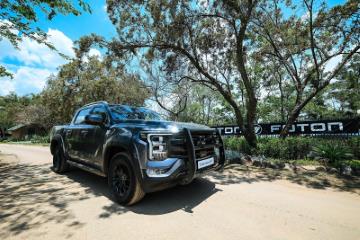
Chad drove the Tata Harrier 2.0 TD Fearless+ in the depths of Gauteng, while I had the opportunity to drive the same model here in the Western Cape. Are we in agreement about its strengths and weaknesses?
Let's start at the beginning.

Tata Harrier price and trims
We have three models in the lineup as follows:
• Pure+: ±R549 900
• Adventure+A: ±R649 900
• Fearless+: ±R699 900 (tested)

Key specs
The Harrier was launched in India in 2019 and underwent an upgrade in 2023; this is the model currently available in SA.
All Harriers in SA use the same 2.0‑litre turbodiesel (125 kW/350 Nm) with a 6‑speed automatic driving the front wheels. The claimed economy is 6.6 L/100 km, and the tank is 50 litres. Dimensions: 4,605 mm L, 1,922–2,131 mm W (mirrors), 1,718 mm H, 2,741 mm wheelbase. Boot: 445–815 litres. Tyres: Pure+ 235/65 R17; Adventure+ A and Fearless+ 235/60 R18. Full‑size steel spare (235/70 R16). Warranty 5 years/125,000 km; service plan 5 years/75,000 km (15,000 km intervals).

What the Tata Harrier gets right
In Fearless+ trim, the Harrier looks the part with its reflective grille detailing. Inside, adults fit behind adults comfortably, there’s proper charging front and rear, and the boot’s low lip makes prams and heavy shopping a slide‑in, not a heave‑up. The panoramic roof, ventilated front seats, and electric tailgate (Fearless+) are feel‑good features you’ll use daily. You also get ambient lighting, ventilated seats, and a JBL sound system, among others. It certainly is not short on spec; in fact, Tata went almost over the top with comfort and convenience features. Have a look at the whole list and download the brochure here.
If you're after a 5-star NCAP rating, you'll be pleased that the Harrier scores top marks. The semi-autonomous technology is impressive; I've never seen a car drive 'on its own', ie, without driver input for such a long time.

Where it doesn't shine
The hazard and boot buttons live too close together on the centre console — it's easy to press the wrong one. There’s too much piano‑black trim, and some finishes feel a bit mixed for the money. The mostly ineffective voice assistant, parking sensors, and the seatbelt jingle are over‑eager, and alert volumes, if you've turned them down, don’t always “stick” after a restart.

Ride comfort on 18-inch tyres can be harsh on rough tarmac, and the steering is vague with excessive play around the centre point. A lot is going on. Throw in a busy mom and dad trying to juggle family life and a career, two boisterous kids, and you may need a prescription for anxiety meds along with your warranty and service plan.
As for the driving assistance systems, I found it odd that it would ask me to put both hands on the steering wheel when they were already there. These software gremlins need to be addressed.
(In Tata's defence, the new Tiago is a great entry-level car.)

Real‑world fuel economy (L/100 km)
Diesels in the mid-size segment are few and far between, so we were keen to find out how economical this Tata would be. Those who tow caravans will appreciate the low-down torque and the decent fuel economy.
These are the average numbers I got when testing the Harrier:
• In the city: Around 9.0 L/100km
• Combined (highway and city, mixed driving): About 7.8 L/100km
• Open road: Around 7.0 L/100 km.
Chad matched the official 6.6 L/100 km on test; other local reviewers broadly align. Your results will depend on your driving style and speed, of course.
There is a selection of driving modes to choose from.

What to check during your Harrier test drive
If the Harrier piques your interest, read this article titled How do I test drive a car before buying it and once you're at the dealership, pay special attention to the following:
• Buttons and beeps: See what you can turn off and see if you can live with what remains.
• Ride and noise: Rough‑tar loop at 60–80 km/h; if you’re sensitive, try the Pure+ on 17-inch wheels
• Driver aids: Test lane‑keeping on clearly marked roads (excellent in our test model), but confirm that the deactivation warnings are prominent enough.
• Everyday ease: Make fine temperature and volume changes without taking your eyes off the road, and see if it poses a challenge.
Who should buy a Tata Harrier?
• Families who want space, a low loading lip and lots of tech and safety features per rand.
• Drivers who value clever aids like adaptive cruise control, lane-keeping assistance and 360° cameras, along with a whole suite of comfort and convenience features such as ventilated seats. If you value semi-autonomous tech that can do the heavy lifting in traffic and on the open road, you'll like the Harrier.
The mid-spec model is the sweet spot for those seeking the best value.
Who should think twice?
You’re allergic to constant beeps and voice prompts, you want plush ride comfort and precise steering feel, you want fuss-free infotainment software, and you're a stickler for a high-quality cabin with excellent ergonomics.

Alternatives in the segment?
I salute Tata for their bravery in taking on the biggest names in the mid-size SUV segment, such as the highly acclaimed Kia Sportage, refined VW Tiguan, and evergreen Kia Tucson. These are established players for a reason.
Want to go bigger at around the same price? Seven-seaters in this price range include the impressive 2.2-litre (turbodiesel) Mahindra Scorpio-N (which features a ladder frame chassis), as pitted against the Harrier in this article.
The Hyundai Alcazar (reviewed here) also offers a seven-seat configuration and a very user-friendly ownership experience, starting from R599 900 for the diesel models.
Related: BAIC B40 vs. Mahindra Scorpio-N vs. Proton X70