Porsche Boxster vs BMW M440i vs Jaguar F-Type: which one is the best value for money?
The Porsche Boxster GTS 4.0 is one of the very last naturally aspirated mid-engine sportscars available, but it certainly isn’t the only sporty convertible on the market. We compare three premium drop-top options to determine which is the most value-filled.


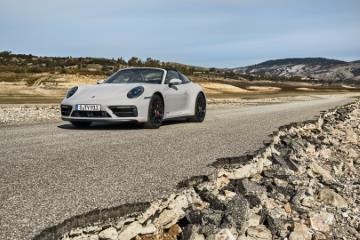
The world of R1.0-million-plus convertibles is certainly a very small automotive niche in the grand scale of things, however, there’s no denying the allure of infinite headroom coupled with grin-inducing performance. One of these best examples of a sporty convertible is the Porsche Boxster, particularly in the GTS 4.0 guise, where the sonorous flat-six can be enjoyed while exploiting one of the sweetest handling products yet produced.
In this comparison, we are pitting the Boxster GTS 4.0 auto against the four-seat BMW M440i xDrive convertible as the Z4 is nearly R300 000 less than the Porsche, making the 4 Series, which is R150 000 less, more comparable in this value comparison. In the interest of fairness, we have also added a product that is both more expensive and more powerful than the Porsche in the form of the Jaguar F-Type P450 R-Dynamic convertible. Today we determine which of these three offer the best value for money.
The competitors
|
|
Porsche 718 Boxster GTS 4.0 auto |
BMW M440i xDrive convertible |
Jaguar F-Type P450 R-Dynamic convertible |
|
Engine size |
6-cyl, 4.0-litre petrol |
6-cyl, 3.0-litre turbo petrol |
8-cyl, 5.0-litre supercharged petrol |
|
Power/Torque |
294 kW/430 Nm |
285 kW/500 Nm |
331 kW/580 Nm |
|
Kerb Weight |
1 510 kg |
1 965 kg |
1 793 kg |
|
Gearbox |
7-speeed dual-clutch automatic |
8-speed automatic |
8-speed automatic |
|
Airbag count |
6 |
6 |
4 |
|
Driven wheels |
Rear |
All |
Rear |
|
Seats |
8 |
11 |
7 |
|
Price |
R1 510 000 |
R1 366 234 |
R1 659 276 |
|
Fuel capacity |
64-litres |
59-litres |
70-litres |
|
Maintenance plan |
3 yr/100 000 km |
5 yr/100 000km |
5 yr/100 000 |
Comparing the trio
Practicality
On paper, the BMW is certainly the most practical, offering seating for four, 300-litres of boot space with the roof stowed away and 385-litres with the roof in place. The rear quarters in the 4 Series are not exactly spacious though, and the fact that the car only has two doors means that this will predominantly be used to transport one or two people.
The Porsche has a bit of a trick up its sleeve, offering a traditional boot as well as a storage area up front, called a frunk. With both storage areas accounted for, the Porsche offers 275-litres of luggage space, sufficient for two people. The Jaguar, despite featuring a massive V8 where one will find the Porshe’s frunk, still offers 132-litres of space with the roof down and 233-litres with the roof in place.

Power and performance
All three of the products assembled for this comparison are strong performers, with large capacity engines, automatic gearboxes and indeed, three different ways of achieving their respective outputs, with turbocharged, supercharged and naturally aspirated engines.
The Porsche’s trump card is its compact dimensions, low weight and large capacity engine. At just over 1 500kg and with a power output of 294kW and 430Nm of torque, the Porsche is quick, getting to 100 km/h in just 4.0 seconds and going on to a top speed of 288km/h. The performance is aided by a lightning-fast 7-speed dual-clutch automatic gearbox and superb traction, a hallmark of many Porsche products.
The Jaguar has the legendary AJ-V8 5.0-litre supercharged V8 under the bonnet, providing a symphony of sound and the most power in this comparison, with 331kW and 580Nm of torque. The engine is paired with a ZF 8-speed automatic gearbox sending power to the rear wheels. The F-Type’s weight is its downfall though, resulting in only the second-fastest 0-100 km/h and top speed, at 4.6 seconds and 285km/h respectively.
The BMW is the heaviest and least powerful in this comparison, producing 285kW and 500Nm from its B58 3.0-litre turbocharged inline-six coupled with a ZF 8-speed automatic gearbox. The M440i has the benefit of being all-wheel drive though, allowing it to sprint to 100km/h in 4.9 seconds and go on to a limited top speed of 250km/h.

Specification
The models that we have chosen for this comparison are premium products, but as with many models at higher price points, there are many optional extras available.
As standard, the 718 Boxster comes with 20-inch alloy wheels, climate control, the PCM infotainment system with Apple CarPlay and Bluetooth functionality, electric windows, suede-cloth/leather seats, fog lamps and xenon headlights making it rather basic, which enthusiasts may find endearing while others may consider it spartan.
The BMW gets quite a bit more kit, with 18-inch alloy wheels, climate control, a multifunction steering wheel, the superb iDrive infotainment system with built-in navigation, Apple CarPlay and Android Auto functionality, ambient lighting, comfort access, front and rear electric windows, leather seats, electric/heated front seats, rear ISOFIX child seat anchor points, LED headlights as well as front and rear PDC with park assist with reverse camera functionality.
The Jaguar also bests the Porsche in terms of spec, with 19-inch alloy wheels, a colour touchscreen infotainment system with Apple CarPlay and Android Auto functionality, climate control, electrically adjustable steering column, multifunction steering wheel, lane keep assist, cruise control, keyless entry, electric windows, suede-cloth/leather seats, electrically adjustable seats, LED headlights and front and rear PCD with a reverse camera as standard.
Safety
Since this trio are convertibles, safety is of the utmost importance for potential buyers. The good news is that all three of these products are considered safe.
The Porsche 718 Boxster has yet to be crash tested and is unlikely to be due to its relatively low sales volume status, however, all other Porsche products tested have received the maximum 5-Stars in the stringent Euro NCAP crash test evaluation programme. We can therefore assume that the Boxster will be safe, with roll-over protection and 6 airbags being just two of its safety items.
As with the Boxster and likely for the same reason, the Jaguar has also not been crash-tested, but also features roll-over hoops, 4 airbags and a host of electronic driver aids.
The BMW was tested by Euro NCAP in 2019 where it achieved a 5-Star safety rating, with a 96% score for adult occupant safety, 80% for child safety, 93% for pedestrian safety and 72% for its safety assistance systems.

Warranty & maintenance plan
The trio assembled here all offer good maintenance plans, but it is the Jaguar and BMW that share the spoils here, both offering 5-year/100 000 plans while the Porsche comes standard with a 3-year/100 000km plan, with the option of extending, at an additional cost.
Verdict
Looking at the figures, it appears that the BMW is the most practical, the cheapest, the safest, second-best in terms of specification but of course, the slowest, an important consideration. The Jaguar is the best specified and has the most characterful engine but is also the priciest. The Porsche presents great value for those looking for a back-to-basics sportscar, but it ultimately lacks the standard features one might expect from something at this price point. In this comparison, the BMW 4 Series, which will be considered the odd one out, appears to offer the most value for money.