
Mercedes-Benz E-Class vs GLC-Class vs X-Class: which one is the best value for money?
The E-Class is one of Mercedes-Benz’s mainstay products – and was, until the 1990s arrived, the least-expensive way to get behind a 3-pointed star in our market. But then their range expansion began in earnest, and pretty soon, there were significant points of overlap in their model range. To examine this phenomenon, we pitched 3 very different (but similarly-priced) Mercedes-Benz models against each other, to see which one offers the best value for money.



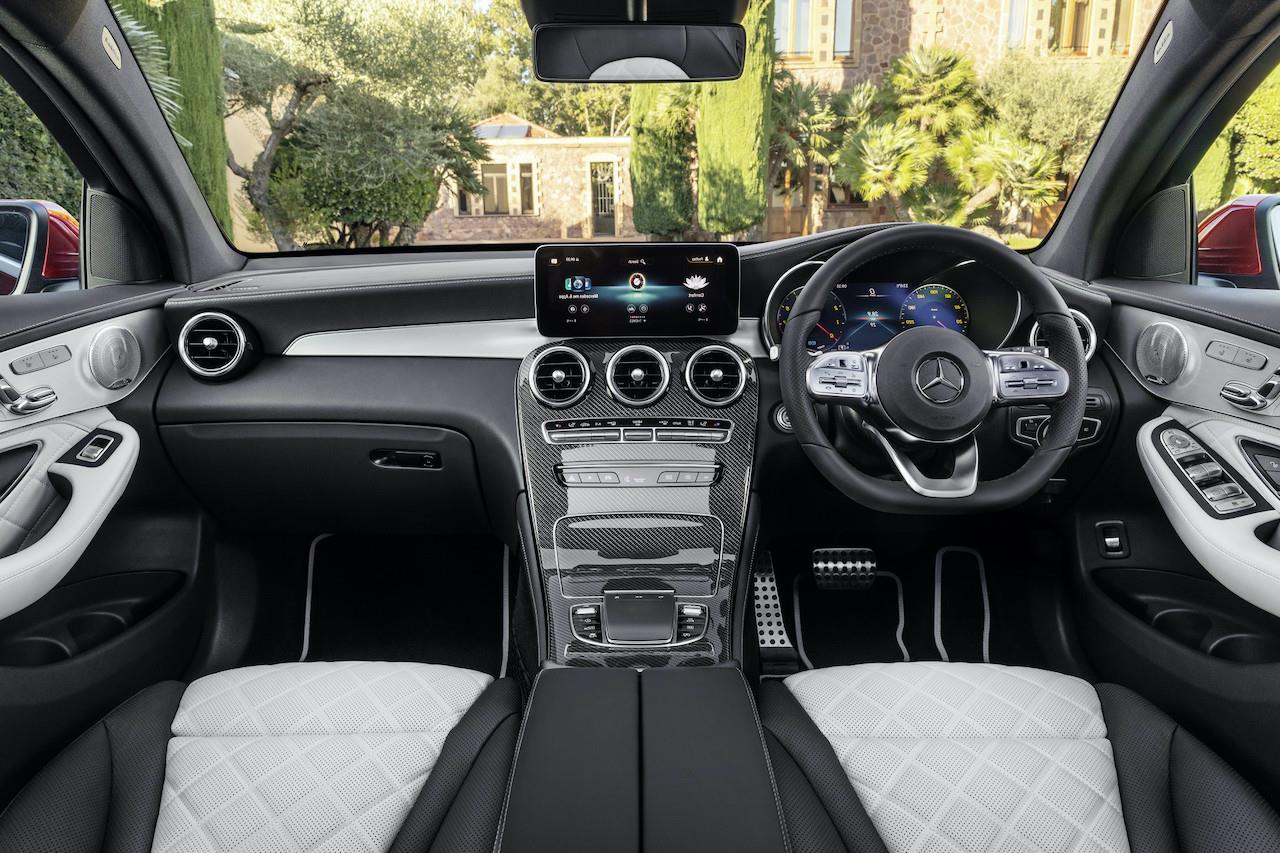
Three ways to get a 3-pointed star in your driveway
Before the SUV-pocalypse decimated their market, sedans and estate cars ruled the premium-brand roost. In fact, most premium manufacturers built their reputations on the excellence of their executive sedans, and still view that body style as the first choice for their most discerning customers. Mercedes-Benz was no different in this regard, with their E-Class serving as the entry point to their local range for years (because we largely missed out on the W201 190-series “baby Benz” model).
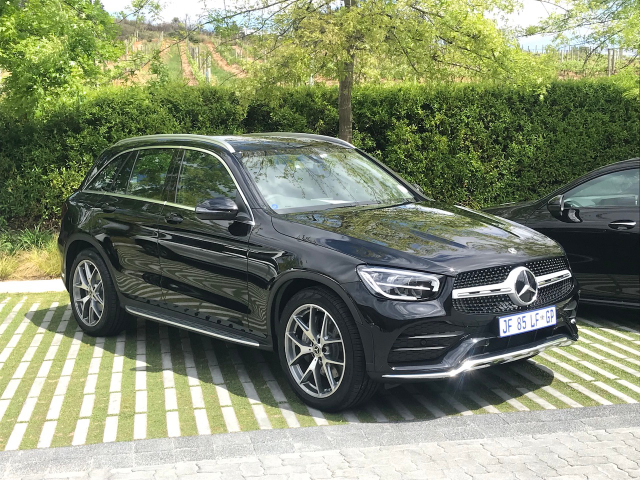
But that’s all changed now. Instead of an E-Class sedan (we don’t even get the wagon here anymore), you could have a selection of price-overlapping C-Class sedans, or a variety of SUV/crossovers, or even a double-cab bakkie. In essence, this strategy boils down to covering as wide a spread of market segments as possible. Mercedes-Benz isn’t alone in this approach, mind you: similar overlaps are evident in almost all the premium-brand ranges, even if Mercedes is the only one to stretch as far as a bakkie (for now).

We decided to determine where buyers will get the best value for money, without giving up on having a 3-pointed star in the driveway. And, seeing as value for money is the prime consideration here, we limited ourselves to two main constraints: the vehicles we’ll compare all have a diesel engine under the bonnet (for fuel economy reasons), and they’ll all need to feature an automatic gearbox. After all, Mercedes-Benz is known for their excellent diesels, and the fuel savings are hard to ignore (and likely of paramount importance to value-biased buyers).
In this comparison, we compare the least-expensive diesel-powered E-Class to the least-expensive diesel GLC-Class, and also put them up against the most-expensive non-V6 X-Class bakkie. Their prices vary by about R 46 000, and although they are all very different, they have that vaunted badge in common. Two of them also compete in very important market segments: SUVs are becoming more popular by the day, and the bakkie is South Africa’s national vehicle. Does the (comparatively) old-school E-Class sedan have what it takes to maintain its presence as a Mercedes mainstay?

Facts and figures:
|
Mercedes-Benz E220d |
Mercedes-Benz GLC220d 4Matic |
Mercedes-Benz X250d D/C 4Matic Power Auto |
|
|
Engine size (cyl/size) |
4-cyl, 2.0-litre turbodiesel |
4-cyl, 2.0-litre turbodiesel |
4-cyl, 2.3-litre turbodiesel |
|
Power/Torque |
143 kW/400 Nm |
143 kW/400 Nm |
140 kW/450 Nm |
|
Kerb Weight |
1 680 kg |
1 845 kg |
2 234 kg |
|
Length (mm) |
4 235 |
4 154 |
4 325 |
|
Airbag count |
7 |
7 (opt 9) |
7 |
|
Load Volume * |
540 litres |
550 litres |
2 480 litres |
|
Top Speed (km/h) ** |
240 |
215 |
175 |
|
Ave Consumption ** |
4.3 ℓ/100 km |
5.4 ℓ/100 km |
7.9 ℓ/100 km |
|
Warranty |
2 yr/Unlimited km |
2 yr/Unlimited km |
2 yr/Unlimited km |
|
Price |
R 835 300 |
R 789 136 |
R 818 341 |
*With all seats in use
**Manufacturer's official claimed figures.
Analysis
Power, performance, and drivetrains
Keen-eyed readers will have noticed that the E220d and GLC220d have identical power- and torque outputs, with engines which both measure 2.0-litres in displacement. That’s because they use the same powerplant (and excellent 9-speed gearbox) – cutting-edge, new-generation Mercedes-Benz units, which are employed in various models across their passenger vehicle brands.
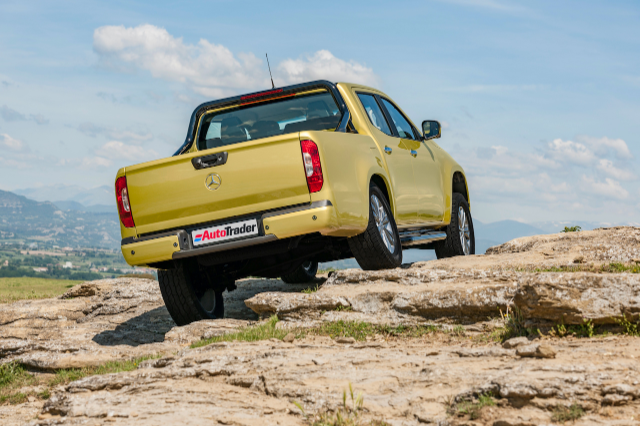
The X250d is the odd one out here, and that’s thanks to its convoluted ancestry: because the X-Class is basically a re-badged (and lightly re-skinned) Nissan Navara, it draws many of its oily bits from the Nissan/Renault parts bin. In the case of the X250d, this means a 2.3-litre twin-turbo mill, mated to a Nissan 7-speed gearbox and AWD system – exactly as you’d find in a Navara.
Related: Watch our video review to find out more about the Mercedes-Benz X250d Power Automatic.
This is no bad thing, though, as this Nissan/Renault turbodiesel is one of the best 4-cylinder bakkie engines out there (even if its gearbox is rather outdated by now). But, even though the X250d’s engine almost matches the power output of the other two’s 2.0-litre unit (and convincingly trounces them on torque), it’s tasked with dragging along a much heavier body.

Their kerb weight figures tell most of the story here: the X250d 4Matic squashes the scales at 2 234 kg, compared to the (all-wheel drive) GLC220d’s 1 845 kg and the (rear-wheel driven) E220d’s surprisingly low weight of 1 680 kg. Combined with the slipperiest bodyshell here, this relatively light weight makes the E220d the undisputed performance champion of this trio: it runs on to a top speed of 240 km/h, and dispatches the 0 – 100 km/h sprint in only 7.3 seconds.
By comparison, the similarly powered GLC220d (with its disadvantages of being heavier and less slippery, and with more drivetrain losses due its AWD system) drops 25 km/h on top speed, and needs slightly more than half a second longer to complete the benchmark sprint, earning it a respectable second place in this company. The X250d rumbles along to the third place here, trundling to 100 km/h in 11.8 seconds and maxing out at 175 km/h. That’s reasonable performance for a big and very heavy 4-cylinder bakkie, but nowhere near as rapid as either of its two adopted siblings – an entirely expected result, really…

Economy
Once again, the X250d has to settle for third place, for the same reasons that put its performance so far behind the other two: weight, aerodynamics, and a less-advanced gearbox. And, even with these disadvantages, its official average consumption claim of 7.9 ℓ/100 km is bound to be rather far on the optimistic side of reality: on test, we achieved a commendable 8.6 ℓ/100 km in a 4x2 Navara with a manual gearbox. This figure is bound to increase by at least 1.0 ℓ/100 km in the 4x4 automatic X250d, due to the inefficiencies inherent to a slushbox and four-wheel drive system.
The GLC220d again ends up in second place, also likely due to its inferior aerodynamics (taller and blockier than the E-Class), added driveline drag from its AWD system, and extra weight. That official claim of 5.4 ℓ/100 km is probably not quite realistic, either, and will likely hover closer to the 7.0 ℓ/100 km mark in normal use.

That’s pretty good for an SUV of this size, but the E220d still holds all the trump cards: it’s the lightest and slipperiest car here, and it’s unencumbered by AWD gubbins. Its official claimed average consumption of 4.3 ℓ/100 km will probably not be attainable in the real world, but it should still return excellent mixed-cycle figures in the mid-5 ℓ/100 km range, in the hands of a considerate driver.
Related: Which E-Class is better: Petrol or Diesel? We looked at the range to decide...
Practicality
This is where the X250d makes its comeback, simply because it’s a bakkie. In comparison to the X’s gigantic 2 480-litre load bay, the GLC’s very usable 550 litres fades into insignificance (although the latter can be expanded to 1 600 litres with the rear seats folded down). And don’t forget about the X-Class’s towing ability of 3500 kg (braked), either – if you frequently cart jetskis and dirt bikes around, this is the Mercedes-Benz to get (if your budget doesn’t stretch to GLS- or G-Class levels, at least).

That’s enough to net the GLC220d yet another second place, barely ahead of the third-placed E220d’s 540-litre boot. It’s interesting to note that the GLC offers more utility space than the E-Class, in spite of it casting a much smaller shadow. That blocky shape (which costs it a little in performance and economy) does come with a handsome payoff in the practicality stakes.
Related: We highlight the top 3 things you need to know about the Mercedes-Benz E-Class.
Equipment and safety
Mercedes-Benz has recently started to buck the German trend of charging extra for features you’d find as standard in much less-expensive vehicles, and this is reflected in the reasonable standard equipment lists of this trio. Included at no extra cost are features such as dual-zone climate control, (static) LED headlights, cruise control, and automatic operation for the headlights and wipers. Nice. You’ll still have to pay more to upgrade to adaptive cruise control (not available in the X250d), navigation, blind-spot monitoring and lane keeping assistance, though, so their basic spec sheets still don’t quite match their asking prices.

However, the E220d nets another first place as far as standard features go, simply because it is the only one with parking sensors all round, as well as a rear-view camera. These are fairly basic, simple add-ons, and it’s mind-boggling that they’re only available as part of expensive option packages on the X250d and GLC220d.
The GLC gets another second place here, because it’s been featuring the new (albeit somewhat simplified) MBUX system with smartphone mirroring since its facelift at the end of 2019, while the last-placed X250d still has to make do with a much more primitive COMAND infotainment system. They might be getting better, but Mercedes still loves to charge a lot extra for things you’d find as standard in many lesser vehicles.

We’re talking about a trio of Mercedeses here, so excellent safety credentials are part of the package across the board. Standard safety kit includes 7 airbags (with an option to upgrade to 9 on the GLC), ABS, stability control, and automatic emergency braking. 5-star Euro-NCAP crash safety ratings apply to them all, and ISOFIX child seat anchors feature on all of them as well. Choosing an outright winner is almost impossible as a result, so we can reasonably call the safety aspect a three-way tie for first place.
Our verdict
The first contender to fall by the wayside is the X250d. Why? It’s not a bad truck, its safety credentials are impeccable, and its equipment levels are roughly what you’d expect from a large Mercedes-Benz at this price level. The X250d also boasts peerless load-lugging abilities (relative to the other two), mainly because it’s the only truck here. But that’s its downfall as well: it’s still a truck, with the downsides you’d expect in comfort, economy, performance, and the whole driving experience, really.

In a value context, the X250d simply doesn’t make much sense, because you can get other bakkies with better performance/more standard equipment/similar or better load capacity, for a lot less money. If you need a bakkie but absolutely have to have a 3-pointed star on its nose, this will hit the sweet spot, obviously. But if you want a premium conveyance, read on.

The next one to be eliminated is the E220d. This is a fine motorcar indeed: its cabin is probably the most agreeable place to spend time, it has the strongest performance and the most frugal drinking habits, and it has a reasonably loaded standard specification sheet. But that’s to be expected at its price point, which is heading for a R50 000 premium over our winner. Not even the lure of a strong warranty and a great maintenance plan (5 years/100 000 km) is enough to swing matters in the E220d’s favour, because you get those with the other two as well.

This leaves the GLC220d as our value winner among this trio. While it never finished at the top of any single category in this evaluation, its wide spread of abilities (coming a very close second in most aspects), combined with the lowest purchase price here, gives it an overall victory. Yes, there are strange specification omissions, but the appropriate ticking of option boxes will get you most of the E220d’s toys, without giving up much of its healthy pricing advantage. This makes it the value champion amongst its siblings.
* Pricing was accurate at the time of writing, but may change without prior notice.
Recommended next:
Find out more about Euro-NCAP crash testing results on their website.
Look for your new or used high-value Mercedes-Benz GLC-Class in our listings.