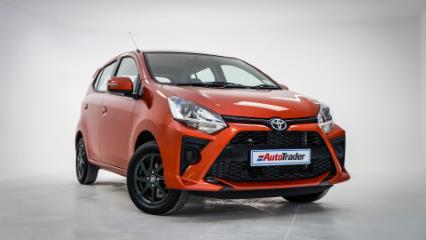
Kia Picanto vs Toyota Agya vs Hyundai Atos: Which city slicker has the lowest running costs?
With a strong reputation for durability and inexpensive running costs, the Kia Picanto is very well-regarded by motorists on a tight budget. But, in the time since the current-generation Picanto arrived, some serious opponents have joined it in the marketplace. How would their running costs compare to that of the trusted Picanto?



Can you pre-determine your car’s running costs?
When considering a car’s running costs, it’s important to look at it over the full life-cycle. This allows third or fourth owners of older cars to get a clearer picture of possible future expenses, and it can help first owners to determine at what age their cars may become too expensive to run.
There are certain key points which could give an idea of a car’s general upkeep requirements. This includes the length of the service intervals, the cost of replacement tyres and service- and maintenance parts, and the prices of service parts. And, in the case of this budget-minded trio, resale value also plays as important a role as the initial purchase price, fuel consumption, and insurance costs.

With all these factors in mind, we selected the least-expensive Kia Picanto (1.0 Start with a manual gearbox), and went looking for two fresh opponents with roughly similar initial purchase prices and intended usage cases. We settled on two other “grown-up” city cars in the same budget bracket: the newly-released Toyota Agya 1.0 (Audio), and the still-fresh Hyundai Atos 1.1 Motion.
That means a price spread of around R 15 000 between the most-expensive (Picanto) and the least-expensive (Atos), in spite of the little Hyundai being the one with the largest-displacement engine. If the initial purchase price is your main consideration, the Atos would be the one we’d suggest, but if long-term running costs matter the most, this comparison may impact your decision.
Let’s meet the contenders

Kia Picanto 1.0 Start (R 187 995)
It may be the oldest car in this trio, but that doesn’t mean that it’s really all that aged in real terms: periodic updates has added safety- and convenience kit to the entry-level Picanto over the years, and helps it to remain as competitive in its segment as ever.
Motive power is provided by a 1.0-litre, 3-cylinder engine, sending 49 kW and 95 Nm to the front wheels through a 5-speed manual gearbox. This isn’t really a recipe for rousing performance, but entirely adequate for a zippy city car: the 0 – 100 km/h sprint should take around 14 seconds (Kia doesn’t supply performance figures for the Picanto 1.0), and it’s claimed to run on to an eventual top speed of 155 km/h.
Related: Shop for new and used Kia Picanto cars for sale here.

Toyota Agya 1.0 (Audio) (R 182 400)
We’ve pitched the Agya against two established budget favourites before, and it walked away with class honours in that company. It has many advantages over those two opponents, with its safety specification and blend of performance and economy handing it a decisive victory based on its value proposition. Sure, it looks weird, but there’s a lot of merit hidden underneath those angular lines.
As with the entry-level Picanto, the Toyota Agya also employs a 1.0-litre, 3-cylinder engine that’s devoid of any form of forced induction, mated to a 5-speed manual gearbox (a 4-speed automatic is also available, but it’s thirstier and slower). This well-regarded Toyota unit produces 49 kW and 89 Nm, giving a 0 – 100 km/h sprint in a claimed 14.6 seconds and 165 km/h flat-out. Once again, not breath-taking performance, but adequate for a car of this nature, and competitive with its opponents.
Related: Shop for new and used Toyota Agya cars for sale here.

Hyundai Atos 1.1 Motion (R 172 900)
Unlike its opponents, the Hyundai Atos is only available in one trim level, with no option of an automatic gearbox or an uprated engine: what you see is what you get. It’s an all-new car, designed with the express purpose of offering a high-value contender in a crowded segment, although some mechanical elements are familiar from elsewhere in the Hyundai- and Kia stables.
The Atos is the only car here to sport the full complement of 4 cylinders, and its engine has marginally the largest displacement in this group. The little 1.1-litre mill with a 5-speed manual sends 50 kW and 99 Nm to the front wheels, for a claimed 0 – 100 km/h run in 14.4 seconds and maximum speed of 155 km/h. For all practical purposes, these three cars have matching performance, so this factor is unlikely to sway any buyer’s decision in any particular direction.
Related: Shop for new and used Hyundai Atos cars for sale here.
Which one has the lowest running costs?

Purchase price and depreciation
Right out of the starting blocks, the Hyundai grabs the advantage with the lowest sticker price here – more than R 15 000 less than the base-trim Kia, and almost R 10 000 lower than Toyota wants for an Agya. It’s also quite resistant to depreciation, retaining 89.8% of its new-car value after a year (based on examples listed here AutoTrader).
At the opposite end of the scale, the Kia Picanto 1.0 Start is the priciest car here, with the (roughly) R 15 000 price difference between it and the Atos sure to have a notable impact on monthly repayments. It performs slightly better than the Kia in the short-term depreciation stakes, however, but its one-year value retention of 90.0% isn’t really all that different to what you’d get in the Hyundai.
The Toyota Agya is still too new in our market to cast an accurate verdict regarding its value retention, but strong buyer’s demand and Toyota’s traditionally good resale values should ensure similar (or even better) value retention in the short- and medium term. This assertion is supported by the 99% value retained by those 2021 model year Agyas that are already listed here on AutoTrader.

Instalment calculator
*Calculated according to the AutoTrader Car Finance Calculator, with a 72-month finance agreement, 10% interest rate, 10% deposit, and no residual value. All prices listed in this article were accurate at the time of writing, but may change without prior notice.
Kia Picanto 1.0 Start manual
List price: R 187 995
Instalment: R 3 135/month
Toyota Agya 1.0 (Audio) manual
List price: R 182 400
Instalment: R 3 041/month
Hyundai Atos 1.1 Motion
List Price: R 172 900
Instalment: R 2 883/month

Fuel efficiency
Using the manufacturers’ claimed average consumption figures as a guideline, the Toyota Agya scores a first place in the efficiency stakes. Its claimed figure of 4.8 ℓ/100 km narrowly trounces the Picanto’s claimed average of 5.0 ℓ/100 km, and puts it quite far ahead of the Atos’s claimed consumption of 5.7 ℓ/100 km.
However, all three will be capable of returning low-to-mid-5 ℓ/100 km figures in normal mixed-cycle driving, where the Hyundai’s slight torque advantage will likely hand it a small boost at freeway speeds. But, seeing as we’re only considering the official numbers, the Toyota should cost the least to fuel.
Related: Which engines have the best efficiency?
Warranties, service plans, and service intervals
This department sees the Toyota drop to third place, simply because it cannot match the comprehensive warranties on offer from the other two. The Agya is covered for 3 years or 100 000 km, as opposed to the Picanto’s warranty that runs for 5 years with no mileage limit. The Hyundai has the best warranty in this group, however, and offers cover for 5 years or 150 000 km for the car itself, with the drivetrain warranty running for 7 years or 200 000 km – clearly the superior package in this criterion.
When it comes to service plans, the Hyundai has to drop to the bottom of this ladder, because it only includes pre-paid servicing for the first year or 15 000 km. The Toyota is about the Hyundai’s equal in this parameter, with coverage for two services or 20 000 km (because its service intervals are pegged at every 15 000 km), but the Kia scores a decisive victory here, with servicing included for two years or 30 000 km.
This means that they’re all covered on the service front for at least the first service, but the Kia is the only one to include two services in its standard aftercare plan. Buyers who plan to keep an Atos for many years will eventually come out on top, though, thanks to that incredible standard warranty, which hands it first place here. Based on warranty- and service plan duration, the Kia Picanto slots into a closely-contested second place, with the Toyota Agya bringing up the rear due to its (relatively) short warranty period.
Related: What is usually covered under a manufacturer’s warranty?

Parts prices
The Agya is still too new to have featured in any AA Kinsey Report of parts prices, but we’d expect most of its parts to be competitively priced. There is plenty of info available for the other two, however, because they both featured in the 2020 AA Kinsey report.
In this department, the Hyundai blew the Kia out of the water, with servicing-, maintenance- and accident repair parts being considerably less expensive for the Atos than they are for the Picanto. As for the Toyota, it will have to slot into third place here, at least until the picture regarding its parts prices becomes clear – it’s still too new to really say whether it will be pricey or not.

Insurance
None of these vehicles will be pricey to ensure: they’re not considered to be at a high risk of theft or hijacking, and they’re certainly not seen as high-performance cars, either. This means that the Hyundai Atos has to take this category, purely because its replacement value is a fair bit lower than those of the other two – that’s its bargain pricing coming into play. By the same token, the Toyota Agya ends up in second place, with the (costlier) Kia Picanto settling for third.
Also remember that insurance premiums will vary, mostly based on the projected mileage to be covered and where the cars are kept and driven, both in the daytime and overnight. Younger drivers or those with prior accident histories will experience additional penalties, due to their higher collision risk.
Related: Top tips to save on your car insurance.

Tyre replacement
Standard tyre prices play a significant part in any running cost evaluation, but it’s not always a given that smaller tyres will be less expensive – if they’re less commonly used, they might be harder to find and more expensive to replace than larger tyres which are in wider use.
In this trio, the Toyota Agya has the widest tyres (175/65R14) as standard fitment, which is a really easy size to find and inexpensive to replace. Its standard rolling stock can be replaced by good-quality “off-brand” units that start around R 660 apiece. Given the modest performance on offer, there’s little sense in paying more than twice as much for the name-brand tyres that are also available in this size.

Taking up the middle ground, size-wise, the Hyundai Atos’s 165/70R14 standard tyres are nowhere near as easy to find, nor as inexpensive to buy as the Toyota’s. In fact, the cheapest tyres we could find in this size starts over R 1000 each, making the Atos’s tyres quite a lot more costly to replace than the Agya’s.
The only car in this group with 13-inch wheels, and with the narrowest tyres as standard fitment is the Kia Picanto, which rolls on 155/80R13 rubber. These tyres also aren’t easy to find, but at least they’re still inexpensive to replace this time around.
In fact, the least-expensive (house brand) tyres we could find for the Picanto costs even less than the Agya’s, and even its premium-brand replacement tyres are more affordable than those for the Toyota. In this department, the Kia ranks first, with the Toyota seconds and the Hyundai bringing up the rear.
Related: How long is a tyre supposed to last?

Verdict
None of these budget superminis will destroy your wallet in the longer term, but some of them start out with a clear advantage, nonetheless. The Kia Picanto appeals on the grounds of its strong warranty and service plan, inexpensive tyres, and very competitive fuel consumption, but stumbles over its parts basket prices and higher projected insurance costs. It gets an honourable third place here, but that’s mainly on account of the other two’s notable advantages in other areas.

Next up is the Hyundai Atos, which stumbles over its claimed fuel efficiency and high tyre prices. It will however be the least-expensive to insure (on account of its lower replacement value), will cost the least in instalments, and has the lowest parts basket price to round out an appealing package.

But it’s the Agya that’s expected to have the lowest running costs, because it will likely have excellent fuel efficiency and more-affordable tyre replacement prices. It may lose out on insurance costs, however, because the Toyota badge itself will probably make it more appealing for car thieves, and its price premium over the Atos will lead to higher instalments.
But, when the times comes to sell it, the Agya’s slower depreciation will put more money back in its owner’s pocket. That turns out to be its knock-out punch, offsetting the few minor areas where its running costs may exceed those of its opponents.