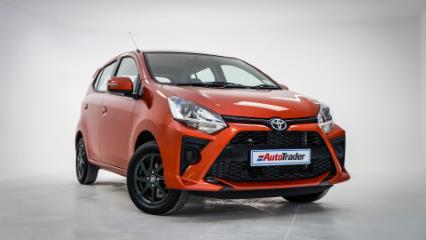
Toyota Agya vs Datsun Go vs Renault Kwid – Here’s our winner!
Budget cars sure have come a long way in recent years, with ever-improving contenders and increasing sophistication in almost all offerings. In this comparison, we pitch the new Toyota Agya against two established favourites from Datsun and Renault, to see if the little Toyota has the potential to upset the apple cart.



Built around a Japanese-market Daihatsu “Kei” car skeleton but enlarged to accommodate bigger engines and improved crash structures, the Toyota Agya entered the local budget-car market with all guns blazing. It’s comparatively inexpensive, well-equipped, and surprisingly spacious, and should have what it takes to cut the current leaders in its segment down to size.

We wanted to see how well the Agya shapes up against its principal new-car competitors, so we used the main criterion by which it will be judged as a baseline: the pricetag. Sticking within the “budget city car” segment, we selected the Datsun Go (in entry-level “Mid” trim) and Renault Kwid (in range-topping “Climber” trim) as opponents, after making sure they’re all equipped with manual gearboxes.

The difference between the cheapest- and most-expensive contenders is less than R 5 000, so these cars truly go head-to-head in the marketplace. Which one would we recommend, and why? Let's find out.
Toyota Agya 1.0 (audio) (R 182 400)
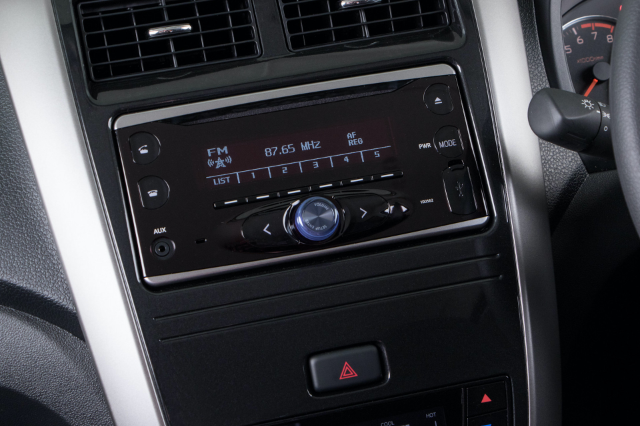
This is the Agya’s higher-trim format, with the only distinguishing feature between this one and the entry-level derivative being the addition of a basic audio system. There’s no touchscreen, mind you, because it’s a generic Toyota FM/AM/USB/Bluetooth double-DIN head unit doing duty on the infotainment front. Toyota charges R 3 800 for this system, so its value is roughly comparable to what it would cost to have a nicer aftermarket head unit fitted to an Agya that didn’t come with one from the factory. Just saying...
Engine, performance and consumption
Under the bonnet is a variation of Toyota’s 1.0-litre, 3-cylinder non-turbo petrol engine, familiar from the outgoing Aygo and some earlier Yaris derivatives. Its outputs are predictably modest at 49 kW and 89 Nm, and it drives the front wheels through a 5-speed manual gearbox.
A 4-speed torque converter automatic is also available (at extra cost), but it’s practically guaranteed to be an absolute slug on the road, so better stick to the manual if you don’t mind changing your own gears. In manual form, Toyota claims that the Agya 1.0 should need 14.6 seconds to get to 100 km/h, with a top speed of 165 km/h.
We didn’t test the latter figure when we reviewed the Agya, but the former figure could even be considered conservative – this little Toyota feels quite a lot livelier on the road than the claims would suggest. It’s all down to a feathery kerb weight of 835 kg, which gives the Agya quite a satisfactory power-to-weight ratio.

That lightweight construction also pays dividends at the service station, where the Agya is said to need only 4.8 ℓ/100 km on average. To be honest, we didn’t get near that figure during our review period, but that would likely be because we deployed the rev-happy little engine’s full power on a regular basis. With that said, our (Gauteng) test average of 5.9 ℓ/100 km was still respectable enough, especially considering that the air-con was blowing at full blast for most of the test period.
Standard equipment
The Agya isn’t a luxury or premium-brand car, so it would be unreasonable to expect the latest and greatest in terms of comfort- and convenience features. It is fully class-competitive, though, and has some upmarket touches thrown into the standard spec sheet to make the package rather more enticing.
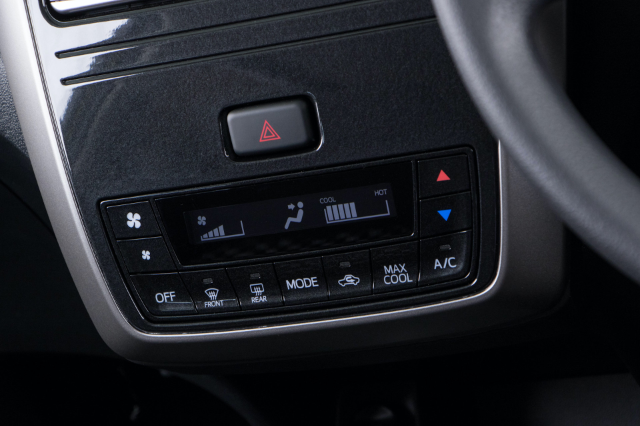
On the menu are electric windows all round, remote central locking, pushbutton start (but no keyless entry), electric power steering, push-button controls for the manual air conditioner, electric rear-view mirror adjustment, a rear windscreen wiper/washer, and LED/halogen reflector headlight units. Pretty much what you’d expect around this price point, then, but with some nice things thrown into the bargain to sweeten the deal.

Safety
The Toyota Agya is one of very few cars in its class to feature pretty solid safety ratings. It starts off with a strong shell, which handed the Agya (in local-release trim) a 4-star ASEAN NCAP crash test rating. Stability control is absent, but ABS with EBD, rear ISOFIX child-seat anchors and 2 airbags with seatbelt pre-tensioners are all present on the standard Agya spec sheet.
This makes the Agya’s safety package a strong selling point, especially in a market segment where most contenders have questionable safety credentials. Note that the Toyota Agya is the only car in this trio to feature ISOFIX child seat anchors - a factor which likely helped it to achieve those good crash test ratings.

Practicality
In spite of its diminutive footprint, the Toyota Agya nonetheless manages to provide a decent amount of cabin- and luggage space. It’s not really a family-sized car, but four large-ish adults will find enough head-, leg- and shoulder room to get comfortable, thanks to the Agya’s upright seating position and elevated roofline.
It's also decent behind the rear seats, where a neat lift-away cover hides a luggage compartment with a volume of 260 litres. Once again, this won’t be big enough for a family vacation, but it will certainly suffice for most commuting/school/shopping runs. One minor bugbear is the palaver to access the boot: there is no exterior boot release handle, which means that it has to opened either by partially disassembling the key fob (to get to the hidden key), or opening it via the driver’s side floor-mounted remote boot release.

Price and value proposition
For a smidge over R 180 000, the Toyota Agya (audio) has everything you’d expect in a budget-basement offering, and a bit more sophistication than you’d really expect. Included in the purchase price of R 182 400 is a warranty for 3 years or 100 000 km, with the first two services taken care of as part of the package. Given its specification sheet, practicality, safety, and efficiency, this tiny Toyota certainly hits the bull’s eye in its target market, and offers a very competitive package for its segment.

Related: Shop for new and used Toyota Agya cars for sale here.
The competition

Datsun Go Mid (R 179 000)
This is the cheapest car in this trio, but it has the largest engine, the most power, and the most available space. Powered by a 1.2-litre 3-cylinder engine (non-turbo, as are the other two), the Datsun Go sends 50 kW and 104 Nm to the front wheels through a 5-speed manual gearbox. But, in spite of its larger dimensions, the Go is even lighter than the Agya (779 kg vs 835 kg), which results in a slight performance advantage.
The 0 – 100 km/h sprint is claimed to take 13.3 seconds (the quickest here), and it should run on to a top speed of 161 km/h – slower than the Agya’s claimed 165 km/h but comfortably ahead of the Kwid’s claim of 152 km/h. The Go’s claimed average consumption of 5.5 ℓ/100 km is higher than those posted by its opponents, but it’s still respectable enough for this class.

In entry-level “Mid” trim, the Datsun Go is rather stripped of any frills. You won’t see LED headlights of any kind on a Go (whatever the trim level), and push-button start and a rear screen wiper are notably absent when compared to the Agya’s standard kit list (although the higher-trim “Go Lux” does offer the latter feature). The Datsun compensates with a standard colour touchscreen infotainment system with smartphone mirroring and rear parking sensors, though, which brings it back to roughly the same level as the Agya in overall usability.
Practicality is a strong suit for the Go, mainly because it’s a bit larger than the other two. It has the most cabin space for both front- and rear-seat occupants in this trio, although its luggage volume is only marginally larger than that of the Agya. In the Go’s case, its added size went into the cabin instead of the boot, giving a bit more passenger space than the diminutive Toyota could offer.

The jury is still out with regard to the latest Go’s safety credentials, however, because the updated Go is yet to be tested. In older crash tests, the early Go (and its derivatives) scored at most 2 stars, but this model has since seen significant improvements in its body construction and standard safety equipment. This means that the latest Go will likely perform a lot better than earlier examples, thanks to the current version’s reinforced body shell and 2 airbags. How much better? We don’t know yet...
With all things considered, the Datsun Go Mid offers arguably the best value in its model range, with everything you need and nothing that you don’t. It’s one of the biggest of the current city car crop, and the latest model’s driving experience and refinement is roughly comparable to the Agya’s. And, although it’s claimed to be slightly thirstier than the Agya, it costs less and has more usable cabin space. It also has a touchscreen, which seems to be very high on buyers’ list of priorities these days.
Related: Shop for new and used Datsun Go cars for sale here.

Renault Kwid 1.0 Climber (R 183 900)
Small and light though the other two contenders are, the Renault Kwid takes these attributes to another level. While the Kwid is marginally longer than the Agya, it’s a fair bit narrower and runs on a shorter wheelbase. This size difference is apparent inside the cabin, where the little Renault is a lot less spacious than either the Agya or the Go.
It fights back with the largest luggage compartment in this trio (279 litres), but that does mean that the Kwid has to make some compromises on cabin space. It’s certainly the least spacious of these three cars, and the proximity of bulky roof pillars and its compact dimensions further eats into the Kwid’s perceived cabin volume.

But, thanks to its very small size, the Kwid is also the lightest car in this trio, with a kerb weight of only 758 kg in range-topping “Climber” trim. As a result, it’s our economy champ in this group, registering a claimed consumption of only 4.7 ℓ/100 km – slightly lower than the super-frugal Agya. As noted earlier, it has the lowest top speed here, and its acceleration should also lag behind that of the Datsun, purely on account of its relative shortage of torque.
The Renault Kwid Climber stages a strong comeback as far as standard equipment goes, however. Not only does it have a colour touchscreen with smartphone mirroring as standard, but it also includes navigation and a rear-view camera to go with the standard-fit rear parking sensors. Once again, there’s no LED lighting (apart from the DRLs), rear screen wiper or pushbutton start, but these gaps are tiled-over quite nicely by the added functionality built into the touchscreen display.

Safety is, as with the Datsun Go, again a bit questionable. Just like the Datsun, early iterations of the Kwid performed exceedingly poorly in initial crash testing, which prompted a host of body alterations and added two airbags and ABS for the late-2019 facelift. The current Kwid was however tested by Global NCAP in December 2020, where it still received only 2 stars in spite of all the recent upgrades. In this area, it seems as though both the Go and the Kwid lag quite far behind the Toyota Agya.
As a result, the Kwid’s value proposition could be deemed as either solid or weak, depending on how important safety is for your usage case. Yes, it has plenty of nice toys and it is wonderfully economical to run (even regarding parts prices), but the driving experience feels nowhere near as “grown-up” as the others, and its poor safety rating is cause for concern on our increasingly-congested roads.

Additionally, like the Datsun, the Kwid does without a standard service plan of any kind. And, although the Kwid does have good warranty for 5 years or 150 000 km, even that strong coverage lags slightly behind the Datsun’s 6 year/150 000 km warranty – although they’re both ahead of the Toyota in this area.
Related: Shop for new and used Renault Kwid cars for sale here.
Facts and figures:
Let’s quickly recap the important numbers:
|
Toyota Agya 1.0 (audio) |
Datsun Go 1.2 Mid |
Renault Kwid 1.0 Climber |
|
|
Engine size (cyl/size) |
3-cyl, 1.0-litre petrol |
3-cyl, 1.2-litre petrol |
3-cyl, 1.0-litre petrol |
|
Power/Torque |
49 kW/89 Nm |
50 kW/104 Nm |
50 kW/91 Nm |
|
Kerb Weight (kg) |
835 |
779 |
758 |
|
Length (mm) |
3 660 |
3 788 |
3 679 |
|
Airbag count |
2 |
2 |
2 |
|
Luggage capacity * |
260 litres |
265 litres |
279 litres |
|
Top Speed (km/h) * |
165 |
161 |
152 |
|
Ave Consumption * |
4.8 ℓ/100 km |
5.5 ℓ/100 km |
4.7 ℓ/100 km |
|
Warranty |
3 yr/100 000 km |
6 yr/150 000 km |
5 yr/150 000 km |
|
Price |
R 182 400 |
R 179 000 |
R 183 900 |
* Manufacturer's official claimed figures.
Pricing was accurate at the time of writing, but may change without prior notice.
Verdict
On paper, a Renault Kwid makes a lot of sense, especially in its lower trim levels. It’s cheap to run (fuel, servicing and insurance), has a comparative ton of standard features (and the all-important touch screen!), and it even looks cute. That’s exactly how thousands of happy Kwid owners experience it in real life too, and good for them.
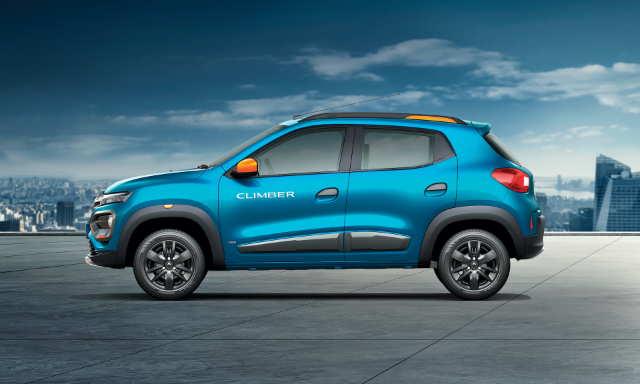
It doesn’t matter that it’s cramped, noisy, potentially unsafe and not much good on a freeway, because it’s well-equipped, light on fuel, easy to drive, and nice-looking for not a lot of money. The problem is that “good enough” isn’t really good enough anymore, especially at the higher end of this segment, where the high-trim Climber runs into trouble with its pricing. This price premium drops it into third place here, because it then comes up against some formidable opponents.

Of those opponents, few are as formidable as the Toyota Agya. Apart from its.... interesting... looks and the odd ergonomic quirk, there’s very little to criticise about the new entry-level Toyota. Almost as fuel-efficient as the Kwid but a lot more grown-up in its ways, the Agya embodies all we’ve come to respect from Toyota, only now at a lower price point.
But the most grown-up car of this bunch has to be the Datsun Go Mid. It’s easily the most spacious here, has decent standard equipment, feels substantial enough after the dramatic mid-life facelift, and has a small extra helping of performance to offset its slightly higher fuel thirst.

With the Renault out of the way, choosing between the Datsun Go and Toyota Agya isn’t such a clear-cut decision, and would depend on the buyer’s priorities. The Go has the advantage on practical grounds, also costs very little to run, and has a bit of extra fire under the bonnet.
But the Agya’s safety package (and part-LED headlights) ultimately win out over the Datsun’s practical advantages. That it’s well-made and comes with Toyota’s reputation for reliability and value retention merely add extra spice to a surprisingly flavourful dish. Or you could just buy a lightly-used Suzuki Swift for the same outlay (or even less), and be done with it...