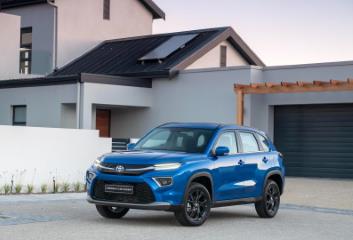
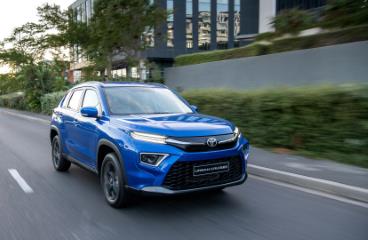
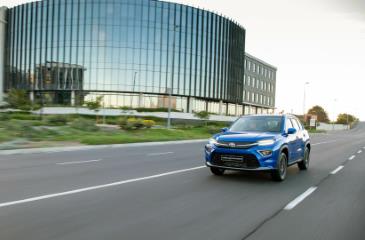
The new Toyota Urban Cruiser (which is the mechanical twin of the new Suzuki Grand Vitara) has everything counting in its favour. That coveted Toyota badge, all the most important safety features, practical ground clearance, a large boot, plenty of rear legroom, a frugal engine, and a budget-friendly price tag. All these characteristics work together to make it a great car for long distances, but let's take a closer look at the specifics. (Read our Urban Cruiser launch report here.)
Top 3 things you need to know about the Toyota Urban Cruiser

The Drive, Power, Performance, and Fuel economy

The naturally-aspirated 1.5-litre engine (with 77kW and 138Nm) is not going to thrill you, but it strikes a decent balance between fuel economy and relative 'oomph'. I've driven both the 4-speed automatic and 5-speed manual models, and the manual gets my vote. Just bear in mind that at sea level, engines feel more peppy. This is because the air is denser at the coast than it is inland. This means there are more oxygen molecules per unit volume. This gives the engine more oxygen to burn, which results in more power.
The 4-speed auto feels quite sluggish and is hard on the ears when you floor the accelerator, but if you prefer the convenience of a self-shifting gearbox, this is the price you'll have to pay. Both have their place! Driving in rural areas of the Overberg, I much prefer changing gears myself, but when stuck on the N2 in peak-hour traffic, the 4-speed automatic is the more pleasant car to pilot.
Related: Toyota Urban Cruiser vs Kia Sonet vs Suzuki Grand Vitara: Which one has the lowest running costs?

The Urban Cruiser performs like a rockstar on poor dirt roads, and we have many of those in SA! Average fuel consumption in the auto came to around 7.3 litres per 100 km, while the manual was a smidge lighter at 6.4 litres per 100 km.
Safety
The usual suspects are all present (ABS, EBD, brake assist) but all models also get hill-start assist, traction and stability control, child locks, a full-size spare, and Apple CarPlay/Android Auto with satellite buttons on the steering wheel. The entry-level Xs model has only 2 airbags, but the XR manual and auto have 6 each.
Comfort and Space

The rear seat now offers a lot more space than its predecessor did, and the boot is a great size if you need to cart baby strollers or sports equipment along, or holiday luggage.

In order to transport two very large paintings, I folded the second row flat for a completely flat surface where I could easily lay down both paintings. Should you need to pack for a long getaway, there's room aplenty.
Can you tow with an Urban Cruiser? Find out here.

Verdict
You can't go wrong with the Urban Cruiser. It's an affordable all-rounder for young drivers, busy families, retired folks and active couples. It's good for long drives as long as you don't expect to overtake slower cars like a Toyota GR Supra would - but how many budget crossovers have that talent anyway? (We recommend buying the 1.5 XR manual model to extract as much power from the 5-speed gearbox as possible.)
Did you know?
The Suzuki Grand Vitara 1.5 GL Manual is slightly better equipped and a little cheaper to buy than its Urban Cruiser counterpart.
Buying used? The previous Urban Cruiser's review can be read here.
ENDS