Toyota Urban Cruiser XR review (2021): A compact crossover destined for success
The age of badge-engineered Toyota products continues with the Urban Cruiser, a vehicle based entirely on the Suzuki Vitara Brezza. We recently received the Urban Cruiser in top-spec XR guise to get better acquainted with what is sure to be a common sight on local roads.


The age of the compact crossover is upon us, with these vehicles registering an incredible amount of growth globally as consumers look to the raised ride height and pseudo-off-road styling as high on their list of priorities when purchasing a new vehicle.
As the most successful automaker in South Africa, it was about time that Toyota introduced a contender into this hotly contested segment. The Urban Cruiser touched down locally early in 2021 and is based upon India’s best-selling crossover, the Suzuki Vitara Brezza. Since we recently tested the Suzuki version, we were keen to get behind the wheel, which became a reality when a Burnt Orange example arrived for an evaluation.
Styling
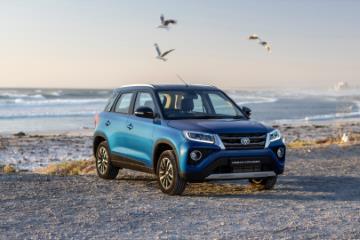
It would be unfair to label the Cruiser’s exterior design as generic, however, it is difficult to ignore that there is a product that is near identical in terms of appearance on local roads. The Cruiser is not identical to the Vitara Brezza though, with a grille more reminiscent of other Toyota SUVs, a different shape to the fog lamp housing and a slightly different lower apron. Overall, the design can be described as attractive, providing the desired small SUV silhouette along with plastic cladding for the wheel arches and roof rails, rounding off a pleasing look that is sure to be popular with consumers.

Interior and space
The interior of Toyota’s compact crossover is, as you may expect, similar to the Suzuki with which it shares its components. From a general fit and finish perspective, the quality is respectable, with the usual hard plastic surfaces combined with good quality material surfaces, including cloth-covered seats with a honeycomb pattern.
The infotainment system is a 7.0-inch colour touchscreen unit that offers Android Auto and Apple CarPlay functionality as well as a rear-view camera. Other features inside include a multifunction steering wheel, cruise control, dual 12-volt charging points, rear Park Distance Control (PDC), airconditioning and keyless entry/start, to name a few.
In terms of practicality, the Urban Cruiser features a 328-litre boot and includes a split-folding rear seat which adds a degree of practicality. From an occupant space perspective, there are five seats, however, the Cruiser is more suited to carrying four occupants, which then allows for sufficient rear leg, head, and shoulder room.

Performance and driving impression
All Urban Cruiser models are powered by the same K15B 1.5-litre naturally aspirated engine that powers many products, including the Suzuki Jimny and Ciaz models. In this guise, it produces 77kW and 138Nm of torque. There are two gearbox options, a 5-speed manual and a 4-speed automatic. Our press unit featured the former, which acquits itself very well in day-to-day driving activities.
Analysing the Urban Cruiser from a performance perspective would be an exercise in futility, however, with a kerb weight of 1 130kg and a rev-happy engine, performance is adequate. Out on the road, the vehicle is incredibly easy to pilot, with a light clutch action, a vague but soft gearshift action along with a reasonable amount of refinement and noise cancellation for a product in this segment. The product features 198mm of ground clearance but is front-wheel drive-only, meaning that off-road ability is limited. We were impressed that it could get through the muddy quarry that we take many SUVs through, though.

Safety
While the Urban Cruiser is yet to be crashed tested by Global NCAP, its mechanical twin the Suzuki Vitara Brezza has. The Brezza was tested in 2018 where it achieved a 4-Star rating overall, however, the child occupant safety was a concerning 2-Stars which Global NCAP explains is because of a low safety score for forward-facing child seats while rear-facing seats were rated as good. Standard safety features on the Urban Cruiser include dual front airbags, ISOFIX child seat anchor points and ABS with EBD, making it acceptable at this price point.
Fuel economy
Toyota claims a combined fuel consumption figure of 6.2L/100km which was relatively easy to replicate in the real world, especially when open road driving was included in the cycle. Our five-day test registered a combined figure of 15.3 km/L which translates into a figure if 6.5L/100km.
Pricing
At R294 500, the XR derivative of the Urban Cruiser is R4 600 more than a near identically specified Suzuki Vitara Brezza GLX which also has a superior warranty and service plan. The other entrant worth comparing to the Urban Cruiser to is the recently introduced Nissan Magnite, which is R11 900 cheaper than the Cruiser in Turbo Acenta Plus guise.
Verdict
The Urban Cruiser is the sort of product that is destined to be a success. With the right badge, a solid platform from a brand with a reputation for reliability that is on parity with Toyota and the simple fact that it is a crossover are key reasons for its near-guaranteed success. The fact that it is reasonably priced and relatively safe also make it easy to recommend as a beginner crossover. You can be assured that there will be many ‘little’ Cruisers on local roads.