The Hyundai H-1 is offered in four derivatives, two in bus form, one in panel van and one as a 6-seater utility van. Although both the Executive and Elite bus variants offer 9 seats, the Elite comes with a host of additional standard equipment and is the more luxurious of the two. Both busses utilise different powertrains, but more on this a little later.
Related: Top 5 features that make the Hyundai H-1 stand out from the competition
The first Hyundai H-1 was introduced locally at the beginning of 2009, while the most recent model made its first appearance in 2018. Since then Hyundai has added more seats to the Elite derivative to offer customers the option of a 12-seater. Hyundai managed this feat by fitting the 5 150 mm long and 1 920 mm wide vehicle, with four rows of three seats each.
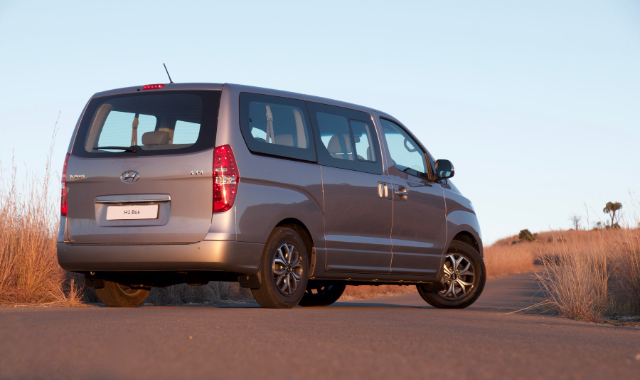
Exterior styling
The new Hyundai H-1 offers attractive styling while following Hyundai's modern design language. To fill the wheel wells on the Executive variant, Hyundai has fitted new 16-inch alloy wheels while the Elite feature 17-inch options. Flanking the large chrome grille are automatic projection-style headlights while lower down fog lamps are fitted as standard equipment. The rear of the new H-1 bus remains mostly the same, retaining the large tailgate providing access to the 842 litres of luggage capacity.
Interior equipment
Both bus derivatives come fitted with leather-clad seats and electric windows up front. While the Executive sees two airbags installed for the driver and front passenger, the Elite variant offers four with the addition of the front side units. Air-condition is standard across the entire H-1 range, however, the Elite gains a climate control system. Occupants of the Elite variant also benefit from glove box cooling to keep refreshments cold.
Both derivatives come fitted with a touchscreen infotainment system compatible with MP3, USB input and Bluetooth connectivity. Functions can be controlled from the multifunction steering wheel which also is home to the cruise control buttons. Other driver conveniences include rear park distance control and electric folding mirrors on both derivatives while the Elite features a reverse camera which displays in the rearview mirror.

Safety equipment
In addition to the airbags, the H-1 comes fitted with ABS brakes with electronic brake-force distribution (EBD). Furthermore, the new Korean offering also retains an electronic stability programme (ESP) system which will help keep the wheels planted during that unexpected swerve.
The H-1 has numerous locking features incorporated including central locking, auto-locking doors, child lock on the rear doors and impact sensing door unlock which allows emergency personnel to easily gain access to occupants after a collision has occurred. The Hyundai is also offered with remote keyless entry, and a transponder immobiliser system to keep the vehicle safe.
Powertrain
The Hyundai H-1 offer different a powertrain in each of the two trims, the Executive is powered by a petrol motor and sees a manual transmission fitted while the Elite offers a diesel mated to an automatic gearbox. Let us see how they compare.
| Hyundai H-1 2.4 bus Executive | Hyundai H-1 2.5VGTi bus Elite | |
| Engine | 2.4-litre, 4-cylinder, petrol | 2.5-litre, turbocharged, 4-cylinder, diesel |
| Transmission | 5-speed manual | 5-speed automatic |
| Power | 126 kW | 125 kW |
| Torque | 224 Nm | 441 Nm |
| 0-100 km/h | 17.1s | 14.4s |
| Top speed | 178 km/h | 180 km/h |
| Fuel consumption | 10.2 L / 100 km | 9.8 L / 100 km |
| CO2 emissions | 241 g/km | 238 g/km |

Warranty and service
One of the biggest selling points of any Hyundai vehicle is the included warranty and service plans. During your test drive, why don't you discuss the 5-year / 150 000 km manufacturer's warranty, additional 2-year / 50 000 km powertrain warranty and 5-year / 160 000 km perforation warranty? Also included with the vehicle is 5-year / 150 000 km roadside assist and a 5-year /90 000 km service plan.
Recommended next:
Hyundai H-1 vs Volkswagen Kombi vs Ford Tourneo Custom: Which one has the lowest running costs?
We compare Hyundai H-1 engines, and the efficiency crown goes to...