
Chevrolet Utility engines: And the efficiency crown goes to…..
Chevrolet’s Utility was the most popular three-quarter-ton pick-up when General Motors pulled the plug on its South African operation at the end of 2017. It is still a highly popular used buy, and here we choose the best engine option in terms of overall efficiency.



One of the most interesting pieces of news to come our way in 2019 was from an auction house that conducted surveys of vehicles that held their value the best in the South African market. The Chevrolet Utility (affectionately known as the “Ute”) was an unfortunate casualty when General Motors withdrew from our country at the end of 2017 but was still rated, 18 months later, as the second-best vehicle of all in terms of value retention!
That says a lot about how well-respected the Chevrolet Ute was when it was available here. Usually, when a manufacturer withdraws, re-sale prices plummet amidst fears that spares backup is going to be dicey. Incidentally, we have it on good authority that spares backup has been well provided for as far as the little Chevrolet bakkie is concerned, and these re-sale prices seem to confirm it. But before you sell your car quickly and easily here and start your search for used Chevrolet Utility models on AutoTrader, let's find out more about the model.
Related: Top 6 things to know about the gone but far-from-forgotten Chevrolet Utility
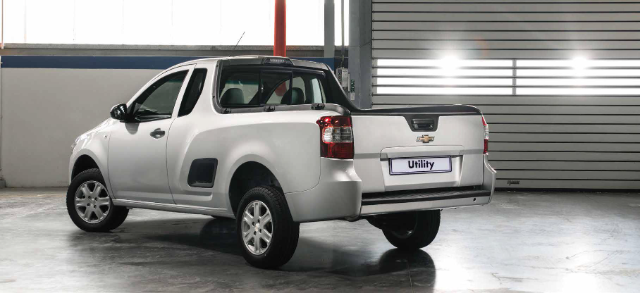
A Chevrolet Ute history
The Chevrolet Utility was initially not much more than a re-badging of the much-loved Opel Corsa Utility, and this occurred in 2010. This directive came from high up in the global General Motors management chain, which, for some reason, was punting bona fide European and Asian smaller cars as “Chevrolets". This effectively undercut all the goodwill that the Opel brand had garnered here over decades!
Opel Corsa pick-ups had gained somewhat of a cult following because of their exterior styling, which was racy for a pick-up and made them eminently suitable to the fitment of big aftermarket wheels, sporty exhaust systems, as well as raspy induction systems.
The first so-called Chevrolet Utility bakkies, then, were very moderately re-styled Corsa pick-ups, but in 2012, there was quite a substantial re-design, with much more Chevrolet bow-tie logo emphasis and a re-shaped load bin area. And the Corsa part of the name was dropped ( that was, after all, a hangover from the Opel days), so the vehicle became simply a “Chevrolet Utility.”
Related: Chevrolet Utility Colours and Price Guide

Engine choices
When the vehicle was still badged as an Opel, it came with a choice of 1.4-litre and 1.8-litre petrol engines and a 1.7-litre turbo-diesel engine. These turbodiesels were rated as extremely long-lived, and we know of owners who clocked up well over 500 000 km with them. With the shift to Chevrolet badging, the 1.7-litre diesel was dropped. The 66 kW 1 389cc four-cylinder engine was retained, as well as the 79 kW 1 796 cc four-cylinder motor.
Then, a year or more after the big 2012 re-style, a smaller 1 248 ccc diesel variant was introduced, with 55 kW on tap and 170 Nm. This engine did not stay long in the line-up, however, and well before the end of the Chevrolet Utility’s run here in late 2017, the range was again down to engine choices, the 1.4-litre and 1.8-litre petrol units.
Related: Running costs of Chevrolet Utility vs Nissan NP 200 vs GWM Steed 5

So, which is the most efficient Chevrolet Utility?
As the smaller diesel had a very short life cycle here, we wouldn’t recommend buying this model if you are in the market for a good used Chevrolet Utility. Thus, the choice would be between the 1.4-litre and 1.8-litre petrol models. Officially, the 1,4-litre was rated with a claimed combined fuel consumption of 8.7 litres/100 km, while the 1.8-litre was rated with 9.7 litres/100 km average.
On paper, the smaller engine looks good, but overall, we reckon that the larger engine will be more efficient if there are any loads to be carried. A larger-capacity engine in a lightweight body often makes better sense in day-to-day running, as the bigger engine can be shifted up to a higher gear earlier than the smaller engine.
Remember, those claimed average consumptions published by all manufacturers refer to ideal conditions rather than the realities of traffic, hilly terrain, and carrying a heavy load. In light of this, that 9.7 litres/100 figure for the 1.8-litre looks good, especially as the overall gearing is slightly taller than it is on the 1.4-litre model. So, for us, the efficiency crown for the Chevrolet Utility goes to the long-lived 1.8-litre petrol engine.
Recommended:
Top 3 Chevrolet Utility articles on AutoTrader
Top 6 things to know about the gone but far-from-forgotten Chevrolet Utility


