Toyota South Africa Motors has officially launched the new RAV4 range, and based on the line-up, the model is focused on new energy. An unexpected but welcome addition to the new range was the plug-in hybrid derivative, which is positioned as the flagship model with all the bells and whistles.
Related: How does the new Toyota RAV4 compete in South Africa?
But before we get into the details of the newcomer, remember that you can sell your car quickly and easily on our website here. You can also search for new or used Toyota RAV4 models on AutoTrader here.
RAV4, the trend setter
The arrival of the first-generation RAV4 truly changed the compact-SUV segment for the local market, even offering a two-door derivative. As time went on, the size increased, safety and tech improved, and most importantly, the engines became more efficient, a core focus for the new line-up. To say that the newcomer is a big departure from the 5th-gen launched back in 2019 is an understatement.

Toyota RAV4 exterior
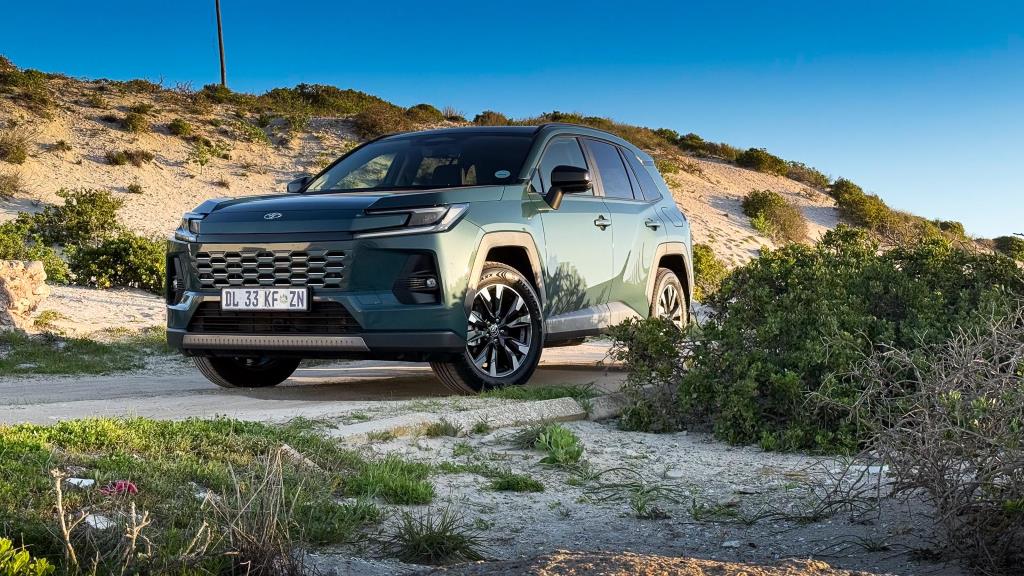
The exterior of the new-generation RAV4 is a big departure from its predecessor. Upfront, the LED headlamps and daytime running lights match the vehicle's very angular, sharp lines, creating a unique lighting signature. The headlamps are connected via a black trim piece which sits above the grille. The grille is made from hexagonal mesh in body colour, flanked by two large air dams that house the foglamps.
Lower down, you can expect either a black splitter or a contrasting grey unit, depending on the derivative. The GR Sport derivatives feature a unique 3D mesh grille that is more sporty and rectangular. Down the sides of the RAV4, there are very aggressive body lines that suit the sophisticated nature of the newcomer. Depending on the variant, 18- and 20-inch alloy wheel designs are available.

Moving to the rear, the sharp angular lines give way to more curvy LED taillamps with a modern signature. The lamps connect via a gloss-black trim piece, with the new RAV4 logo centrally positioned. Lower down a new skid plate with variant-specific black or resin finishes. Once again, the GR Sport sets itself apart with a more sporty spoiler and a modern black rear diffuser.

Toyota RAV4 interior
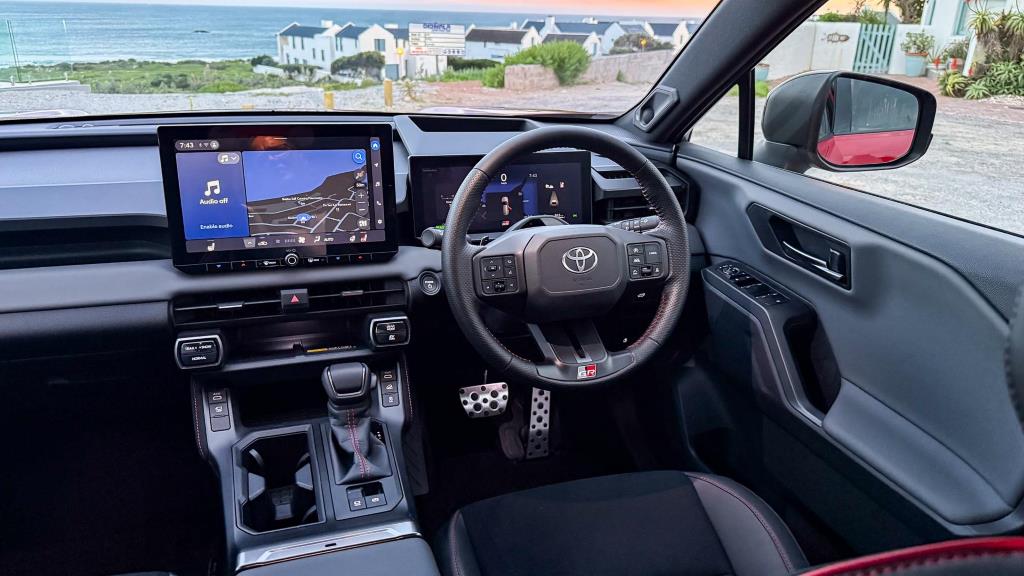
The interior blends tech and design rather well. Toyota calls the design theme "Island Architecture", where the large infotainment screen floats in front of a more horizontal-style dashboard. While there are indeed hard plastics on the dashboard, door handles, and doorcards, soft-touch materials are incorporated to enhance the premium feel.
The interior of the GX derivative gets cloth upholstery; however, from there up to the flagship PHEV, it gets leather seats and door card inserts. Matching the vehicle personalities, the PHEV gets blue contrast stitching, while the GR Sport gets red contrast stitching with red piping. As for size, the RAV4 offers plenty of space for both front and rear occupants, with ample headroom.

The electronically adjustable seats are comfortable and supportive, and after around 200km, we did not fatigue at all during the first drive. And while the 2.0 VX, 2.5 HEV VX and 2.5 PHEV derivatives get heated units front and rear, only the front ones are ventilated. The 2.5 HEV GR-S gets heating and ventilation of the front seats only. Drivers of the GR-S and PHEV benefit from heated steering wheels, too.
The GR Sport derivative further sets itself apart from the range with a leather shift knob instead of the small prindle in the other units, as well as Sports Alloy pedals. The 2.0VX and GR-S derivatives also get moon roofs, while the 2.5 HEV VX and 2.5 PHEV get full panoramic roofs, new to the RAV4 range.
The interior is well insulated, with road and wind noise kept to a minimum. Overall, this is a really well-executed interior with a lot of space for occupants, and all derivatives offer over 680 litres of boot space, plus luggage space.

Toyota RAV4 technology
Step inside the new RAV4 and you will quickly notice the large infotainment system. In fact, the entry-level GX trim gets a 10.5-inch infotainment system that, for now, offers wireless Apple CarPlay and Android Auto via an included dongle that plugs into the system. Toyota says it will update the system in the future so owners can connect without the dongle. Both at the front and the rear are two USB-C ports, while the VX, GR-S, and PHEV variants also offer wireless charging pads for smart devices.
As for sound, the system comes with six speakers as standard. The VX, GR-S and PHEV derivatives see the infotainment system grow to 12.9 inches and get a 9-speaker JBL sound system as standard. In front of the driver is a 12.3-inch digital instrument cluster that provides a wealth of information and can be controlled via the multifunction steering wheel. The driver also benefits from a digital rear-view mirror on the VX, GR-S and PHEV derivatives.

Toyota RAV4 safety
The Toyota RAV4 comes with no fewer than 7 airbags as standard, including driver and front passenger front and side airbags, a driver knee airbag, and curtain airbags. Front and rear park distance control sensors are also featured across the range; however, only from the VX derivatives and upwards can customers expect a reverse camera with surround view.
All variants except the GX get Toyota's latest Safety Sense 4.0 system, which includes improvements to sensors, networking, processing, and software to make the system respond more like natural driving and enhance functionality. All the system settings and controls have now also been moved to the infotainment screen for easier user access.

The new system includes an enhanced Pre-Collision System (PCS), Front Cross-Traffic Alert, Advanced Lane Change Assist, Predictive Curve Speed Management, Proactive Driving Assist (PDA), Lane Departure Alert & Lane Tracing Assist and Full-Speed Range Dynamic Radar Cruise Control and Road Sign Assist. The HEV VX, GR-S and PHEV variants further benefit from Downhill Assist Control, while all variants get hill-start assist.
All variants benefit from the usual ABS brakes with electronic brakeforce distribution, stability control and traction control. This new RAV4 has not yet been crash-tested, and more information will be available as soon as it becomes available.

Toyota RAV4 drivetrain
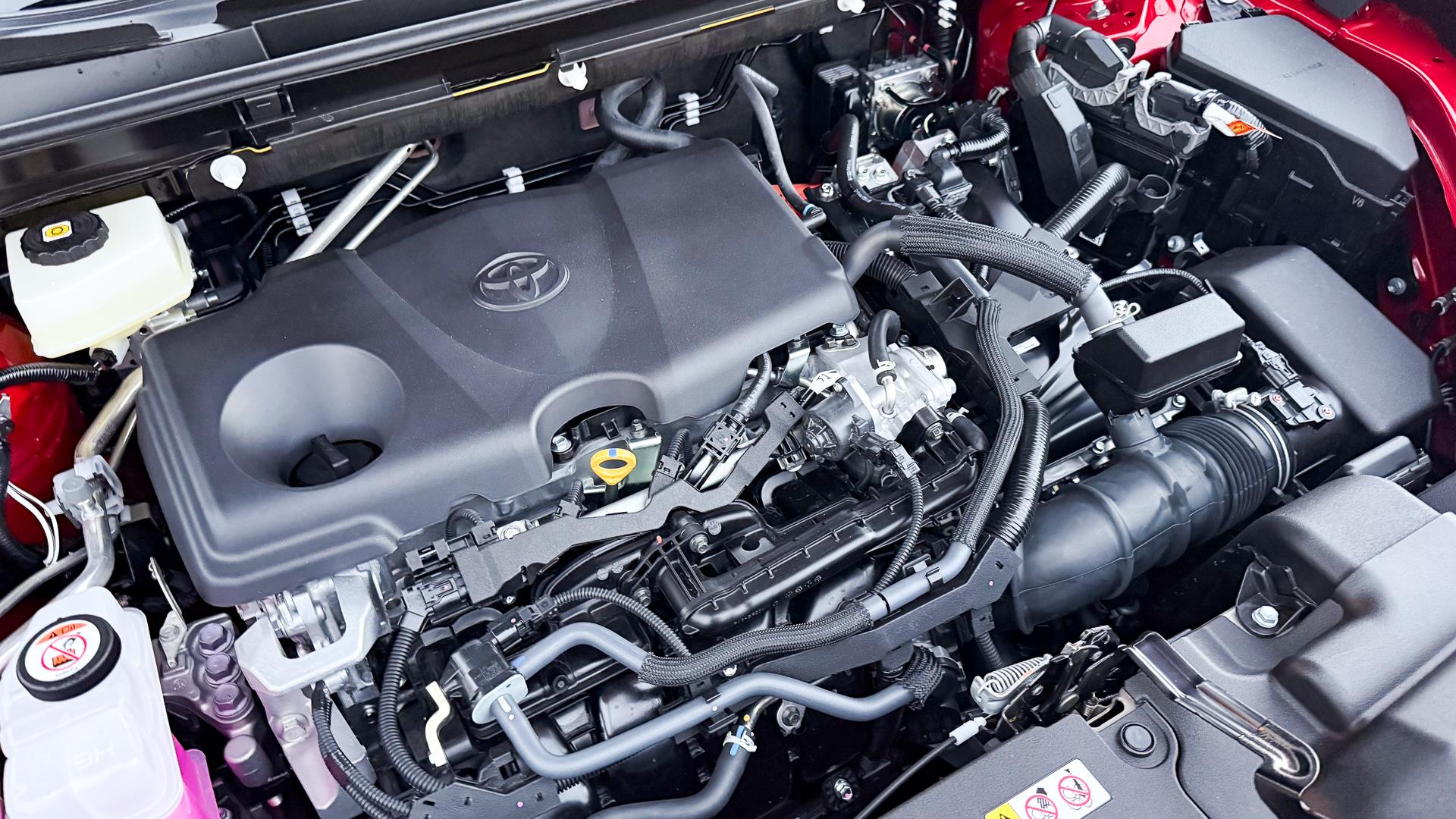
Looking at the new RAV4 range, there are three drivetrain combinations overall. Starting with the most traditional is the Toyota RAV4 2.0 VX. This variant is motivated by a 2.0-litre, naturally aspirated, petrol engine developing 127 kW and 203 Nm of torque. It is paired with a CVT, which is standard across the entire RAV4 range. Toyota claims an average combined fuel consumption figure of 6.3 L/100km for this unit. This variant sends power only to the front wheels.
Then the 2.5 GX, VX and GR Sport derivatives get their propulsion from a 2.5-litre petrol-electric hybrid combination that delivers 176 kW and 221 Nm of torque, plus the electric torque. Power is sent to all four wheels, as indicated by the E-Four designations. For the GX and VX trims, Toyota claims an average combined fuel consumption figure of 4.5 L/100km; however, the GR-S trim is claimed to return around 4.7 L/100km.

The most advanced powertrain in the range is the plug-in hybrid variant. This unit combines a 2.5-litre, 4-cylinder petrol engine with an electric motor and a 25.4 kWh, 104-cell Lithium-ion battery. This will provide an EV-only range of around 142 km; however, this will depend greatly on driving conditions, battery state of charge, and age.
Use the electric component with the petrol engine, and Toyota claims an average combined fuel consumption of 0.7 L/100km, with a range on a full tank of fuel and a full charge exceeding 1,000km. This PHEV should produce a combined power output of 242 kW and 228 Nm of torque, which can be felt in the acceleration as it has a claimed 0-100km/h sprint time of 5.7 seconds.

The Toyota RAV4 driving impression
During the launch, we had the opportunity to test the RAV4 range across a mix of city and open-road conditions. Traffic was light, but there was a good mix of flat and mountainous roads to feel how the engine and transmission perform in different situations. Overall, the power delivery is linear, especially with the PHEV, as the power only starts tapering off later.
While hard accelerating, you still hear the CVT hum; overall, the driving experience is smooth, refined, and quiet across the range. Very little road and/or wind noise enters the cabin, and the little that does will be easily overwhelmed by the powerful JBL sound system across the range, except for the GX.
Driving inputs, whether it be the steering, throttle, and/or brake, are very responsive and direct, but also predictive, making it rather easy to pilot. The suspension across most of the range is very compliant, making even going over speed bumps or rough terrain very soft. However, step into the GR Sport derivative, and you will quickly notice that Toyota has tuned the suspension and upgraded the front and rear crossbraces for added handling performance as more of the road's imperfections and undulations are translated into the cabin.
Overall, the driving experience is confident, and the engines are more than ample for the target market, seeing as the RAV4 bridges the gap between the more adventurous Cruiser FJ and the fully electric bZ4X.

Toyota RAV4 price
Included in the purchase price of a Toyota RAV4 is a 3-year / 100 000km vehicle warranty as well as a 6-year / 90 000km service plan. For the EV battery, there is also an 8-year / 160 000km warranty.
| Toyota RAV4 2.5 HEV E-Four GX | from R770 500 |
| Toyota RAV4 2.0 VX | from R799 900 |
| Toyota RAV4 2.5 HEV E-Four VX | from R927 800 |
| Toyota RAV4 2.5 HEV E-Four GR-S | from R941 800 |
| Toyota RAV4 2.5 PHEV E-Four | from R1 043 900 |
*The information in this article was correct at the time of writing; however, it can change at any time and without notice.

Verdict
We are rather excited about the new RAV4. It seems to blend utility, technology and luxury really well. Based on the updated tech alone, this vehicle is a big upgrade for the Japanese automaker. That said, we hope that Apple CarPlay and Android Auto in this model receive an upgrade sooner rather than later. You might be asking about the pricing.
Well, considering the dealer network and parts costs compared with some of Toyota's fiercest competitors and newcomers to the South African market, not to mention the value retention, investing a little more upfront could lead to a better ownership experience down the road. What stood out to us was that Toyota positioned a hybrid at the entry point of the range, making this efficient technology more attainable for new customers. We would definitely recommend you test-drive this new RAV4, as we truly think this model will tick most drivers' boxes today.