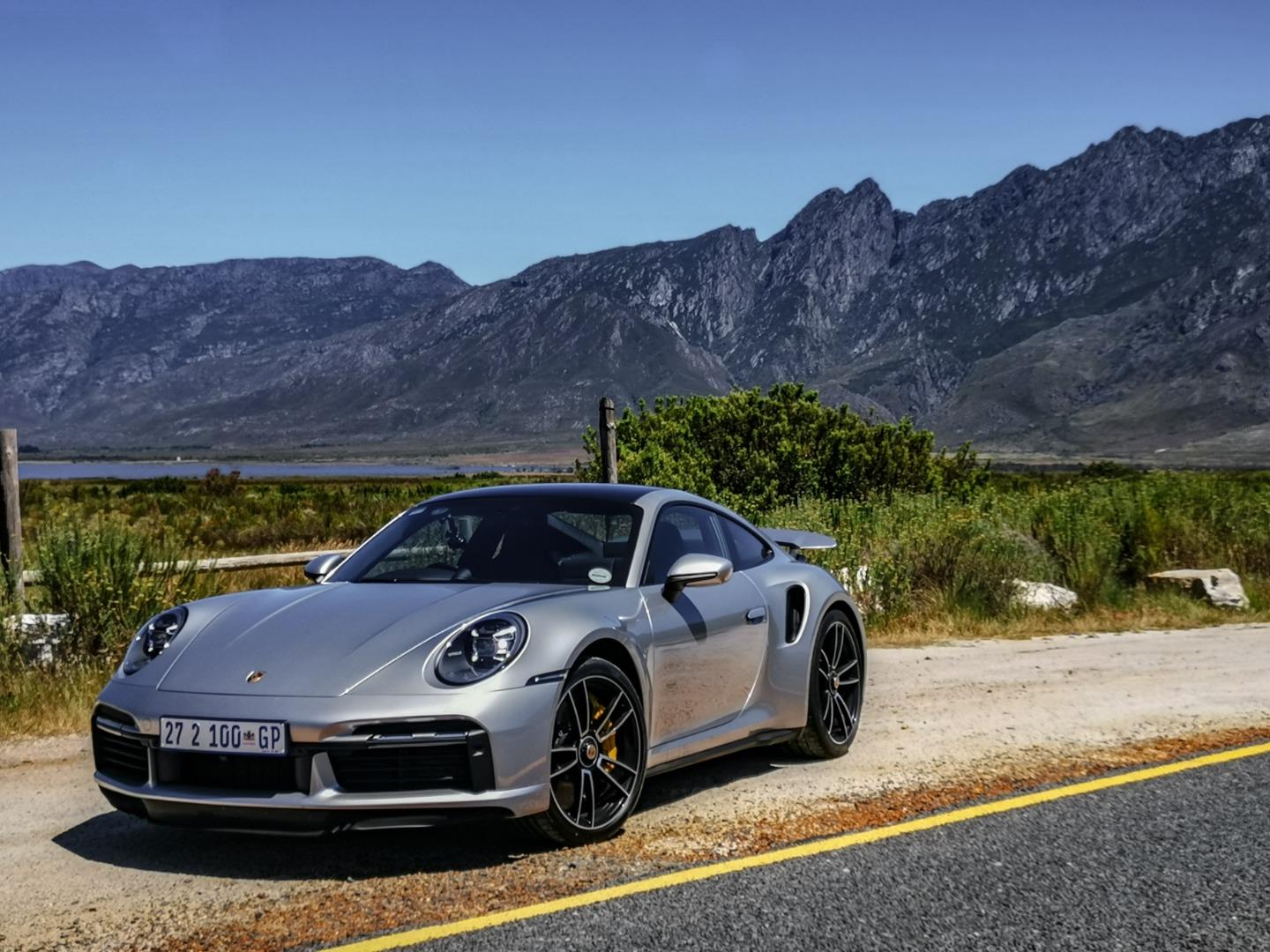
Porsche 911 Turbo S (2020) First Drive Impression – Supercar performance in an approachable package
Porsche has introduced a new flagship model within its 911 range, boasting performance figures that are difficult to fathom until you have experienced the car. I travelled to the Western Cape to experience what is one of the fastest road-going production cars currently on sale in South Africa.


The Porsche 911 Turbo model first made its debut in 1974 at the Paris Motor Show, making it the fastest road car to come out of Germany at that point. That model produced 191 kW and reached a top speed of 250 km/h, modest by modern standards, but impressive for that period. Fast forward through the years and 911 Turbo models become faster, bigger and more powerful, cementing their place as sports cars with supercar-rivalling performance figures.
Related: Porsche 991.2 911 GT3 RS (2020) Review: Flacht of fancy
The latest 992 generation Turbo S has landed on local shores and claims to be one of the fastest road-going 911s ever made.
Styling
The 911 Turbo range has always managed to fly under the radar thanks to designs that differ only slightly from a lesser Carrera or GTS-badged 911s and the 992 iteration is no different. Despite being the widest production 911 yet, measuring 20 mm wider at the rear and with 45 mm wider front wings than a Carrera, the Turbo S could still be mistaken for other 911 models at a glance.
It is only when you look up close and notice the massive 20-inch tyres up front and 21-inch items at the rear, complete with centre-lock nuts, the Matrix LED headlamps with darker inserts, a slightly different rear wing and an extended front splitter, that you realise that this 911 looks quite a bit more purposeful than other models within the range.

Interior
The interior of the Turbo S is almost identical to that of other 911 models, with the only giveaways being the Turbo S logos on the door sills, in the instrument cluster and one the headrest of the sports seats. As standard, the interior comes with leather and carbon trim with silver accents which the brand claims pays homage to the 930 Turbo of yesteryear.

The general material usage and build quality are exemplary, as is to be expected from a car costing close to R4-million sans options. The press car features a 12-speaker Bose sound system with a 12-speaker Burmester system available as an option. The PCM infotainment system measures 10-9-inches and offers niceties such as wireless Apple CarPlay but misses out on any Android Auto functionality, which was irksome, for me at least. For Apple users there is access to the Porsche Track Precision app which features over 300 international racetracks, allowing the driver to have detailed telemetry from their respective sessions around a given track.
In terms of practicality, Porsche claim that the 911 range, in general, can seat four occupants, however, the second row of seating is simply too small for a reasonably sized human being to sit in comfort. I find the second row better as storage, which offers 264-litres of space with the seats folded flat. There is also the traditional Porsche ‘frunk’, a boot located at the front of the car which provides 128-litres of space, or enough for an overnight bag.

Drivetrain
The drivetrain in the Turbo S dominates the show. The 3.8-litre flat-six engine is closer to 3.7-litres in terms of capacity, but engineers at Porsche have rounded things up. The engine is a new development of the current 911 range motor and features two large, symmetrically mounted Variable Turbine Geometry turbochargers. Porsche claim that the new turbocharger layout improves packaging and responsiveness while providing more power. The result is 478 kW and 800 Nm of torque from a car weighing around 1 640kg.
The 8-speed dual-clutch PDK gearbox has been reinforced by using eight corrugated steel plates in the clutches while also strengthening the gear wheel. All gear ratios have been changed, with first gear now being shortened with a longer eighth gear. The model also features the Porsche Traction Management (PTM) all-wheel-drive system which has also been developed, with improved water cooling and reinforced steel plates that allow up to 500 Nm of torque to be sent to the front axle if need be.

Performance
The result is a devastatingly effective tool for covering tarmac at a rapid rate. The 0-100 km/h sprint time is taken care of in 2.7 seconds, while the 200km/h mark comes up in 8.9 seconds and the top speed is 330km/h.
The launch control function in this car is even more impressive than in the all-electric Taycan Turbo S. For the first 100 metres or so your brain attempts to make sense of what has just happened as the car explodes forward. Passengers need to have their heads against the headrest to avoid unwanted gravitational forces going to work on their neck.
I was surprised as to how symphonic the Turbo S sounded from inside the cabin, with the Sports Exhaust staying true to its name, particularly when I encountered a tunnel and my inner child had to experience a second gear pull with the windows down. It is not a GT3 RS in terms of outright aural delight, but it is most certainly surprising for a turbocharged car.
The acceleration figures only tell half of the story though because attempting to get the Turbo S unstuck from the road/track surface necessitates a rather deliberate approach, meaning that it is approachable, accessible and ultimately, fun for all who experience it. The second-generation Porsche Active Suspension Management (PASM) in combination with torque vectoring and the all-wheel drive system make this an absolute weapon for carving-out your favourite mountain pass.
A car with this much performance needs braking power, but I was surprised to hear that Porsche has gone with ten-piston callipers and a 420mm set of discs up front, which provides an unbelievable amount of stopping power, especially when you consider that there are four-piston items at the rear.

Driver systems and safety
The German brand has made a habit of not testing its low volume sports cars with new car assessment programmes such as EuroNCAP, so there is no crash test data available for the 911, however, its Taycan, Macan and Cayenne all scored 5-stars in their respective tests. Items such as cruise control, a rear-view camera and braking assistant are standard while adaptive cruise control, lane-keeping assist and night vision with thermal imaging camera are optional extras.
Optional packages
Porsche has included the option of a lightweight package for the Turbo S Coupe for the first time. The package includes lightweight glass, full bucket seats, less sound insulation and the removal of the rear seats, saving a total of 30kg. There is also the option of a Sport package which includes, among other things, gloss black body details and a carbon fibre roof. For those with a bigger budget, there is also the option of the Porsche Exclusive Manufaktur interior package which features a two-tone design complete with leather with contrasting stitching among other niceties.

Pricing
The 911 Turbo model range consists of both a Coupe and a Cabriolet models. The former retails for R3 899 00 while its drop-top sibling is priced at R4 099 000. All models come as standard with a 3-year Drive Plan, covering servicing and maintenance for this period.
Verdict
The 911 Turbo S is the fastest car that I have ever driven, which is impressive considering that it is not marketed as a supercar, and is less expensive than exotica from Lamborghini, Ferrari and McLaren, to name a few. The way in which this product combines daily usability with deeply impressive performance credentials is commendable.
As the age of internal combustion slows and we usher in electrification, the Turbo S shows just how impressive a car that burns old dinosaurs can still be. For those who have the means to own one of these, I would recommend placing your order, it really is a magnificent piece of engineering.
Recommended next:
Totally Taycan: Porsche's first all-electric sports car driven in SA
Which Porsche 911 is better: one with a turbo or one without?
The Porsche 911 Targa 4S Heritage Design - Steeped in History