Porsche 911 GTS (992.2) first drive review
Porsche invited me to the Western Cape to drive its latest 911, an email I'm always rather excited to receive. However, this one was slightly different, with the word "T-Hybrid" immediately grabbing attention. I knew this day would come, the dawn of a hybrid Porsche 911, and I approached the launch of the latest GTS with a healthy blend of scepticism and intrigue.


For a dyed-in-the-wool petrolhead like me, the arrival of the 992.2 generation of the Porsche 911 Carrera GTS on South African soil represents a shift in the performance car landscape. If a brand like Porsche has felt the need to make its 911 a hybrid, it showcases where the industry is and how far brands need to go to comply with stricter emissions regulations!
Related: Porsche 911 Carrera T coupe (2025) Review
GTS overhaul
This isn't just a mid-cycle refresh; it's a recalibration of the "sweet spot" in the 911 range. The big news is the T-Hybrid powertrain, a concept that could either be a purist's nightmare or a performance-nerd's dream. After a few days behind the wheel, I can tell you it's firmly the latter.

An electrified flat-six
While marketed as a hybrid, it's not the plug-in or series parallel system you'd see in a family SUV; this is purely for performance, with no "electric-only' mode. The "T-Hybrid" is a subtle application of motorsport-derived technology to an already potent engine. The displacement increases from 3.0 to a new 3.6-litre flat-six, providing a more substantial base. Porsche’s move to a single, electrically assisted turbocharger is the absolute engineering masterstroke. While a large single turbo usually means lag, the 41kW electric motor integrated between the compressor and turbine wheels minimises it. The result? Instantaneous boost, regardless of revs. It's like having a V8's low-end grunt with a naturally aspirated engine's response.

The numbers tell the story. The combustion engine alone puts out 357kW and 570Nm. Still, the T-Hybrid system adds a second electric motor integrated into the strengthened 8-speed PDK transmission, bumping the total system output to 398kW and 610Nm. This is a significant jump from the previous GTS; the difference is felt when pinning the throttle. The 400-volt battery is a lightweight, performance-optimised unit that behaves more like a supercapacitor, designed for rapid charging and discharging. This allows it to recuperate energy from braking quickly and then unleash it for explosive bursts of acceleration, all without the weight penalty of a large-capacity battery.

On the road
The true test of a 911 isn't on a dyno sheet but on a winding road. We started our drive at Porsche Centre Cape Town, where the model's dramatic start procedure, thanks to the integrated starter motor from the 48-volt system, was immediately apparent. The GTS literally barks into life. The GTS's improved low-end torque made its presence felt almost immediately.
But it was on the open road that it truly came alive. The acceleration feels brutal and relentless. There is a nearly electric vehicle (EV)-like sensation with the acceleration, purely because there is no perceivable break in acceleration between gears, thanks to the electrical assistance filling in the gaps of the internal combustion engine. There is quite a bit of road noise, a 911 hallmark, and perhaps necessary here, as it provides a sensation of speed in a car that can get you into trouble rather quickly, such is the level of performance.
The electrification doesn't numb the flat-six sound; it provides a new layer to the acoustics. At the recommendation of a particular Porsche employee, I dropped the rear seats and could hear more of the engine and the whooshes and whines of the turbo and hybrid system.

Chassis and handling
The GTS has always been the goldilocks of the 911 range, balancing daily usability with track-day prowess. The 992.2 takes this to another level. For the first time, rear-axle steering is standard on the GTS. This is a big plus for the handling, particularly on the tight, twisty mountain passes, where it improves agility. I drove the rear and all-wheel drive models at the event, and while the traction afforded by the latter was impressive on the damp roads I encountered, I found the rear-wheel drive model the better car, feeling more keen to turn in, slightly lighter and more eager to wag its tail.
The Porsche Dynamic Chassis Control (PDCC) system is now electrohydraulically controlled via the high-voltage system, making the suspension more precise and flexible. While firm, I found the ride entirely agreeable on the roads we encountered, and I will soak up the larger bumps and imperfections along the route.

The battery

Design and tech
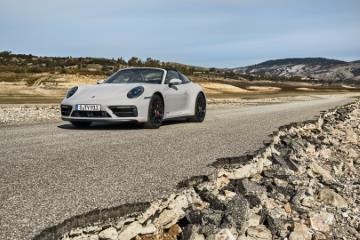
The exterior changes are subtle—new front and rear bumpers with active cooling flaps and an updated light strip make the model look more distinctive. While the GTS looks sporty, its exterior is quite understated compared to its performance credentials. This car is a supercar in its performance, but some may find its styling too restrained, while others will find it elegant.

The cooling slats make the GTS immediately identifiable
The interior now features a fully digital instrument cluster, replacing the traditional analogue tachometer. There is also a push-button start, replacing the old turn-key setup. I prefer the analogue nature of older 911s as they will age better, while digital set-ups tend to date rather quickly, but perhaps I am in the minority.
The latest PCM software powers the infotainment system, which offers wireless Apple CarPlay and Android Auto. There's also a new Porsche application called Roads, which allows you to plan and discover scenic driving routes. The Carrera 4 I drove on the second day of the venet was fitted with the Performance app within the PCM, allowing the driver to view their battery charge level, boost pressure and other key driving information.
Pricing*
Verdict
The 992.2 GTS showcases Porsche's willingness to adapt to ever-more stringent emissions regulations while not compromising on the attributes that make the 911 an appealing internal combustion-powered sports car. By embracing electrification to serve performance above all else, the brand has created a faster, more dynamic, and more engaging car than its predecessor. It remains the perfect blend of daily driver and track day warrior. The pricing seems steep, but considering the performance, I think it is entirely reasonable. I shudder to think about how fast the new Turbo S will be!
A Technical Comparison
| Feature | Porsche 911 Carrera GTS (992.2) | Porsche 911 Carrera GTS (992.1) |
| Engine | T-Hybrid, 3.6-litre flat-six | 3.0-litre twin-turbo flat-six |
| Induction | Single electrically assisted turbo | Twin-turbo |
| System Output | 398 kW | 353 kW |
| System Torque | 610 Nm | 570 Nm |
| 0-100 km/h (Coupe claimed) | 3.0 seconds | 3.4 seconds |
| Top Speed | 312 km/h | 311 km/h |
| Hybrid System | T-Hybrid | None |
| Electric Motor | 41 kW (in gearbox) & 11 kW (in turbo) | None |
| Battery | 1.9 kWh, 400V, Supercapacitor-like | None |
| Rear-Axle Steering | Standard | Optional |
| Curb Weight (RWD coupe) | 1 595 kg | 1 520 kg |