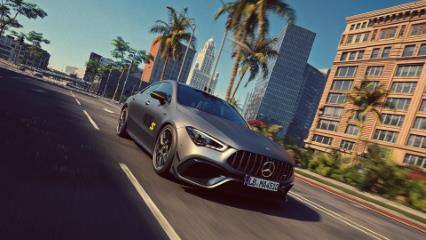
Mercedes-Benz Museum: a celebration of 140 years of innovation
Mercedes-Benz South Africa invited AutoTrader to go to Stuttgart, Germany, to visit the Mercedes-Benz Museum. In this article, we highlight some of the most interesting exhibitions and provide a high-level explanation of why this museum can be described as the cradle of combustion-powered vehicles.


It is believed that the wheel was developed gradually around 3500 BCE in Mesopotamia (modern-day Iraq) by the Sumerians, with independent origins in the Carpathian region. This then allows us to estimate that the first wheeled vehicles were likely carts or chariots, appearing around 3500-3000 BC. What we do know is that modern combustion-powered cars trace their origins to Mannheim, Germany.
Related: Mercedes-Benz celebrates 140 Years of Innovation - What's new for 2026 and beyond? New S-Class!
Start of the innovation
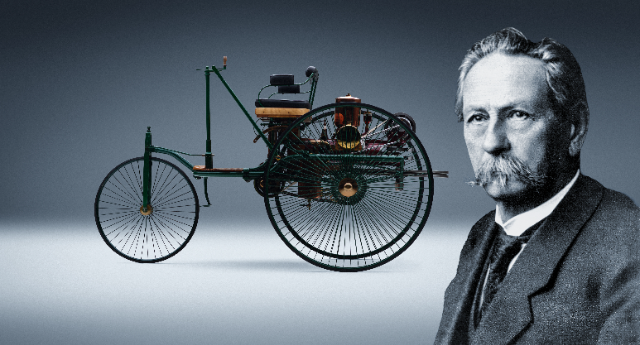
Enthusiasts of the early days of transportation will know that there were so-called cars before the 1886 Benz Patent-Motorwagen. But these were typically carriages drawn by a steam engine on its own rolling chassis, placed where the horses would typically go. Then there were even early electric carriages. But the Benz wasn't a carriage, and it was the first to use a type of gasoline and a combustion engine.
In 1885 (141 years ago), a man named Carl Benz completed the development of a three-wheeled, 954 cc, four-stroke, single-cylinder automobile with around 0.9 horsepower (0.66kW) and a top speed of around 16 km/h. And on January 29, 1886 (140 years ago), this particular vehicle was patented. It became known as the 1886 Benz Patent-Motorwagen.
What few don't know is that, had it not been for his wife, Bertha Benz, his invention and the brand might have stayed on the pages of history books. On the 5th of August 1888, then 39-year-old Bertha Benz drove from Mannheim to Pforzheim with their sons Richard and Eugen, thirteen and fifteen years old respectively. The total distance one way was 106 km.
She did this without notifying her husband or the authorities, because she wanted to visit her mother and ask for advice; her husband's business was suffering, and they were quickly heading toward bankruptcy. However, during this first long-distance drive in a combustion-powered vehicle, she also came up with practical solutions to the problems that arose.
When the wooden brake blocks were failing, Bertha visited a cobbler to have leather installed, ultimately inventing the brake-liner. She also used her hat pin to clean a fuel line, then her garter as insulation. One of the biggest problems was the fuel. Considering that fuel stations hadn't been invented yet, Bertha had to use ligroin, a petroleum solvent typically used for cleaning. She stopped in Wiesloch at the city pharmacy to buy fuel, which essentially made the chemist the world's first fuel station.
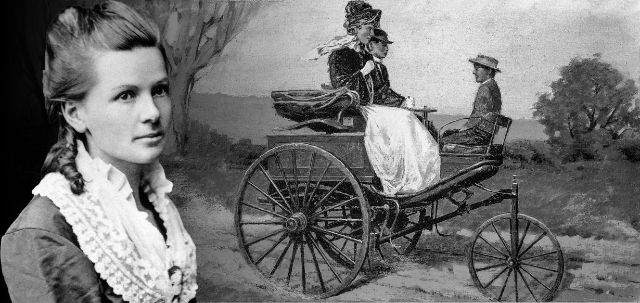
Visiting wasn't her only motivation. Having worked alongside her husband, building and developing the cars, Bertha truly believed in her husband's invention and also wanted to showcase the capabilities to the world. The 106 km trip took about 13 hours, and after she arrived, she notified her husband via telegram and then drove back a few days later.
This showed everyone along the route what was possible, and her bravery, resilience, and confidence in their work could be the only reason we find Mercedes-Benz cars and commercial vehicles today.
The Museum
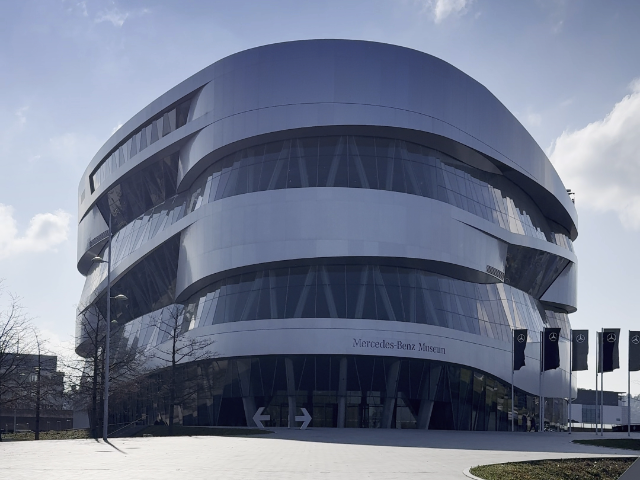
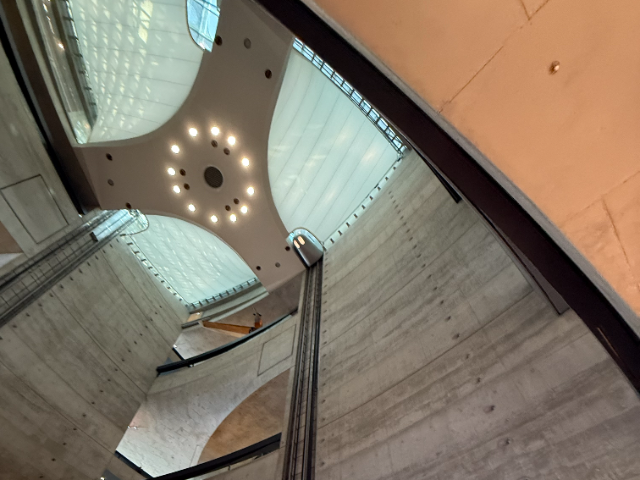
I don't need to be invited twice to go to an automobile museum, and when Mercedes-Benz South Africa reached out to visit the Mercedes-Benz Museum in Stuttgart, Germany, my bags were packed and ready to go. Why was I so eager to visit this particular museum? Since Stuttgart is considered the birthplace of the modern car, the interior was designed to resemble the DNA double helix.
Inaugurated on May 19, 2006, the architecture still looks futuristic both inside and out. The museum displays over 160 vehicles, tracing the brand's history from early motorisation through to futuristic designs, and includes a detailed look at the company's motorsport heritage. The exhibition is designed as a journey through time, spanning nine levels and organising history by "Legend" rooms (brand history) and "Collection" rooms (thematic history).
The journey begins with the 1886 Benz Patent Motorwagen, passes through the creation of the Mercedes brand in 1901, the "Silver Arrows" racing era of the 1930s, and the post-war economic miracle, leading to modern innovations. The collection features iconic vehicles such as the 1902 Mercedes-Simplex, the 1909 "Blitzen-Benz," the 1955 300 SLR Uhlenhaut Coupé, and notable racing cars, including the Mercedes-Benz 300 SLR “722” and CLK GTR.
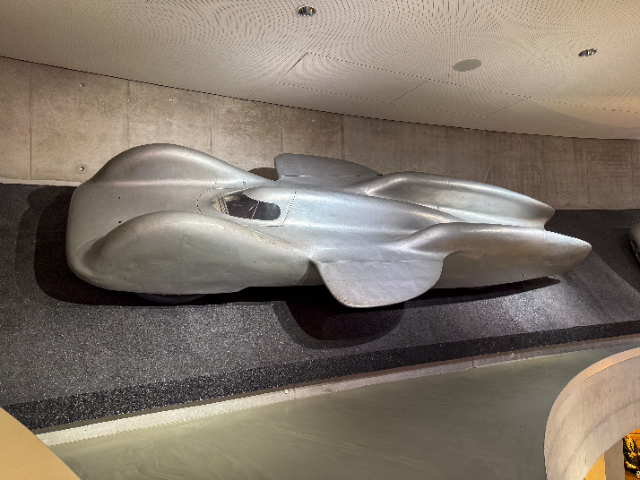
Highlights of the Mercedes-Benz Museum
The elevators are referred to as time machines, and while travelling up to the top floor, the ambient audio of what different ages would have sounded like is played. When you reach the top, you start at the furthest point in time and work your way down.
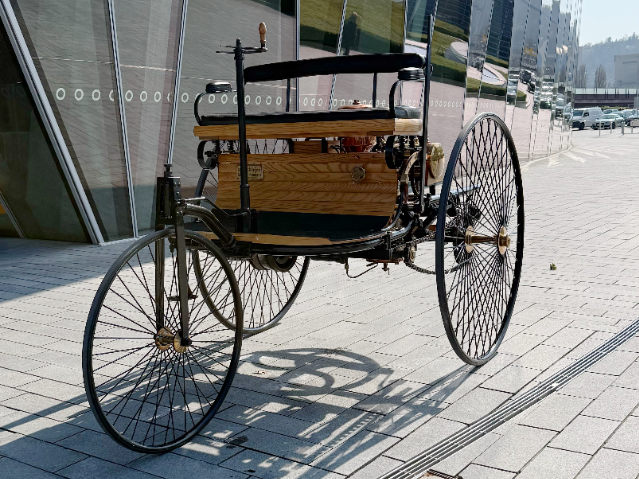
1886 Benz Patent-Motorwagen
The very first automobile is the one you see first. Of course, these are replicas of the original, based on Carl Benz's original patents.
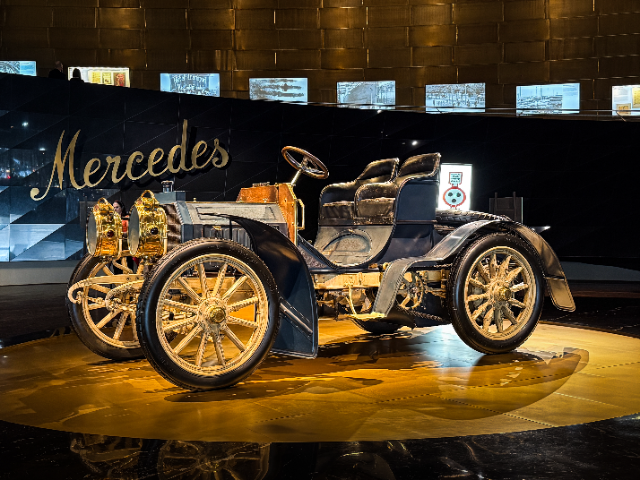
1902 Mercedes-Simplex
What makes this example so special is that it is the oldest surviving original Mercedes. This is a true look back into time.
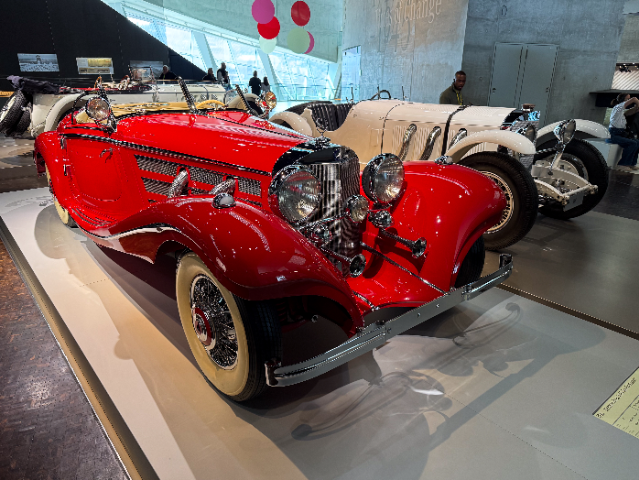
1936 Mercedes-Benz 500k Special Roadster
Considering the time period, seeing a vehicle as beautiful as this still being produced by the premium marque just gives you goosebumps.
1955 Mercedes-Benz 300 SLR Uhlenhaut Coupé
With only two original examples ever produced, it is as rare as it comes. Originally built to go racing, but never did. It offered a top speed of 290 km/h from the 222kW produced. It can be considered a hypercar of the day.
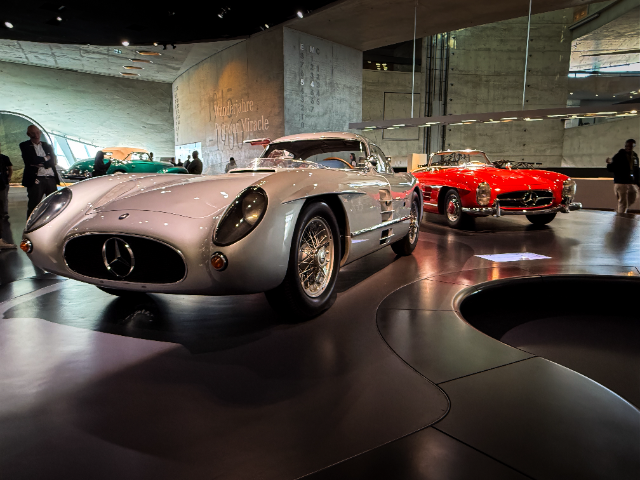
What makes seeing this car in person even more special is that in May of 2022, one of the two examples went to the auction block, and at the time of writing this article, still retains the record as the most expensive car to have successfully auctioned to a new owner, with the final hammer dropping at €135 million, that is around the R2.7 Billion mark, yes with a "B"!
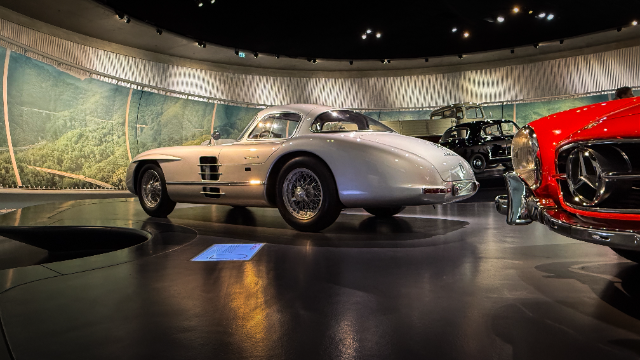
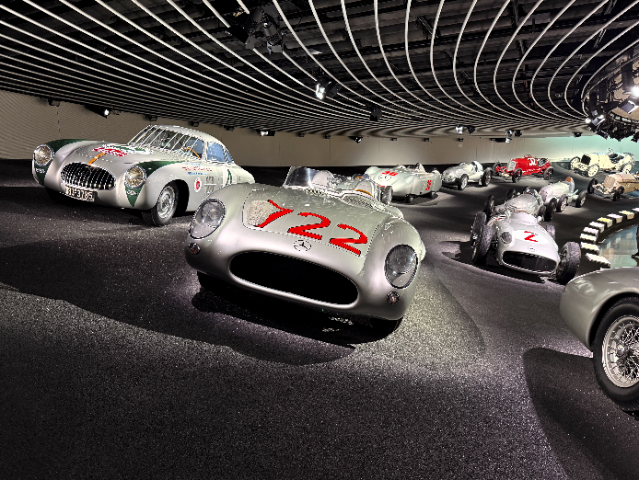
1955 Mercedes-Benz 300 SLR "722"
Mercedes-Benz 300 SLR "722" is a legendary racing car in which Stirling Moss and Denis Jenkinson won the 1955 Mille Miglia, starting at 7:22 a.m, hence the race number.
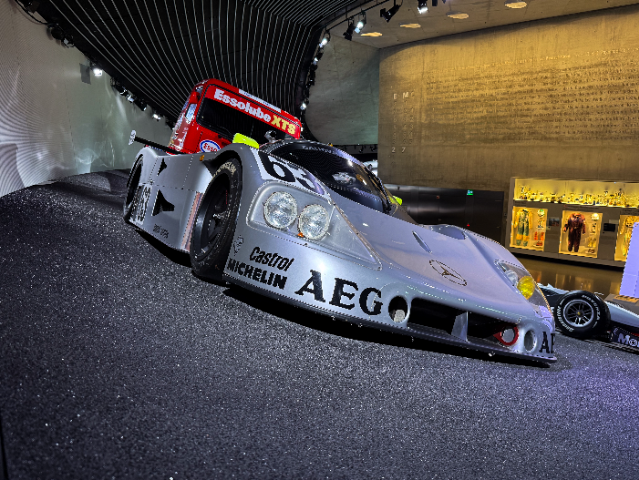
1987-1989 Sauber-Mercedes C9 #63
Earlier iterations of the Sauber-Mercedes C9 had quite a difficult history in motorsport. The C9 on display at the Mercedes-Benz Museum is the 1989 24h of Le Mans-winning car piloted by Jochen Mass, Manuel Reuter, and Stanley Dickens.
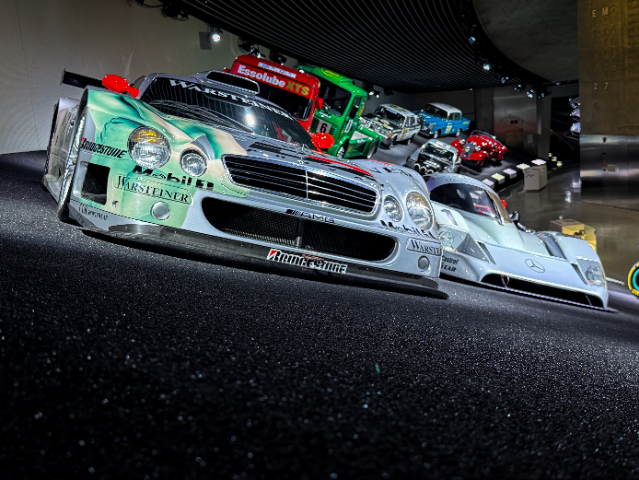
1997 Mercedes-Benz CLK-GTR GT
Mercedes-Benz and AMG took just 128 days to develop the CLK-GTR for the FIA GT Championship, launched in 1997. Powered by a V12 engine, the CLK-GTR dominated the 1997 season, winning six of the eleven races and completing four 1-2 finishes along the way. Mercedes-Benz ended the season at the top of the team rankings, while Bernd Schneider also won the drivers’ title for the brand.
Final thoughts
Even if you prefer other automotive brands, the Mercedes-Benz Museum is a must-visit location for any automotive enthusiast. From the architecture, to the rare examples on display and the history conveyed in such a beautiful way.
We would recommend allotting a full day for the visit if you plan to take in as much information as possible. Also, a power bank for your mobile device is a must if you plan to take many photos and videos.
Then, for a quick break, there are racing simulators where you can compete against drivers across the world, and the burgers at Bertha's restaurant inside the museum can definitely be recommended.
Congratulations to Mercedes-Benz for its 140 years of innovation, and we here at AutoTrader look forward to what is next!