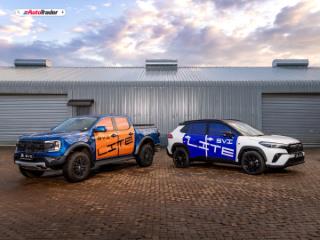


We got an exclusive tour of the key new facilities and production lines at the Silverton manufacturing plant, which is building Ford Ranger PHEV models for the global market. What makes the entire process even more impressive is that Ford South Africa is the world's first and only Ford production plant to manufacture these models.
Related: Ford Transit Sport (2025) launch first drive
Remember that you can sell your car quickly and easily on our website here. You can also search for new or used Ford Ranger models on AutoTrader here. But let us tell you about the Ford Ranger PHEV and how South Africa manufactures them.

Ford Silverton Manufacturing Plant
PHEV adoption
The Ford Silverton Manufacturing plant, situated east of Pretoria, has been responsible for building Ranger models for 100 countries worldwide. With an installed capacity of up to 200 000 vehicles annually, the plant can produce up to 720 vehicles daily in three shifts. Most of the vehicles produced are manufactured for export markets, with Europe being the primary export region. In 2024, Ford exported 66 284 units to over 100 global markets.
However, after the Ford Ranger PHEV models reached dealership floors in global markets, the American automaker had to find the best plant to produce it. After extensive investment, modernisation and expansion of the Silverton facility, South Africa was the country to that. The New Zealand and Australian markets are the first to receive the PHEV units produced locally, with Europe and other markets soon starting to get their units.

In addition to adding tooling for the Stamping Plant for the charge port that features the fuel filler port, Ford had to adapt the chassis plant to produce chassis with wider rear sections to comfortably accommodate the hybrid battery. Additionally, Ford had to adjust the chassis, body, trim and final assembly lines to accommodate the PHEV models. Around 200 of these Ford Ranger PHEV units, in a combination of left and right-hand drive, come out of the production line daily, ready for export.

PHEV Battery Assembly Plant
The largest part of the expansion and modernisation of the Silverton plant to build the PHEV models was the construction and tooling of the PHEV Battery Assembly Plant. The newly constructed 1,376-square-meter facility incorporates 13 stations with 19 work pitches. There are 18 specialised operators per shift, which excludes the process coaches. In this facility, the operators assemble the entire battery pack that is fitted to the vehicles.
At each step of the process, the operators have to scan specific barcodes of each item that goes into the assembly and follow a strict order in the assembly process. In addition, there are high-definition cameras situated around every workstation and testing station to ensure quality control, the safety of the individuals, and ultimately, the customer's final user of the batteries. If, at any point, a mistake is made, the entire battery gets disassembled, and the building process starts again.

This means that each battery and the construction files are linked to each vehicle through visual inspection and testing. The facility also incorporates battery pack testing, using vacuum testing with differential noise cancellation to eliminate environmental interference. It is also among the first to separate low voltage, vacuum leak, and high voltage testing for enhanced production quality and safety.
For safety purposes, containment units are placed between each step of the assembly process to ensure the safety of the workers. If any leaks are suspected, the entire unit is placed into the containment "tank" and disposed of effectively. After assembly, the finished batteries are moved to a 2 116 square-meter logistics warehouse, which allows Ford to produce the 62 000 battery packs for the annual Ranger PHEV production units.

Ford Ranger PHEV
During our visit to the production facilities, we saw the Ford Ranger in PHEV configuration. On display were Wildtrak and Stormtrak variants of the PHEV Ranger. How does it work? Ford installs a 75kW electric motor between the 2.3-litre EcoBoost petrol engine and the 10-speed automatic transmission. This results in 207kW and 697Nm, which is around 23kW and 97Nm more than the 3.0-litre turbo-diesel V6 on offer from Ford.
This electric motor gets its power from an 11.8 kWh usable battery, which is situated under the floor of the load bay. Based on visual approximation, this raises the load bay floor by 2-3cm. However, this battery can be charged from empty to full in under four hours using a 16-amp charger and, according to a global press release, can offer an EV-only range of over 45km. The Ford Ranger in PHEV configuration continues to carry a payload of up to 1 tonne or tow up to 3 500kg. The system's benefits will quickly be noticed in terms of efficiency and off-road driving conditions.

However, if you choose the Pro Power onboard technology, you get a power socket in the load bay that can power tools with a draw of up to 2.3 kW as standard. There is also a 6.9 kW option, with two 15-amp power outlets in the load box and 3.45 kW for each outlet. At the time of writing, Ford has not confirmed the Ranger PHEV models for the local market.